
It’s not quite an ACC tournament redux. But it’s close.
There will be three ACC teams converging on an ACC football stadium for the first on-campus championship weekend in 24 years, the third time in six years the league produced a triumvirate of semifinalists.
There’s Notre Dame, seeking its third title in four years.
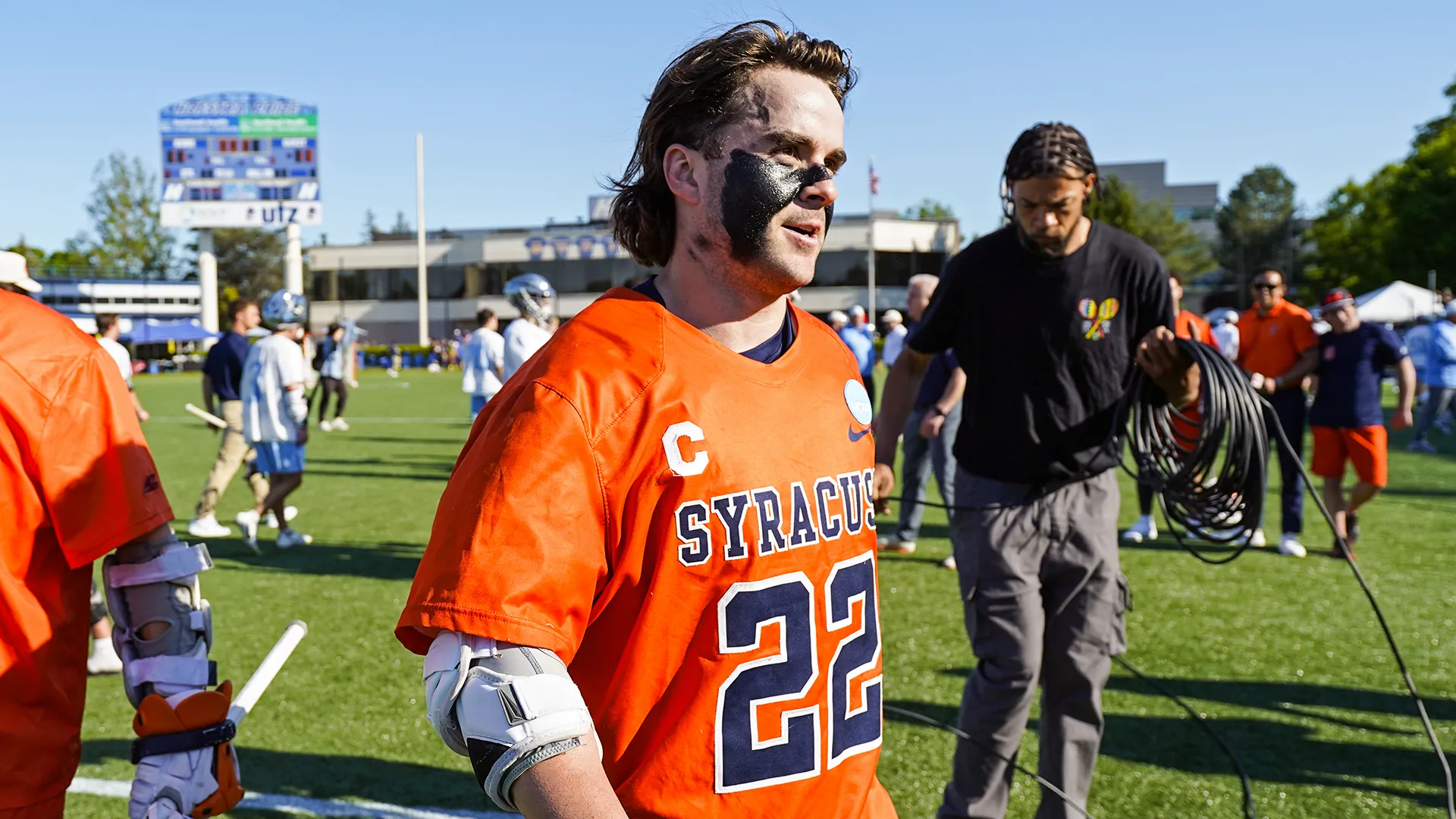
And Syracuse, chasing a restoration of championship glory with a senior class lauded from the day it stepped on campus as the one capable of leading the Orange to its first national title since 2009.
And Duke, which didn’t even make the ACC tournament earlier this month but is the first unseeded team since 2017 to advance to the season’s final weekend.
All three will converge upon Scott Stadium in Charlottesville, Va., for a championship weekend teeming with familiarity.
(Go ahead and pour one out for event host Virginia, which will not be playing this weekend and is also seeking a new coach after a terse three-paragraph news release Monday morning announcing the end of coach Lars Tiffany’s 10-year tenure).
The outsider is, theoretically, one of the sport’s great insiders. Princeton won six national titles from 1992-2001 but is back in the semifinals for only the second time since 2004. Oh, and the Tigers (15-2) just happened to be the NCAA tournament’s No. 1 seed.
Truth is, there isn’t an outsider here. Championship weekend consists of the programs that won the most titles in the 1990s (Princeton with five), 2000s (Syracuse with five), 2010s (Duke with three) and 2020s (Notre Dame with two), all eager to add to their considerable respective legacies.
PICK YOUR POISON
Which is the toughest remaining offense to guard?
Well, both Princeton (Nate Kabiri) and Syracuse (Joey Spallina) have a Tewaaraton finalist on their starting attack. Princeton (14.82) and Duke (14.73) rank third and fourth, respectively, in scoring offense. And Princeton is fourth nationally in shooting percentage at 33.9 percent.
The Tigers, obviously, are going to be in this conversation.
But sometimes difficult-to-defend arguments can be tied to depth, and that’s where Notre Dame can make a decent case for itself. The Irish have four other players with at least half as many points as Josh Yago, who has a team-high 47. Syracuse has two that close to Spallina (though Luke Rhoa is a point away from making that cut) and Princeton has three within that range of Kabiri.
“We’re not talking about, ‘We have to get so-and-so here’ or ‘We have to get so-and-so there,’” Notre Dame coach Kevin Corrigan said. “We’re just saying as the defense moves the ball this way, move the ball that way. We’re not concerned with right-handed or left-handed. We’re not concerned with right guy, wrong guy. We’re just playing, and it’s so much easier to play that way. It’s a better way to play if you can. We don’t have a lot of guys who are pigeonholed into roles in our top nine offensive guys.”
Intriguingly, Duke also does well in this measure, with Benn Johnston’s 40 goals and eight assists topping out a group of four 40-point scorers. (Max Sloat, Kyle Colsey and Michael Ortlieb are the others.) The Blue Devils have seven players with 24 points or more.
But back to the original question: There’s no easy answer. It’s safe to say all four defensive coordinators are unlikely to get much sleep this week.
HOYAS HITTING A CEILING?
Georgetown isn’t one of the top four programs in the country. It probably is among the top eight.
Neither of those should be particularly controversial assertions. The Hoyas have reached the NCAA quarterfinals in four consecutive seasons and five of the last six. Their seven-year record is 83-23. They own the longest active postseason streak (eight) and are the only Division I team ever to win eight consecutive conference tournaments.
And yet, Georgetown is still seeking its first semifinal appearance since 1999 after Sunday’s lackluster 16-6 loss to Duke.
“There will be a million things I’ll look at driving up 95 and the Jersey Turnpike 3,000 times for recruiting this summer and try to think about how we can take the next step,” coach Kevin Warne said.
Not every quarterfinal exit is cut from the same cloth. Sometimes, there’s an eventual national champion in the way (like 2021 Virginia and 2024 Notre Dame, in the Hoyas’ case). Sometimes, simply getting one postseason victory constitutes maxing out, like last year’s first-round upset of Duke and frisky showing against Maryland in a 9-6 quarterfinal loss.
Sunday’s blowout was different and will remain so even if Duke wins twice next weekend. The Hoyas scored in the first minute and then proceeded to get obliterated. The Blue Devils did enjoy an athleticism advantage; but so did Virginia a week earlier, and Georgetown figured out how to adjust and eventually earn a 14-10 victory.
That two-week dichotomy — tough, forceful and resilient on the road against the Cavaliers, and pretty much the opposite on a neutral field with a final four berth at stake against Duke — is what’s so hard to square about Georgetown’s latest quarterfinal loss.
Plenty of programs would trade places with a team that regularly finds itself in quarterfinals. (Georgetown and Notre Dame are the only teams to do so in each of the last four years.) But every disappointment two weekends before Memorial Day evokes memories of an earlier iteration of the Hoyas that bowed out in six consecutive quarterfinals from 2002-07.
“We like where we are,” Warne said. “Do we want to get better? Absolutely. Is there room to get better? Absolutely. Do I have to get better? Absolutely. That’s the chase, that’s the journey, and that won’t stop.”
ABSENT POWERS
Maryland didn’t even make the tournament. Virginia was bounced in the first round. And Johns Hopkins fell in the quarterfinals.
It marks only the fourth time since the tournament was established in 1971 that none of those three schools advanced to the semifinals.
The other three?
1990: Hopkins and Virginia dropped first-round home games, while Maryland didn’t make the 12-team field. But the Terrapins beat the other two back to Memorial Day weekend, making the semifinals the following year.
2001: Virginia lost as a No. 8 seed in the first round to Hofstra, while Maryland (to Towson) and Hopkins (to Notre Dame) fell to lower-seeded teams in a quarterfinal doubleheader in College Park. Hopkins and Virginia returned to the semifinals the following year.
2013: Like 1990, none of them made it out of the opening weekend. Maryland dropped a home game to Cornell, while Virginia went 7-8. Hopkins didn’t fall below .500, but its record streak of 42 consecutive tournament trips came to an end that spring.
NO SEED, NO PROBLEM
Duke’s 16-6 victory over Georgetown matched the largest margin of victory for an unseeded team in an NCAA quarterfinal. Syracuse defeated fourth-seeded Princeton 15-5 in 2003 and Cornell topped third-seeded Ohio State 16-6 in 2013.
SURVIVING AT THE TOP
Princeton and Penn State were tied at 9 going into the fourth quarter. It marked the 10th time a No. 1 seed did not lead after three quarters in a quarterfinal game. The Tigers prevailed 14-10 and avoided becoming only the second No. 1 seed ever to miss the semifinals.
HELPING HAND
Joey Spallina’s three-assist day Saturday gives him 16 in seven NCAA tournament games, tying him for 10th on Syracuse’s career postseason list.
A LEAGUE OF THEIR OWN
The Notre Dame-Syracuse matchup will be the 13th time conference rivals have met in the NCAA semifinals. The ACC is responsible for 11 of them, including four in the last seven tournaments.
FOUR GAMES, FOUR STARS
Josh Yago, A, Notre Dame: The Air Force grad transfer had a season-high seven points (four goals, three assists) as the Irish used a strong second half to pull away from Johns Hopkins.
Riley Figueiras, D, Syracuse: The senior authored one of the best defensive performances of the weekend, playing a large role in keeping North Carolina’s Dominic Pietramala scoreless until the fourth quarter of the Orange’s 13-11 victory.
Tucker Wade, M, Princeton: A four-goal day from the junior was a major difference for the Tigers as they pulled away from Penn State on Sunday.
Max Sloat, M, Duke: After being held scoreless on four shots in the first round, the senior had four goals and an assist on seven shots in the Blue Devils’ bludgeoning of Georgetown.
TEWAARATON WATCH
Owen Duffy, A, North Carolina: The junior clearly wasn’t fully healthy two weeks removed from a hamstring injury, but he gutted out a goal and an assist in the Tar Heels’ quarterfinal loss. His season ends with 31 goals and 40 assists in 17 games.
Nate Kabiri, A, Princeton: The junior had two assists but was held scoreless on seven shots while contending with Penn State defenseman Alex Ross.
Shawn Lyght, D, Notre Dame: Effectively helped erase Hopkins attackman Jimmy Ayers, who didn’t register a point and took only two shots as the Irish advanced to the semifinals.
Joey Spallina, A, Syracuse: Had a splendid final college homecoming to Long Island, delivering three goals — one the go-ahead tally, another a bit of insurance with 2:40 to go — plus three assists as the Orange beat North Carolina to win a quarterfinal at Hofstra for the second consecutive year.
SEMIFINAL SERIES
Princeton is 9-2 all-time against Duke, including a 15-14 victory early last season in their most recent meeting. The teams have met just once in the postseason, when the title-bound Tigers spoiled Duke’s first NCAA semifinal trip with a 10-9 victory in 1997.
Notre Dame and Syracuse have evenly split their 24 games, all played since 2001, but the series has tilted heavily toward the Irish in recent seasons. Notre Dame has won eight of the last 10, including a 16-11 victory on April 25 in South Bend.
Given what postseason mainstays both programs have been, it’s curious this will only be their third NCAA tournament matchup. Syracuse earned a 12-5 victory in the 2001 semifinals (which was Notre Dame’s first trip to Memorial Day weekend), then collected an 11-9 victory in the 2008 quarterfinals.