
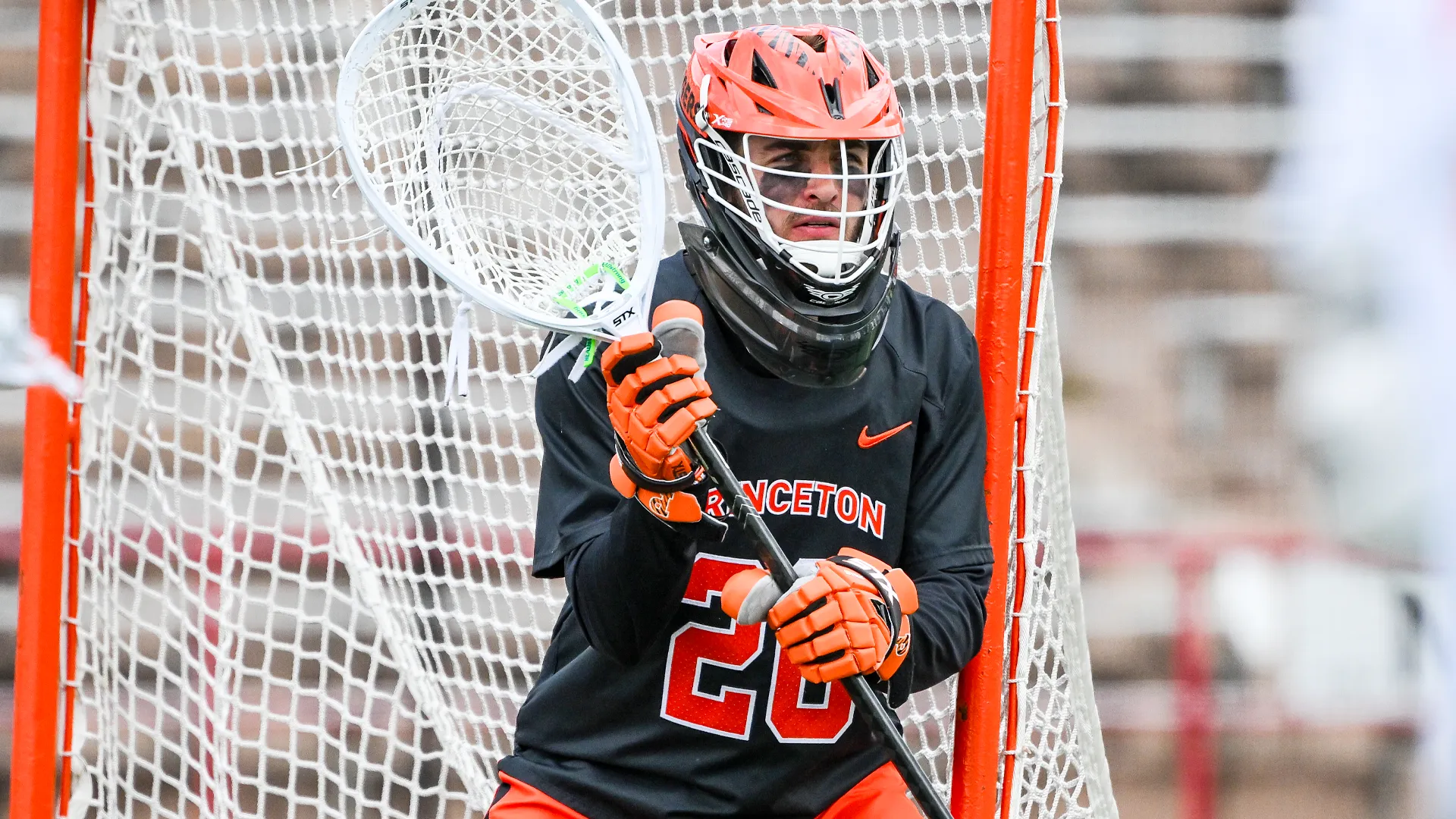
As Ryan Croddick continues to supply sparks that have pushed the Princeton men’s lacrosse team forward for three straight months — all the way to the 2026 season’s final stop in Charlottesville for championship weekend — the senior goalkeeper reflected on how much he has evolved since that first time he had ever held a goalie stick in a competitive setting.
That would be the third-grade version of Croddick, who grew up in Rumson, N.J., an affluent town on the North Jersey Shore.
Croddick was part of his first travel team that year. At that point, for boys that young, the goalie position was filled by volunteering players, and on a rotational basis.
“Back then, you would tie on an old-school neck guard to your helmet. I used a goalie stick from Target,” he said.
Once town team tryouts were underway the following year, when he was a fourth-grader, Croddick showed up with two sticks — one each for attack and goalie use. The rest is history.
“I knew already that I had a natural ability to catch the ball and to not flinch or be afraid of the ball,” Croddick added. “I brought my own goalie stick. I was later told to leave the other stick at home. I became the goalie that day. My parents caught on quickly that this was something I loved and was passionate about. I’ve always loved playing as a goalie since.”
Croddick’s dedicated lacrosse path over the last 15 years has put him in position to cap an outstanding two seasons guarding the goal for Princeton (15-2).
The No. 1-seeded Tigers, who have won 10 consecutive games, including their third Ivy League title in four seasons, have matched a program-best 15 victories. Only the NCAA champion Tigers’ undefeated 1997 squad under former head coach Bill Tierney has won that often in one season.
To reach their main goal of bringing home the program’s seventh NCAA championship trophy and first in 25 years, the Tigers must defeat two of three Atlantic Coast Conference representatives at the final four event, hosted by the University of Virginia.
If Princeton knocks out unseeded Duke in Saturday’s semifinals round — the first time an unseeded school is facing the top seed on the last Saturday of the Division I season — the Tigers would face the Notre Dame-Syracuse semifinal winner for the national crown on Memorial Day.
Princeton, which last attended the sport’s final weekend in 2022, understandably likes its chances this weekend. Much of its confidence revolves around the team balance that has helped the Tigers roll with the top scoring offense (14.8 goals per game) and top scoring defense (9.9 goals allowed) in the Ivy League.
Princeton has held its 17 opponents to 25.3% shooting with a group that has remained unselfish and connected throughout the season, as the close defense and rope units have been tough to handle on numerous days.
And then there is Croddick. He is averaging 12 saves a game with a .571 save percentage, good for seventh-best among D-I goalies. He presents the ideal mix of instinctive athlete and calculating artist, in or out of the cage. He has combined his advanced stick skills, quick hands and hand-eye coordination with his steady ability to stop shots with his stick, feet or other body parts.
In addition, he excels in the passing and clearing games. Same with his defensive communication game.
“Ryan’s ability to change games comes with his consistency. We have gone weeks without scoring on him in practice,” said Matt Madalon, Princeton’s 10th-year head coach and ex-goalie, who alluded to Croddick’s extensive experience playing ice hockey. “He’s a natural athlete, with a real athletic presence about him in the cage. Such an impressive guy.”
“He has some fire in his belly, but Ryan is a really positive kid. He’s very thoughtful about his leadership on defense, how he talks to his teammates. He loves chirping in practice, trying to get under our shooters’ skin,” Madalon added. “But he’s very respectful of his position and the game. His consistency in practice gives everyone the utmost confidence on game day.”
Croddick is a two-time, back-to-back Ivy League Goalie of the Year. He was named a first-team All-American by USA Lacrosse, before he earned a shared honor with Army goalkeeper Sean Byrne. Each was a recipient of the USILA Ensign C. Markland Kelly, Jr. award as a Co-Outstanding Division I goalie.
This year, the Tigers have held nine opposing offenses to single-digit scoring, all victories, thanks in significant part to Princeton’s last line of defense. Croddick is only the second Princeton goalie ever to produce at least 200 saves in two seasons (Kevin Gray pulled off the feat in 1973 and 1975).
Back in February, after the Tigers opened with a disappointing 13-7 loss to a Penn State team they later would beat, 14-10, in last week’s quarterfinal round, Croddick led the way in setting the tone for the rest of a strong year.
First, his dazzling, point-blank ninth save at the buzzer saved Princeton’s first victory, a 13-12 thriller over Maryland, which had beaten the Tigers nine consecutive times before that day.
Princeton responded by winning two more huge weekend games at home on Feb. 27 and March 1 against Syracuse and North Carolina, respectively, with a huge boost from Croddick, who staged a monster of a show.
His 14 saves, including several fourth-quarter thefts, led the way in a 11-7 win over the Orange. Two days later, Croddick one-upped himself with a 25-save masterpiece that preserved an 11-9 decision over the Tar Heels. It featured a 10-second sequence with under five minutes left, during which Croddick denied Carolina three times at close range.
Croddick was honored as Division I Player of the Week after his 39-save, 16-goals-against weekend. His 25-save day marked the highest single-game total by a Princeton goalie since 1985.
“One thing that is easy as a competitor is rising to the level of higher competition. That weekend was a really big challenge,” Croddick said. “Those games were like a bang-bang blur. I kind of blacked out at times. It gave us an example of what this weekend might be like.”
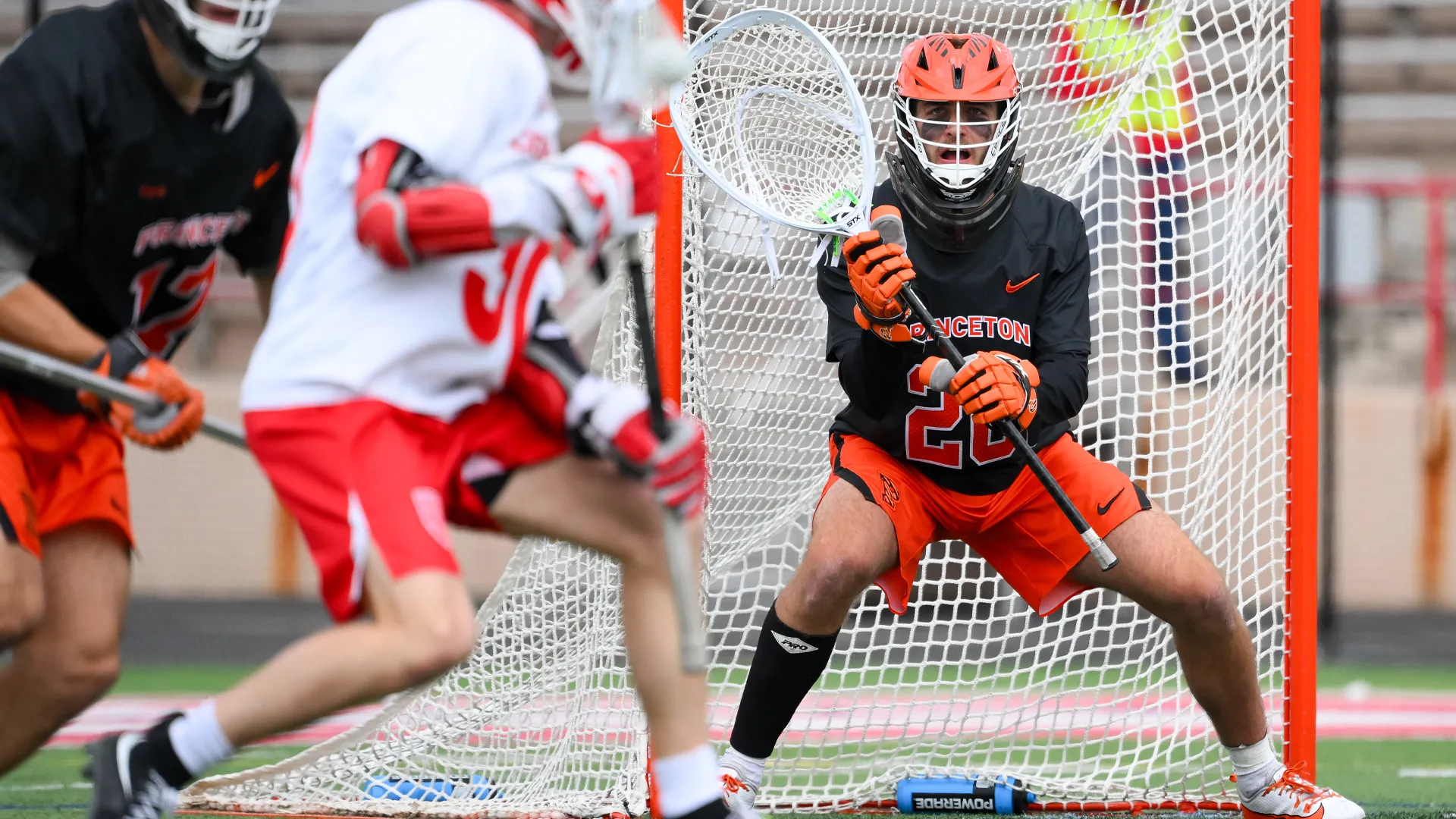
Following his first two seasons as a backup goalie while playing behind former Princeton (and later North Carolina) netminder Michael Gianforcaro, Croddick blended quickly with his rugged yet polished style. His defensive mates responded to him and his game. After all, they certainly were not strangers.
Although Croddick has started every game the last two years, the 6-foot-3, 185-pound product of Rumson-Fair Haven High School (and one-year postgraduate product of The Hun School) has made the most of his diligent work behind the scenes, especially as a freshman and sophomore who barely saw action on game days.
“We saw that effort and energy and raw emotion, when he was working really hard at developing his game,” said Hunter Spiess, a junior starter at close defense now. “He’s always had that fire you can see on tape, that competitive edge. He’s also a calming presence. As a leader, he knows the right moments when to say the right things that makes you confident.
“Moments like the ones against Maryland, Syracuse and UNC solidified our belief in ourselves and our defense. That really helped to propel us forward.”
Spiess added that Croddick’s work ethic and leadership style have been factors in developing a culture on defense. Watch the Tigers D diving in front of opposing shots, in attempts to block or deflect them. Think of Croddick’s influence — even though Spiess said Croddick will sometimes playfully chide his fellow defenders for doing too much of his job.
When asked if he was ever frustrated by the two-year wait to become Princeton’s starter, Croddick answers with a hard, “No.”
“I wouldn’t be the same goalie or person I am today without with that,” Croddick said. “No one knew my name or anything about me. I knew I wasn’t going to get that starting job. It helped my perspective, gave me time to develop as a goalie and a person, helped me to get my mind right, so I was ready by my junior year.”
Croddick was ready, all right. His 241-save season as a junior is second-best in Princeton history. He had 24 stops in his first start against Penn State, 22 more against Rutgers. He ranked third in Division I saves per game, seventh in save percentage. He even had three assists.
As a four-year letterman in lacrosse and hockey Rumson-Fair Haven, Croddick earned senior honors, including first-team All-Division, first-team All-Conference and Shore Conference Specialist of the Year. But the pandemic torpedoed any normal recruiting process — and killed the Ivy League’s 2020 and 2021 lacrosse seasons.
Croddick initially committed to Richmond. Other offers trickled in. All along, Princeton was on his radar and vice versa. So Croddick decided to attend The Hun School for a postgraduate year, which also included a successful lacrosse experience. He was named team MVP.
“During things like Ryan’s backup years, that’s actually where you see how someone really is,” said Jackson Green, Princeton’s junior short-stick defensive midfielder. “I’ve seen people get frustrated in that position, maybe check out here and there. Ryan never did that at all.
“Every single day, he showed up like he was the starter, locking in on every rep, being hard on himself in a good way. What stands out the most is how much he cared. Even though he wasn’t playing, he was as invested in this team as anyone else.”
Said Croddick: “There is a mental aspect to being a goalie. You’re on an island, kind of by yourself. You want to be as present as possible, seeing that little rubber ball coming at you at 95 miles an hour, with nothing else on your mind in that moment.”
“The longer you play, the more you learn as a goalie,” he added. “You get an adrenaline rush when you make a save, whether the ball hits you or you catch it in your stick. In the middle of games, you don’t even feel it when you’re getting hit. You get addicted to saving the ball. You chase that feeling. It drives a lot of goalies.”