

This story was written by Jerry Price, the senior writer and historian at Princeton University. It is being republished with his permission.
Chad Palumbo is thinking and talking — and not in the same proportions that you might expect from a 22 year old. For every moment that he speaks, there is a greater period of silence that precedes it. If our conversation lasts 45 minutes, he is silent for probably 25.
He is not shy. Hardly. If anything, he’s among the most affable players in this Princeton men’s lacrosse locker room in which he has spent these 45 minutes. In a regular conversation, he is all smiles and laughs, with an easy-going manner that naturally draws people to him.
This is not one of those regular conversations, though. This is a conversation about what he has been through for the last four years, a time period that has tested him in ways that most his age — or really any age — could not have imagined, nor come through the way he has.
As such, a different side of Chad Palumbo has come out. No word that he speaks in these 45 minutes is accidental. None of his pauses are meant to create an illusion of depth. To quote him directly: “You can tell in a heartbeat whether what someone is saying is genuine or not.” He’s right, and he is.
In the somewhat random assignment of lockers, Palumbo’s is next to that of Jake Vana. Opposite Palumbo’s are those of Colin Burns and Jackson Kane. It is to those lockers, sitting over my right shoulder, to which Palumbo looks during his pauses. These are deep subjects, and he is giving them deep answers.
The more he pauses, the more I start to wonder. Is it on his mind? Does it ever really go away? Can he push it to the back?
Mortality, I mean. His mortality.
“I was 18,” he says. “Having to confront death at 18, I guess, changed me for the better. I understand now that you never know when the shot clock is going to run out.”
“
Having to confront death at 18 changed me for the better. I understand now that you never know when the shot clock is going to run out.
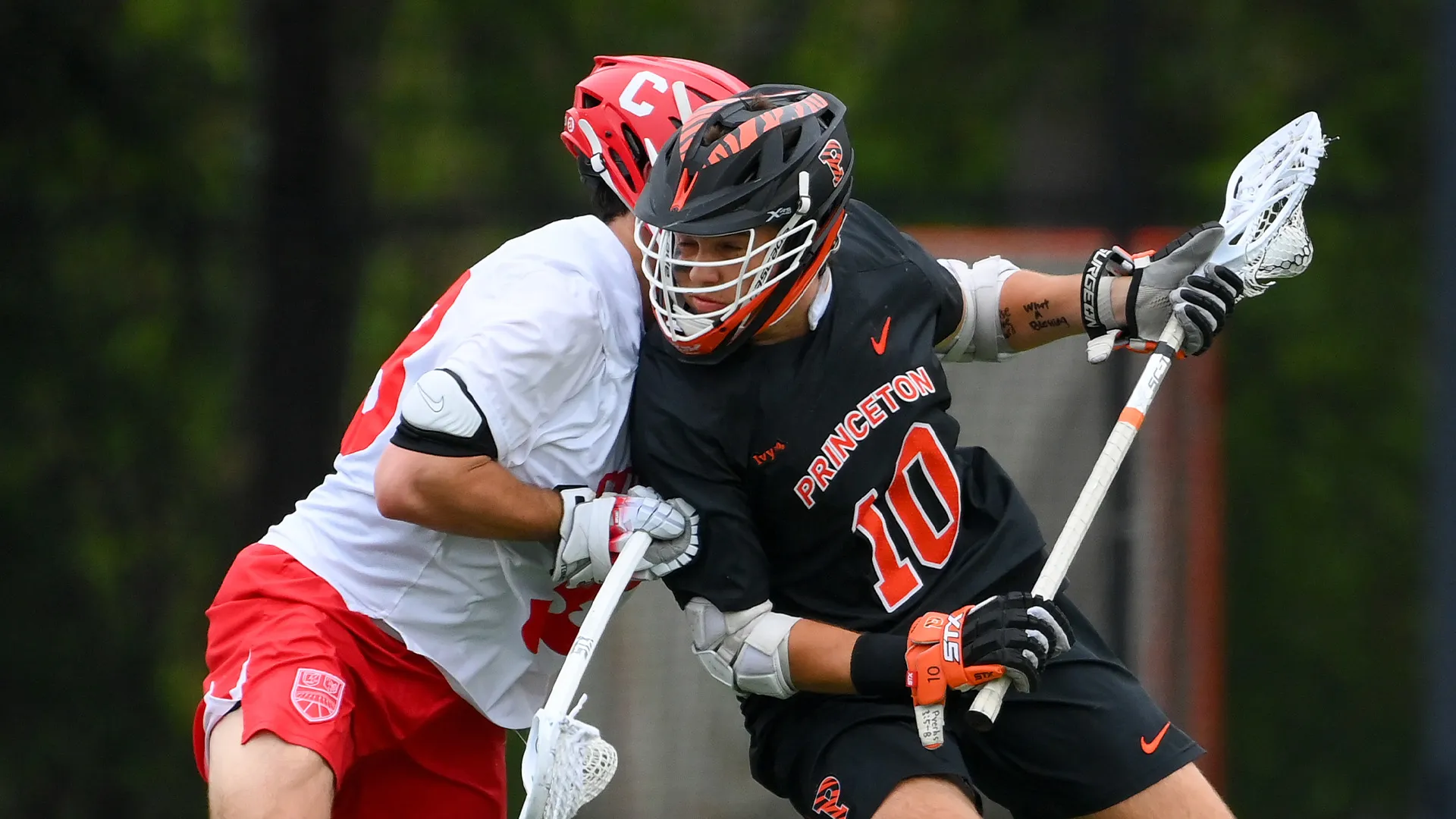
Chad Palumbo, a 6-2, 205-pound midfielder, is a few days away from the start of his senior season at Princeton when we have our conversation. He is not just any midfielder; USA Lacrosse has named him its preseason Division I Midfielder of the Year, and he is a preseason first-team All-American for every major outlet.
“He is, in many ways, what we hope the guys in our program will be like,” says head coach Matt Madalon. “He is a great teammate. He buys into what we’re trying to do. He gives us everything he has. And he’s also a great player. He’s big and tough. He plays hard. We love having him on our team.”
Palumbo looks to be completely indestructible. If you doubt that, consider Princeton’s last game of the 2025 season, a 19-18 loss to Syracuse in the NCAA quarterfinals in what is widely considered to have been the best college lacrosse game of last year.
Palumbo scored six goals, on just six shots, tying the program record for goals in a NCAA tournament game. He also had two assists. He was unstoppable, by the Syracuse defense and by his own body.
“The first goal of the game, I dunked it and landed on my knee,” he says. “When I stood up, I felt it give a little. Running off the field, I thought ‘this is not good.’ With the adrenaline, though, there was less pain but just no stability. I couldn’t run past anyone at 65 percent or so. But you would have had to drag me out of the game. At that moment, I was thinking ‘how can I add value if I’m not going to be able to escape pressure or move as well as I’d like.’”
I stood on the Princeton sideline the entire game and never knew there was a thing wrong with him. So did Jim Mitchell, the Princeton offensive coordinator.
“I had absolutely no idea,” the man they call “Coach Mitch” says. “He didn’t say a word to me. It was a heroic performance. Moments like that are what make sports so great, to see what guys are capable of in the biggest moments like that.”
Catherine Miller, then Princeton’s athletic trainer for men’s lacrosse who left after the season to work with North Carolina football, was at first the only one he told.
“Catherine knew something was wrong,” Palumbo says. “I obviously wanted to keep playing, and I said ‘what can we do.’ She wrapped it to keep pressure on it for swelling purposes and said we’d deal with it after the game.”
Palumbo’s six-goals, six-shots performance in an NCAA quarterfinal game would have been extraordinary under any circumstance. To do so with his knee the way it was? As Mitchell said, it was “heroic.”
He had partially torn his posterior cruciate ligament and sprained his medial collateral ligament on that first goal. It would be six months from the end of the Syracuse game until he was 100 percent again.
“It is very difficult for an athlete to do as much running, cutting and dodging that lacrosse players do with any knee injury and/or any pain,” Miller says. “Spraining any ligament decreases the stability of the knee and makes it that much harder to perform even after a few weeks of rehab to regain the strength and decrease swelling, much less a fresh injury day of. Most can’t return that same day, and it was impressive he finished the game”
“My mindset hasn’t really been about winning and losing and more about giving everything,” Palumbo says. “The outcome just sorts itself out. As Coach Mitch always says, no one has ever regretted giving their all to something, and I find that to be true. I always ask myself, ‘did I give it my all?’ That’s what is important.”
That is also why, as Princeton gets ready for the 2026 season, Chad Palumbo is alive and able to be a part of it.
It was August of 2021 when the first symptom first presented itself. At the time, Chad Palumbo was a high school All-American at Noble & Greenough School, near his home in Newton, Mass. He was also a three-time varsity letterwinner in football.
In an era when high school lacrosse players become legendary with their highlight videos, few could match those of Palumbo. Mitchell calls him a “human highlight film, with one highlight reel goal after another.”
His senior year of high school was only a few weeks away. He had already committed to Princeton as one of the program’s prize recruits. Nothing could touch him — or could it?
“I felt a bump in my pelvic/hip area,” he says. “There was no pain. Just a lump. I didn’t even think it needed to be removed, but my mother [Jennifer] said she’d sleep better at night if I did. I got it removed. It wasn’t very invasive. I thought that was that.”
Instead, when he woke up, his doctor broke the news to him. He said he was pretty sure it was malignant, and he was correct. It turned out to be what is known as Rhabdomyiosarcoma, a rare soft tissue cancer that affects on average 400-500 people per year, mostly teenagers like Palumbo.
“I had no reaction when the doctor said it ,” he says. “It was like an out of body experience.”
He was 18 years old and was just told he had a cancer he’d never heard of, with no idea of what was to come next.
“There is no way I could have handled that,” says Madalon. “When we found out the news, the last thing in the world any of us were thinking about was lacrosse. We were worried about Chad the person and making sure we could help him in any way we could.”
There was very little anyone could do, though, other than Palumbo himself. He almost immediately embarked on a six-month course of chemotherapy that included a treatment every Thursday, with a different mix of drugs each week. The first of the cycle was the worst of the three.
“Your body feels like it has the flu, but it never goes away,” he says. “The first one made me feel the worst. I’d have really bad nausea and feel just awful. Then I’d start to feel better very slowly, very incrementally. Then you know the next Thursday was approaching, and you start to dread that. You know you’re going to go right back to feeling horrible. Doing that over and over and over again was so mentally challenging.”
Still, for all of that, he found strengths he didn’t realize he had.
“I learned the difference between emotions and physical feelings,” he says. “How I felt wasn’t who I am. Yes, I feel terrible, but that doesn’t get to be a stakeholder in how I am. I could feel terrible but still be happy.”
He began to lose his hair shortly after the treatments began, so his teammates decided they would shave their heads in support. After that, pretty much all of his friends, lacrosse or otherwise, shaved theirs. His sister Julia ran a half-marathon to raise money.
All of the support he received was helpful. The unfortunate reality, though, was that making it all the way back would have to come from inside him. And so he made himself a vow: No matter what happened, no matter how sick he felt, he would not allow himself to lose weight.
Consider what this entailed. Remember, his chemo cycle was every Thursday. It took him most of the week to stop feeling awful. His doctors told him losing weight and muscle was inevitable. How was he going to pull this off?
“I ate everything I could,” he says. “Through the nausea I kept trying to get food down. I would eat crazy amounts of food toward the ends of the cycle. I was working out three to five times a week.”
Somehow, he managed to do it. After six months, he had actually gained weight and maintained his strength. Through that experience, a deeper version of Chad Palumbo began to emerge.
“If I would tell anything to someone on chemo, it would be to keep moving, keep working out,” he says. “It is so good for your mental health, even if you feel terrible. What I learned was that everything is always worse in your mind than in reality. I would say to myself ‘I feel terrible sitting on the couch and going to the gym is going to suck, but after I do, I’ll be so much better for having done it. The mental battle of motivating to go to the gym was really big for me to learn about discipline and resilience.”
He wouldn’t spend much time in school in that fall semester, especially in the days after the cycles would start, though Nobles worked with him to make sure he stayed current and would graduate on time. By the time the spring semester rolled around, his six months of chemo were over and his scan was clean. He was healthy. He was, stunningly, fit. He earned All-American honors again after leading Noble & Greenough to a league championship.
“Coming back in the spring was thrilling,” he says. “I just remember Day 1 felt like I was jumping and touching the clouds. It felt like every positive sense that had been dulled for so long was released in an explosion of everything physical or emotional.”
About an hour after my conversation with Palumbo, I am now in the men’s lacrosse office at the top of the Dillon Tower. To get there, you walk across a modern design on the main court for volleyball and then you take an elevator that reminds you that this is the same building in which Bill Bradley played basketball more than 60 years ago.
The men’s lacrosse office is also a mix of the past and present. Madalon has his own office to the right as you walk in. There is a desk where Director of Operations Drew Cottrell sits by the door. Beyond that is one large room where Mitchell, defensive coordinator Jeremy Hirsch and face-off coach Casey Dowd each sit. This setup hasn’t changed in decades.
The program’s six NCAA championship trophies look out on the large room from their perch on an elevated shelf. There are also more recent trophies, ones commemorating the team’s 2022 NCAA Final Four run and 2023 and 2024 Ivy League tournament championships. Princeton was the No. 3 seed in last year’s NCAA tournament and is a preseason No. 3 team nationally, as well as the Ivy League preseason favorite. The 2026 Tigers will be chasing a fifth straight NCAA tournament appearance.
The five men who work in this office have built one of the top programs in the country, and they haven’t done this by lowering their standards or expectations of those who compete for them. Madalon calls it being “buttoned up” and “taking care of our business,” whether that is on the field, in practice, on a Saturday night out on campus or even when it comes to making sure the bus is immaculate when they leave it.
As for Mitchell, he speaks quickly, with a deep, staccato voice that punctuates its thoughts in a way that leaves no doubt what what his point is. Anyone who has ever heard him in the lockerroom can attest to the fact that when he speaks, he does so with obvious passion, and this makes him one of the best motivators I’ve ever heard.
Now I am sitting on a couch under the NCAA championship trophies. Mitchell paces a bit as he is asked about Palumbo.
“Chad came to Princeton after having just been through a lot,” Mitchell says. “I don’t know that I’ve ever talked to Chad about this, but when Chad got cancer, my mother had just died of cancer. That hit me really hard, and I felt it for him. I really felt him. I knew what he was going through, and his positivity through all of that is really, really inspiring. It makes him one of the most memorable and inspiring lacrosse, no, make that more memorable and inspiring people I’ve ever been around.”
If the Chad Palumbo who came to Princeton as a freshman and the Chad Palumbo I just spoke to are two different people, they are also two different lacrosse players. He scored twice in his first-ever collegiate game — and that would be it for his freshman year. He would play in only five games, none in the second half of the season. Just as I expect, Mitchell pulls no punches when talking about the evolution between the two Chad Palumbos.
“I told him when he got there that the things that got him recruited here, the highlight reel goals and all, weren’t going to get him on the field,” he says. “That was going to be a supplement. Trying to get him to see the game through the lens of what we were doing was challenging. Also, he was a turnover machine that year. For every goal he’d score in practice, he’d turn it over 10 times. I’ve always liked Chad very much personally, but you know, after his freshman year, it could have gone either way for him. To his credit, he understood.”
“I didn’t fit in on the field as well as I thought I would,” Palumbo says. “Getting benched my freshman year was tough, but I really appreciate it looking back. I didn’t work with my teammates as well as I needed to, and I had to learn how to be a better teammate. I remember my summer after freshman year, making a conscious decision to really love this sport. I’d be remiss if I hadn’t done everything I could to help my team. I think this is related back to my chemo experience. I definitely dedicated myself fully to lacrosse after that. Since then, I’ve worked my tail off. I realized I love lacrosse, and what’s the point of loving something inauthentically.”
The results were clear. He went from two goals as a freshman to 26 goals and 11 assists as a sophomore, earning second-team All-Ivy honors. No Princeton player has ever scored more goals as a sophomore after having two or fewer as a freshman. He also had the most goals by a Princeton sophomore since Tom Schreiber, the one bound for the Hall of Fame one day, had 30 in 2012.
He followed that up with 28 more goals and 19 more assists last year, when he was a second-team Inside Lacrosse All-American and third-team USILA All-American. He has become one of the most clutch players around, having made the Ivy League All-Tournament team the last two years. His postseason numbers between the Ivy tournament and NCAA tournament are seven games, 19 goals, seven assists.
“Once Chad bought in, his growth has been second to none of any player I’ve coached in my career,” Mitchell says. “His shooting improvement is maybe the best I’ve ever seen. He was competent. Now he’s elite.”
A lefty, Palumbo’s game is either bodying up defenders and taking them to the cage, where he can get his shot off in an instant, even with his hands seemingly tight to his body, or getting open off ball and rocketing shots from the outside.
What he isn’t is fast. Remember when the first person he told about hurting his knee against Syracuse was Catherine, the athletic trainer? The second person he told was Tucker Wade, a preseason All-American junior in his own right who has started the last two years on the same midfield line as Palumbo.
“I said ‘Tuck, I can’t run,” Palumbo says, laughing. “He said ‘That’s okay. We don’t put you out there for your speed. If it had to happen to someone, it’s a good thing it was to you.”
In a game where speed is often the difference between good and great, Palumbo has turned that completely around.
“He’s such a different style of player,” Mitchell says. “I’ve never coached anyone who can force the game to his own speed like he can. We are able to play fast and slow around him. As he gotten better and better, we’ve adapted more around his strengths.”
As I said, one of the lockers that Palumbo was looking across to was that of Burns. There has been absolutely zero doubt in anyone’s mind that, from his first day in this lockerroom, that Burns was going to be a captain one day. That day is now, even as a junior, as he is one of the tri-captains for 2026 along with defenseman Cooper Kistler. And Palumbo.
“Chad has become very selfless, very welcoming and very approachable,” Mitchell says. “To see Chad from his situation as a freshman to being a senior captain is pretty amazing. After his freshman year? He was a guy who could have been, you know, voted off the island.”
The opposite has happened. Just ask Wade, his linemate. You can find them at Conte’s after home games.
“He’s made me a better player in so many ways by getting to play with him, and, more importantly, he’s made me a better person,” Wade says. “Freshman year he was one of the first people to give me the confidence I needed. It really felt like he believed in me, with a genuine belief with no other motive than what was best for me and the team. He is one of the most genuine people I’ve ever met giving unconditional support without judgement.”
The 2026 season starts Saturday with the game against Penn State on Sherrerd Field at noon. Wherever this season ends, it is unlikely to be the end of Palumbo’s career, as he has a great chance to be a first-round pick in the coming Premier Lacrosse League draft.
“What has made him such a great leader is that he makes you feel like you are on the journey with him, that he needs you to achieve the collective goal and that he wants you to be great,” Wade says. “He was older, more experienced, better than I am, but he always treated me as an equal in every aspect which meant the world to me. Good leaders make you believe in them; great leaders make you believe in you.”
“
I just remember Day 1 felt like I was jumping and touching the clouds.
Since the end of his chemo treatments after six months, Palumbo has gone back for regular scans to make sure the cancer hasn’t returned. They went from every six months to now every year, meaning his next one will be early next winter. Should it be clean, he will be considered cancer-free.
Talking to him now, watching him play — even just looking at him — it’s hard to believe that he is on the verge of being a cancer survivor. He is the picture of health, one of the best players in college lacrosse and one of its best leaders.
With our talk over, he is about to stand up as I am closing my laptop. Before I do, I notice the photo of him that I have open to use for this story, and so I turn my computer around so he can see it.
“That’s the classic Chad Palumbo picture,” I say.
“Why’s that?” he asks.
“Because you’re always smiling.”
Then I close my laptop, stand and thank him for his time. He reaches out his hand to shake mine, and as he does so, he says this:
“It’s the best thing to do.”