
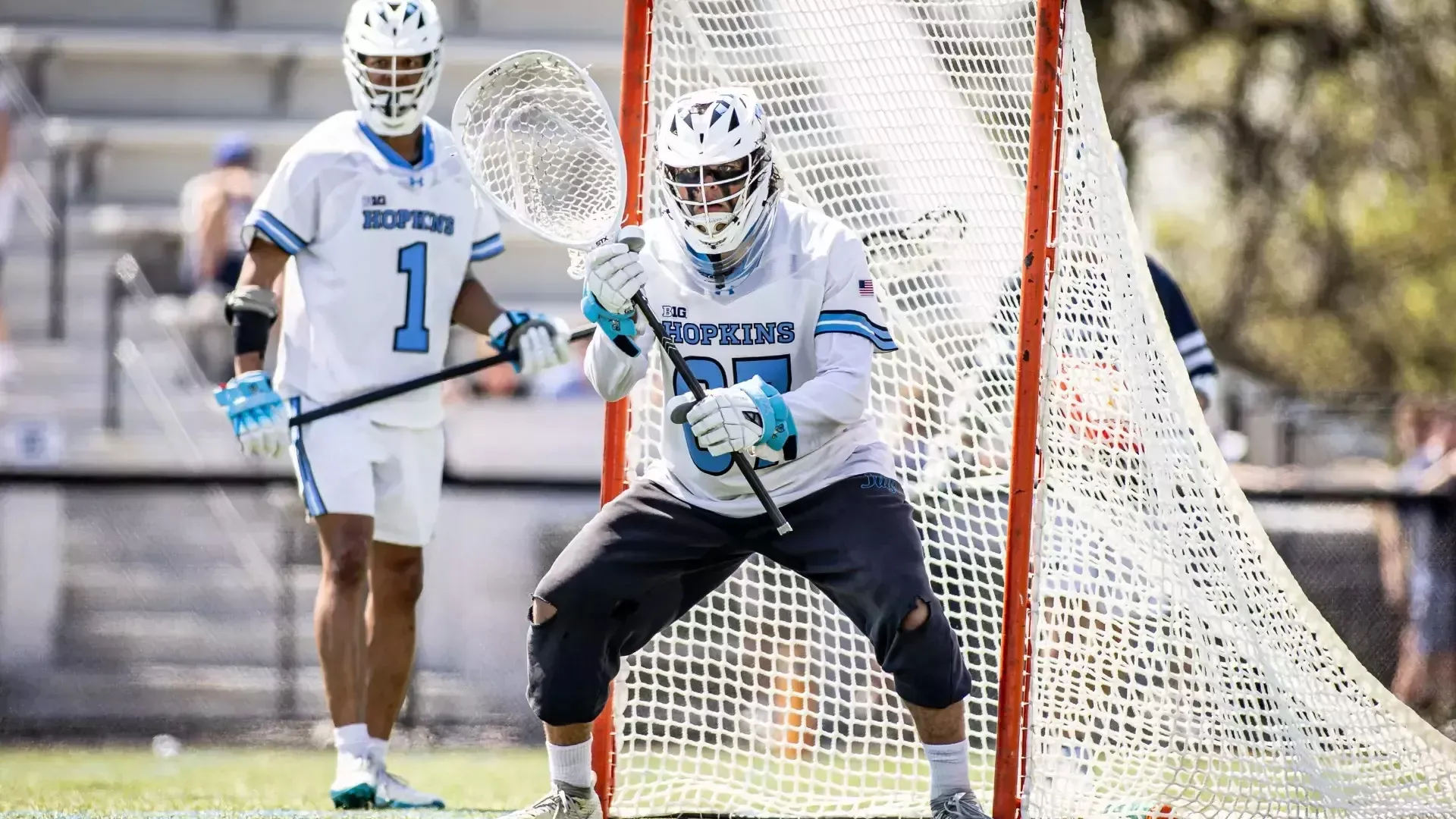
BALTIMORE — Oran Gelinas had thought about everything over his first two seasons of college lacrosse. Maybe too much.
He made two appearances at Ohio State in 2023, transferred to Johns Hopkins, and didn’t play in any games as a backup to Chayse Ierlan the following year. But he was always tinkering, putting in plenty of time on the field while always seeking answers while riding a wave of good and bad days at practice.
Finally, two summers ago, Gelinas recognized he needed a different approach.
“I was really good at little goalie tasks, but when I combined them up into [being a] goalie, other guys were outperforming me that weren’t as good at these things as me,” Gelinas said. “I feel like there was definitely a missing piece between physically and mentally where I was, so trying to shorten the distance between my brain and my stick in my play, I think that was the biggest piece for me.”
At 6-foot-4 and 225 pounds, Gelinas offers a presence in the cage. Yet the linchpin to his emergence as the Big Ten’s specialist of the year and a first-team all-league goalie can be summed up in simply being present.
For the second consecutive spring, Gelinas took over a starting role in the middle of the season, posting a .615 save percentage in five regular season conference games as the Blue Jays (9-5) returned to the NCAA tournament.
And he’s embraced consistency without the need for rigidity, savoring incremental progress even as his play has rightfully earned him attention as Hopkins heads into Saturday’s first round game at seventh-seeded Cornell (11-4).
“He’s not afraid of who he is, and I think that’s super-special as a young adult to be so confident in yourself especially in an environment where the spotlight can get super-heightened on one player or one position,” Hopkins defenseman Quintan Kilrain said. “I think he’s really bought into that and stayed true to himself, and I think it’s something myself and my teammates can really see within him and admire.”
“
I praised the game and worshipped the game and I lived and died by the game. Because of that, I died a whole lot, so to say.
Gelinas settled in as a goalie almost as soon as he took up the sport in elementary school. He was a big kid, but he also had Sever’s Disease, a malady that can occur around puberty. Technically, it is tied to swelling and irritation in the growth plate in the heel. In practical terms, the foot grows faster than the tendons.
The upshot is that running hurt a lot for Gelinas, who was already wearing size 8 shoes at age 8. So playing goalie made a lot of sense.
Over time, the rest of his body evened out, and he continued developing as a goalie, a position more than any other that requires a consistent mindset to smooth out the inevitable highs and lows that come with being the last line of defense.
It’s not hard to imagine why a goalie might fixate on outcomes. There’s a clear reward system; make a stop, especially at home, and there are cheers. Allow a goal, and it’s time to fish the ball out of the net.
“I was very results-oriented,” Gelinas said. “How I played on the field kind of defined who I was off the field. And I praised the game and worshipped the game and I lived and died by the game. Because of that, I died a whole lot, so to say. I kind of got in my head, a head case. I was very hot and cold. I’d have a day where I played really, really well and it’d be, ‘Oh, I’m back.’ Then I just focused on that, and I wouldn’t do so well the next day.”
By the time he arrived in Baltimore, he was playing behind a goalie in his sixth year of college and fifth as a starter. Ierlan made 50 starts and earned an honorable mention All-America nod at Cornell, then posted a .564 save percentage while using a COVID-era year of eligibility as a grad transfer while reuniting with former Big Red coach Peter Milliman at Hopkins.
Gelinas redshirted that year, but he was still putting in the work to improve. Perhaps, in retrospect, a little too much.
“[It’d be], ‘Hey, I think I need to change my stance today, I have to change this and that,’ kind of worrying about the technique too much and focusing too much on making all these changes all the time,” said Ierlan, now a Hopkins assistant. “We had plenty of conversations.”
When Gelinas reflected on his first two college seasons, he could see a disconnect. There was clearly a missing piece between where he was mentally and physically.
The psychology major thought back to the lessons imparted by his high school coach, Doug Worthen, who preached the importance of mindfulness. The more he considered them, the more eager he became to implement the philosophy in his play.
Perhaps the most succinct part of Gelinas’ epiphany was that working hard only guaranteed working hard. And while there clearly is value in logging time in practice and viewing film, it isn’t the only source of inspiration.
“I cared so much to the point where it was kind of overbearing,” Gelinas said. “I knew I wasn’t performing, but I knew I could be better than I was. It was definitely a reflection of maybe there’s a different approach to this. I was caught up in the discipline and the hard work, this grind mentality, and I think it wasn’t working for me.”
If the stereotypical work-work-work approach wasn’t the right one, what was? Gelinas has invested a lot of thought and time into finding it. He views his play as an act of creativity, making athletes sort of a parallel to artists.
Every morning, he journals for about three pages, then does so again immediately after a practice. What did I notice? What did I learn?
Before a game, he’ll open a sketchbook and channel whatever comes to mind with colored pencils and crayons. The aim is to establish the mentality that, at least in a creative exercise, there is no right or wrong.
He doesn’t have a laptop open during classes, instead taking a decidedly old-school approach by taking notes on what the professor is saying. He keeps his phone in his bag while walking to class, often slowing himself down to look around and notice details that could easily whiz by. And he’s embraced meditation as part of his routine.
And make no mistake: There may not be an inflexible structure to it all, but there is consistency to how he readies himself.
“It is a good reminder that we are just playing a game,” Kilrain said. “In one of his interviews, his message was we get to play the game of lacrosse — we play it, not work it. I really enjoyed that, and it really embodies who Oran is.”
If there is a tenet in Gelinas’ thinking that could help anyone, it’s how he’s altered how he views play-to-play results.
For him, the simplistic good/bad accounting of whether a ball gets by or not doesn’t come close to accounting for every variable.
“Outcomes can lie to you; they’re deceptive,” Gelinas said. “You could not execute at a high rate and still get away with stuff. I can stand in the net, close my eyes and I could come out with 10 saves because people just hit me. And I could feel like I’m executing at a high rate and controlling my controllables in the flow of things, and I can come out with a pretty low save percentage, because maybe they’re getting pretty high-percentage shots or maybe they just stung the corner. No play is the same and nothing that happens once will happen exactly the same again.”
If painting and drawing and playing goalie are all acts of creativity, then anything connected to music definitely is as well.
Which brings things to perhaps the most indelible image of Gelinas this season to keen in-stadium observers.
Look down on the field during a timeout, and the Hopkins goalie is swaying to whatever happens to be coming from the pep band or the loudspeaker, a man in a No. 87 jersey and beat-up sweatpants with holes in them holding a lacrosse stick and just as content as he could be.
It’s hard to be much more present than that.
“I love it at away games because they’re always going to play a song after they score, and I just try to take energy from that,” Gelinas said. “They score a goal, and my energy is supposed to drop. They’re usually playing some sick song, so now I’m listening to the song and how can I be upset and sad and [have] negative energy when there’s a great song playing? Something that’s supposed to drop my energy actually raises it by the time the faceoff comes around.”
All these precepts are easy to espouse when things are going well. But after starting the final seven games a year ago, Gelinas found himself back on the bench when the Blue Jays opened the season Feb. 2 against Robert Morris. Instead, freshman Dash Lamitie made the first five starts.
But when Virginia scored five times in a little more than nine minutes on Feb. 28, Gelinas came in and provided enough stability to allow Hopkins to rally for a 14-13 victory. He hasn’t left the field since.
That might qualify as fulfilling to some, and Gelinas certainly finds some in the Blue Jays’ success. Taking over a starting role, though, is far from the most satisfying part of the spring for him.
“I want to be driven by internal factors of wanting to be the best version of myself [rather] than the external factors of being better than someone else, being the starter, having so many saves,” Gelinas said. “I think that’s where a lot of the fun is in the experience. I think falling in love with the experience and the passion of, ‘Oh, I feel I’m a little bit better than I was last week or a few months ago.’ I think that is really where I find the most joy.”
Those around the Hopkins program nonetheless appreciated how Gelinas handled the situation. He had dealt with injuries in the fall, and Ierlan said he believes his former understudy understood that to some degree.
Ultimately, Gelinas didn’t complain. He just stuck with his routine and was ready when needed.
“He put on a master class. … Oran never copped an attitude, never questioned, never said, ‘Heck with this, you don’t know what you’re talking about,’” Ierlan said. “He never turned on his teammates, he never rooted against anybody. He cheered for the guy in front of him. He cheered for the other goalies because he’s not judging himself on just starting. He’s judging himself on how well he plays.”
One of the pivotal moments of Gelinas’ mental transformation came last year when he started against his old team for the first time. Ohio State scored eight goals in the first half and Gelinas was yanked at the break.
In his telling, on a personal level it was one of the worst things that could have happened. But the sun came up the next day, his friends and family were still supportive, and the net cost turned out to be a loss and having to swallow his ego a bit.
For as grandiose as the scenario might have seemed in the past, he couldn’t help but to think, “That’s it?” It wasn’t fun, but it also wasn’t cataclysmic.
“Once I’ve accepted the worst and anything that can possibly go wrong, it’s OK,” Gelinas said. “I accept it. Maybe I’m nervous; that’s OK. I’m going to go out there and do it anyways. I can be free. Because of that, I’m not worried about the outcomes and I can be free and be myself out there and be a rock star. Not a robot. I was very much a robot early in my career: ‘I have to do this-this-this and I have to be perfect.’ Now I’m going to do my process, try to make it as consistent as possible. It’s not always going to be perfect, but I’m going to go out there and do it anyways because I’m a rock star and that’s kind of what they do.”
Not a bad thought to end with. Or start with, either, as Gelinas has discovered.