In a beauty contest, the University of Richmond wins every time.
The idyllic campus located six miles west of Virginia’s capital city feels a world removed from the bustle. Red-brick buildings with white columns and slate roofs frame winding brick walkways, shaded quads and wooded hillsides. A footbridge connects the east and west ends of Westhampton Lake, the university’s showpiece.
A fixture in The Princeton Review’s annual rankings of the most beautiful campuses in the country — including No. 1 nods in 2023 and 2024 — Richmond possesses a charm that’s especially inviting on an unseasonably warm Tuesday in March. Most of the approximately 3,000 undergraduate students who attend the school have vacated campus for spring break. Some who have stayed seek sanctuary at the James River watershed, where blue catfish and smallmouth bass emerge for eager anglers.
Inside Robins Stadium, the serenity stops at Spider Rock. The engraved stone bears the likeness of the school’s iconic (if anatomically incorrect) mascot that originated in 1894 when a reporter described a lanky baseball pitcher’s delivery as “a spider in a web.” But baseball no longer holds such esteem at Richmond. The spring sport that matters most here?
If you don’t know, now you know.
They charge admission for four sports at Richmond — football, men’s basketball, women’s basketball and, yep, men’s lacrosse. For $15 you can watch an emerging college powerhouse in one of the best new venues for the sport. The NCAA quarterfinals are coming here in 2028.
But that’s just outside noise to Brayden Penafeather-Stevenson, the junior long-stick midfielder tattooing the turf with his cleats during an agility ladder workout. And Charlie Packard, the U.S. Men’s U20 National Team midfielder poring over Georgetown game film in head coach Dan Chemotti’s office that overlooks V. Earl Dickinson Field.
Twelve years ago, 4,249 people packed this place to watch a cast of misfits — club teamers and freshmen, mostly — go toe-to-toe with commonwealth colossus Virginia. Chemotti points to a framed photo not of that game but rather the team’s senior day three years later. Posed in the picture are Richmond ride-or-dies like J.P. Forester, Benny Pugh, Brendan Hynes and Mitch Goldberg, among others.
“Laying the foundation,” Chemotti says, reading the inscription beneath the photo. “They established the team culture. They were all uncommitted in November of their senior year of high school, during the height of early recruiting. We just said, ‘We might not be more talented than anybody else who we’re going to play. But we can be tougher, and we can be more fit than any team that we play.’ We put these guys through the ringer and they responded. They set the standard for every group to come after them.”
That ethos is alive and well with this year’s Spiders, who as of this writing had raced to a 7-0 start and No. 2 national ranking with wins over Virginia, Cornell and Georgetown — and a neutral-site encounter with No. 1 Notre Dame in Chicago on the docket.
No longer the plucky underdog, Richmond reached revered status in the sport last May when it defeated North Carolina in the first round of the NCAA tournament and nearly picked off Cornell in the quarterfinals at Hofstra.
What Chemotti noticed in the locker room afterward was a profound sense of disappointment. Just like they weren’t content to almost beat Virginia in their inaugural game, the Spiders took no solace in almost defeating the top seed and eventual NCAA champion Cornell.
Midfielder Joe Sheridan staked Richmond to a fourth-quarter lead with a pair of goals just 38 seconds apart before Tewaaraton Award winner CJ Kirst and the Big Red answered with two goals of their own to prevail 13-12 in front of 8,209 fans at Shuart Stadium.
“
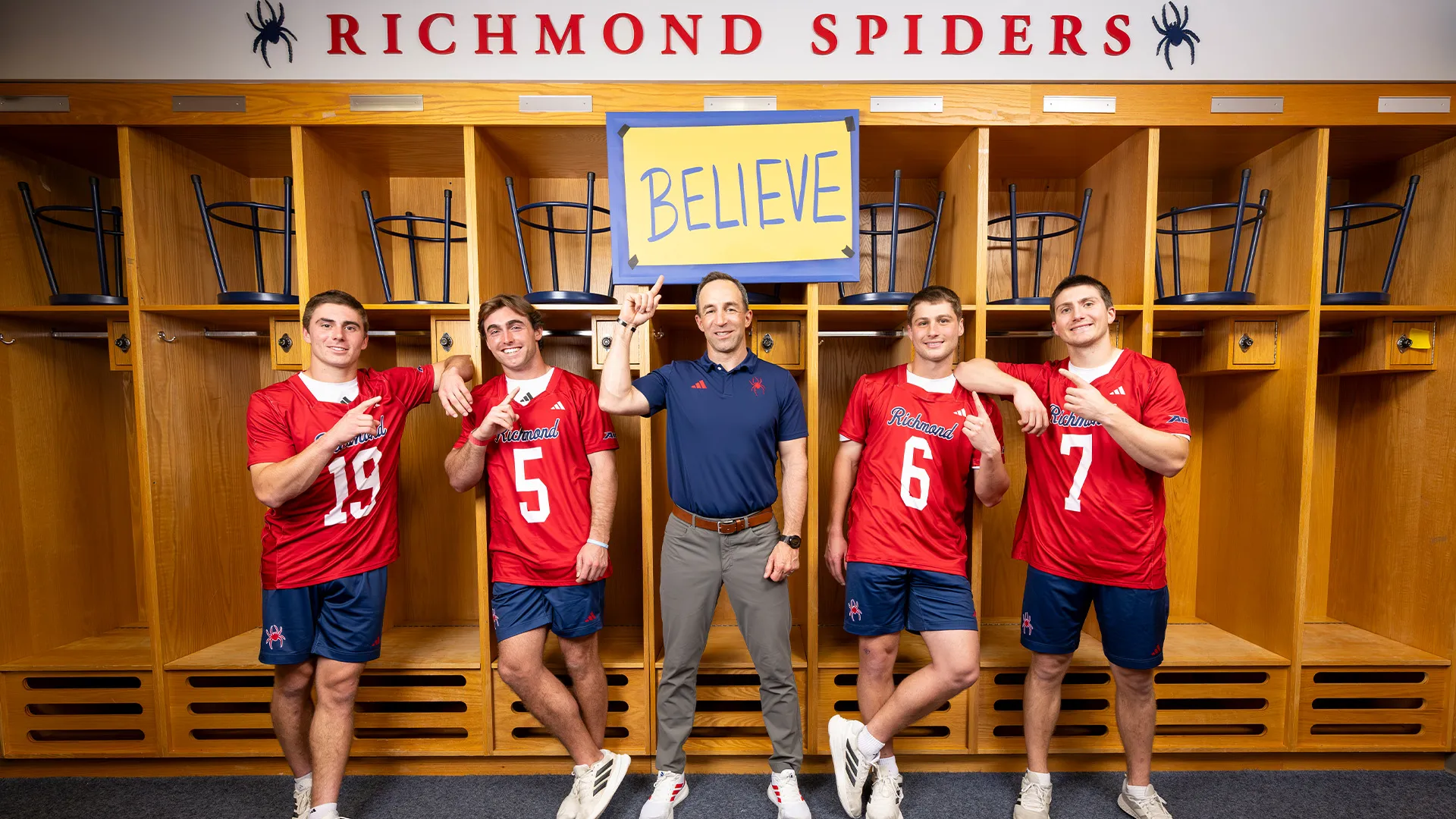
Aidan has spoken a lot about belief. Shifting the mindset from beating certain teams to being one of those teams.
“I want to see it be mentioned,” defenseman Hunter Smith says at the end of a magazine cover shoot and reiterates in a Zoom interview, “Joe Sheridan is my favorite player.”
Laughing, Sheridan buries his face in his hands. He’s the silent assassin of the group and has the highest GPA on the team with a pre-med courseload.
Smith provides the levity, not to mention his lethal capabilities with a long pole. Days before the interview, he broke Georgetown’s 10-man ride with a 48-yard missile to score on the open goal, swinging the momentum Richmond’s way in a 14-10 victory.
To Smith’s right sits Jack Pilling, the short-stick defensive midfielder who swears the only reason he got recruited to Richmond was because he had a decent game opposite Sheridan — the blue-chip prospect the coaches truly coveted.
“He went for, like, four and two,” Sheridan says.
“And now I don’t play offense,” Pilling retorts. “Went downhill after that.”
They’re both Philly guys who say they were drawn to Richmond because Chemotti and long-time consiglieri Paul Richards reminded them of the demanding mentors they played for in high school — Sheridan for Inter-Ac legend John McAvoy at Malvern Prep (Pa.) and Pilling for longtime La Salle College (Pa.) coach Bill Leahy.
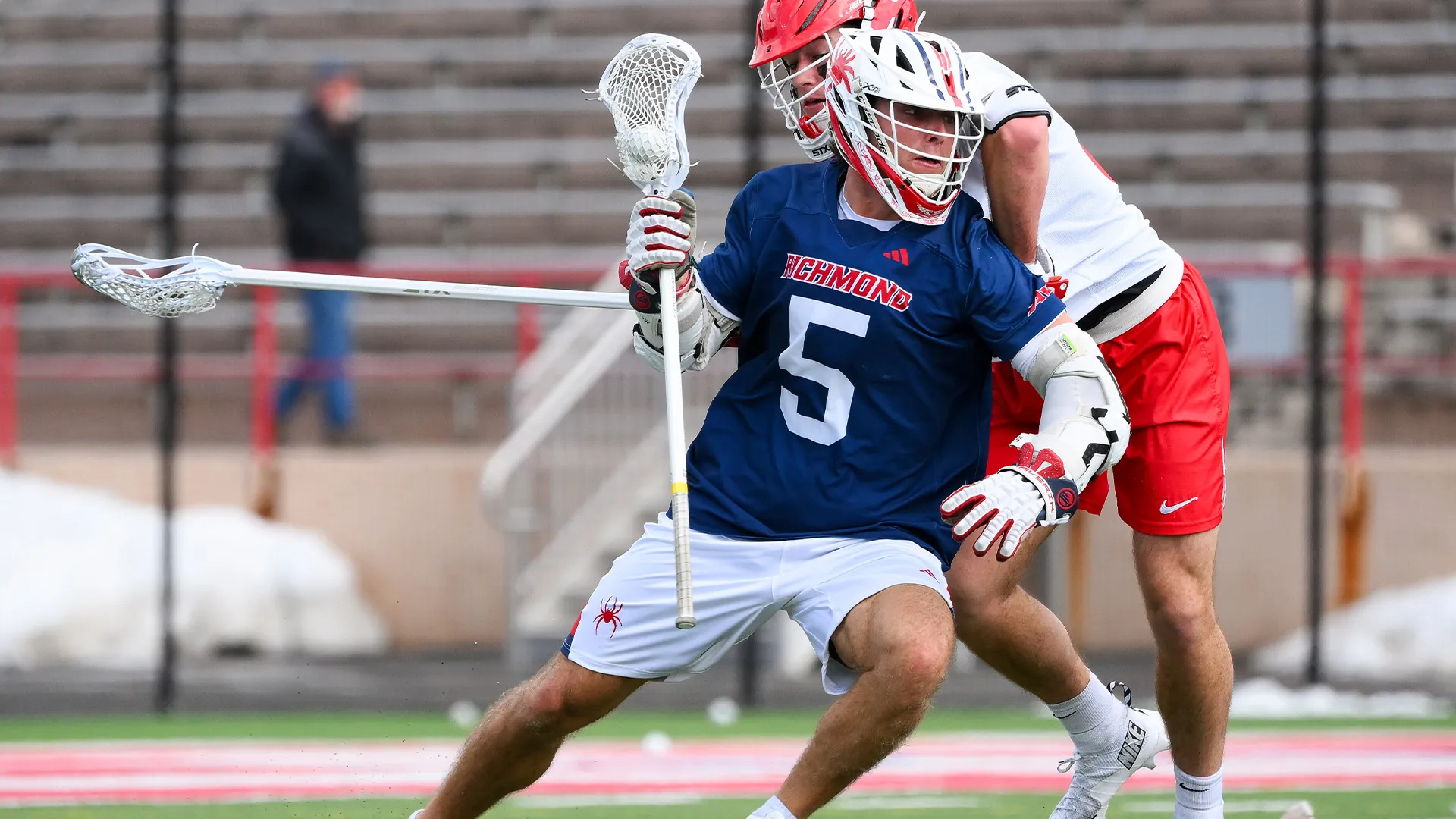
Then there’s attackman Aidan O’Neil, a New Englander and the second-highest recruit (No. 63 in the Class of 2022, according to Inside Lacrosse) the Spiders have ever landed after Ryan Lanchbury (No. 26 in the Class of 2017). O’Neil initially committed to Utah but opted to come to Richmond after the Utes overhauled their coaching staff.
Of all Richmond’s senior captains, O’Neil speaks with perhaps the most conviction.
“Aidan has spoken a lot about belief,” Richards says. “Shifting the mindset from beating certain teams to being one of those teams.”
Chemotti and Richards run a tight ship. Media attention like this makes them nervous, distractions and all.
“At the same time,” Richards concedes, “You can’t complain about never getting coverage and then complain when you get coverage.”
They might not have been so accommodating were it not for their faith in this foursome. O’Neil, Pilling, Sheridan and Smith all started as freshmen in 2023. They’re the team’s four most visible (if not vocal) leaders now, equal parts grateful for the example set by those before them and eager to one-up their predecessors. All four were USA Lacrosse preseason All-Americans.
Besides O’Neil, they committed to Richmond sight unseen. With official visits suspended during the pandemic, Pilling, Sheridan and Smith got a virtual tour of the athletics facilities. One joy ride down UR Drive was all it took for Smith to decide on the school.
The Spiders were a proven commodity at that point. Among the sport’s most remarkable streaks, Richmond has played in the conference championship game in every season of the program’s existence. It started with a surprising run to the Atlantic Sun title and NCAA tournament in their inaugural campaign (2014) and then an eight-year stretch in the Southern Conference.
Since 2023, they’ve been the most consistent contender in the Atlantic 10 — a mix of teams with established lacrosse pedigrees (Delaware, Hobart and UMass) and recently ascendant programs (High Point, Richmond and Saint Joseph’s).
And they’ve always been a thorn in the side of the blue bloods. When Richmond defeated Chemotti’s alma mater, Duke, in 2016, Chemotti called it the biggest win in team history. The Spiders beat North Carolina the next two years, edged Notre Dame in 2019 and finally got the better of Virginia when the Cavaliers were the defending NCAA champion and the nation’s No. 2-ranked team in 2022.
That’s not to mention the heart palpitations they gave Duke and Penn in the 2019 and 2022 NCAA tournaments — both one-goal losses — and Maryland in double-overtime thrillers in 2020 and 2024. No one wants to play Richmond mid-week anymore, that’s for sure.
And yet, O’Neil thinks there’s still a large portion of the lacrosse populace that’s sleeping on the Spiders.
“I’ll be completely honest,” he responds to a question about Richmond getting respect. “I think people are still coming around to it.”
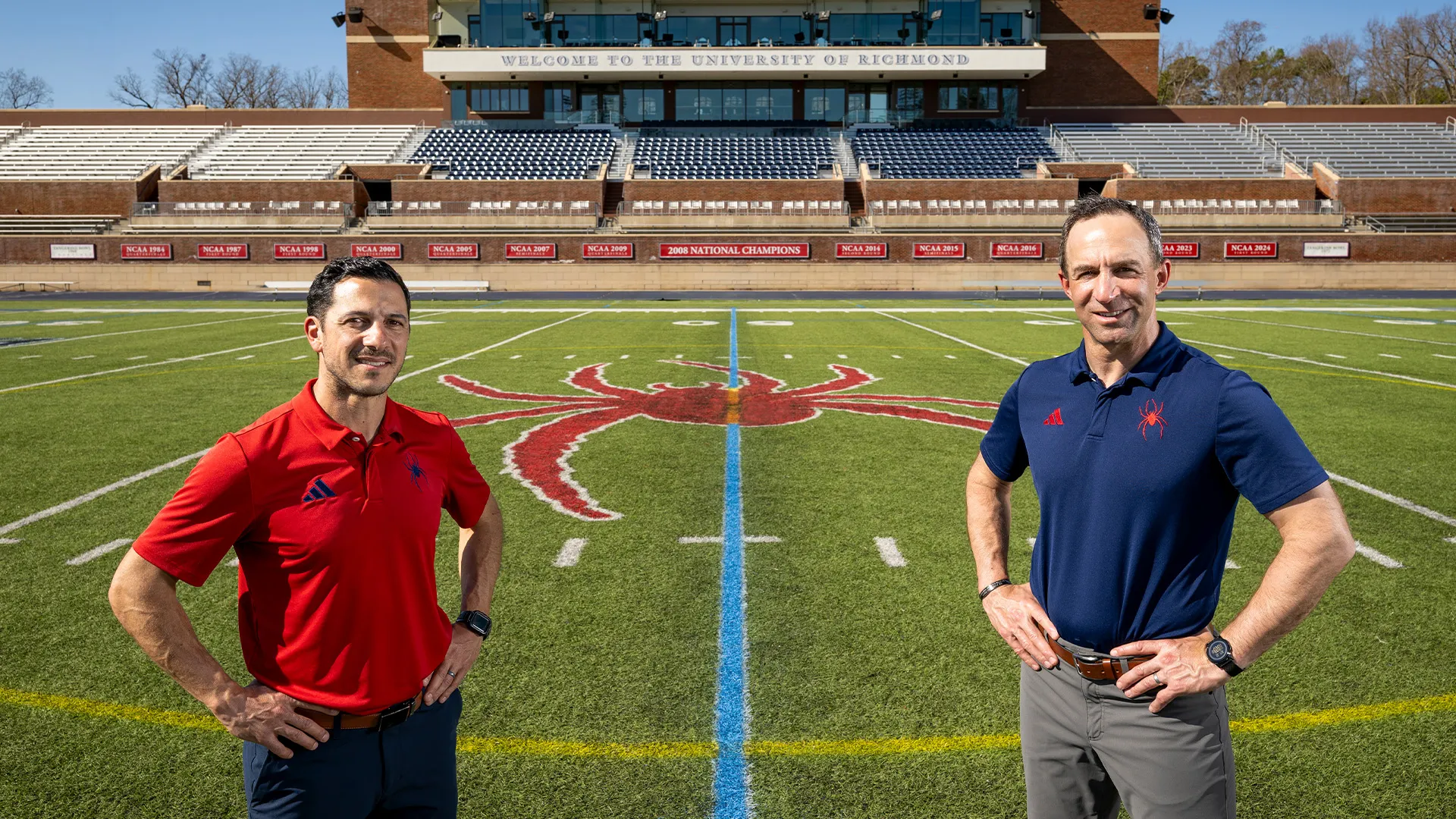
It didn’t take nearly as long for Chemotti to believe in Richmond. He envisioned men’s lacrosse here before the sport was even a glimmer in the administration’s eye.
Chemotti grew up in Syracuse, N.Y., where his father coached high school basketball. Hoops were his first love, but West Genesee High School legend Mike Messere made a lacrosse player out of Chemotti, who topped out at 6 feet tall.
While Chemotti chose to play lacrosse at Duke, he would visit his childhood friend, Scott Ungerer, who was a 6-foot-7 shooting guard for the Richmond basketball team. And he would come to the same conclusion he arrives at today when pitching the university to recruits.
This is the perfect lacrosse school.
While playing professionally in Major League Lacrosse, Chemotti charted an equally impressive course as a college assistant. He got his start at Dartmouth under Rick Sowell, followed Sowell to St. John’s and then earned a reputation as one of the sport’s bright young offensive minds as the coordinator under Charley Toomey at Loyola.
Capitalizing on the momentum of the Greyhounds’ 2012 NCAA championship, Chemotti was a finalist for two Division I head coaching positions that summer. When those did not pan out, he accepted that he might just have to run it back at Loyola.
Until Richmond shocked everyone that September by announcing it was discontinuing men’s soccer and track while adding men’s lacrosse. Chemotti couldn’t believe his luck. His college coach, Mike Pressler, had previously mentioned the possibility of Richmond adding the sport when the two had lunch the day Pressler moved his daughter in at Loyola. Chemotti begged Toomey to make a call on his behalf.
It worked. Richmond invited Chemotti to campus for an interview and liked his preparedness, humility and commitment to attracting not only talented lacrosse players but also model students. They told him to wait on hiring a staff and gave him just six guaranteed admission spots his first year, which paled in comparison to other startups. So he stalked Cornell and pounced on the opportunity to poach Richards when the Big Red’s 2013 season ended in the NCAA semifinals.
Also from the Syracuse area, Richards played for Chemotti at Loyola, and they were teammates with the Washington Bayhawks. They sealed the deal over dinner at The Continental, the same neighborhood restaurant where they courted O’Neil and more recently nabbed a Canadian recruit named Matthew Ford.
Be they prospective coaches or players, Chemotti knew that if he could get them to campus, they would be wooed by its beauty and surprised by its prestige.
Chemotti reaches under his desk and pulls out stacks of legal pads and loose-leaf papers bound by paper clips — keepsakes of winter recesses spent in the basement of Messere’s rural Elkbridge, New York, home watching film and identifying patterns. Messere’s wife, Barbara, brought homemade Christmas cookies and pies downstairs for sustenance.
Chemotti considers himself the embodiment of the great coaches for whom he has played or served as an assistant. From Pressler, he learned the meaning of loyalty. From Joe Alberici, his offensive coordinator at Duke and now the Army head coach, he got empathy. Sowell showed him how to build a program, and Toomey showed him how to get players to run through a wall for you.
But Messere has had the greatest influence on Chemotti. On the first line of the first page in this tome of lacrosse wisdom is a single word written in all caps and underscored twice:
FUNDAMENTALS
That first season, Chemotti and Richards invested an inordinate amount of time teaching. Once they had enough players, that was. They cast a wide net. Some candidates didn’t make it past the run test. They quit on the spot. Bolstered by a few mid-year transfers, Richmond’s first roster had 36 players. They designed practices that emphasized skill work over physical exertion. Besides, you can’t ride if your footwork stinks and you can’t clear if you have shoddy stickwork.
The Spiders lost their first five games and seven of their first eight. But they had the freshest legs in the conference tournament. They dominated No. 1 seed Mercer 14-6 and eked past High Point 8-7 to claim the Atlantic Sun championship. That weekend, Richmond committed far fewer turnovers than their opponents, cleared at a higher clip, got terrific goaltending from Pugh and saw 10 different players score.
“People talk about culture all the time. I think we overdo it,” said Dom Starsia, the Hall of Fame former Virginia coach who does color commentary for Richmond broadcasts. “What Richmond has developed is an environment of development. They don’t spare the fool. They coach hard. And they’ve got kids willing to hear the message.”
Even as the roster grew, the university unlocked full funding and more polished players matriculated here, Chemotti never forgot the first word in his coaching bible. Richmond spends the first month of fall ball rebuilding its fundamental base — starting with the most rudimentary skills like hand placement and stick path.
“We barely even touch our sticks at the beginning,” O’Neil says. “We’ll be doing wrist snappers with jerseys and the most niche shooting drills. You start from ground zero, regardless of who you are or what you’ve done.”
What Richmond has done is captivate the lacrosse world with its continuous ascent. The 2026 season has the potential to be its best yet. The Spiders are averaging 16.45 goals per game (first in Division I) and allowing just 7.91 (tied for second). Senior goalie Connor Knight has flourished in his first year as the starter. The offense features an elite ball carrier in O’Neil, a lethal inside finisher in Lucas Littlejohn and a forceful step-down shooter in Gavin Creo.
The Spiders earned the No. 1 national ranking for the first time ever on March 30 but relinquished it a week later. They are 10-1 with two regular-season games to go.
Starsia saw the makings of this when Richmond handled North Carolina easily in a preseason scrimmage. “I thought maybe UNC was overrated,” he said. “It turned our Richmond was just that good.”
And in another sign of the program’s coming of age, Richmond, as of the publication of the April edition of USA Lacrosse Magazine, was second only to Syracuse in total attendance. The Spiders host the Atlantic 10 tournament later this month. Will an NCAA tournament home game follow?
“They’re the hunted now,” Starsia said. “They’re not sneaking up on anyone anymore.”