
It was sometime Sunday night — probably around the time Georgetown’s Anderson Moore snared a Chase Band shot late in the third quarter for the 12th of his 15 saves, a tidbit I dutifully noted for future reference — that one of the apparent trends of the first week of the NCAA tournament hit me.
It sure has been a good couple days for goalies. But was it? And is this a particularly good year for goalies?
The most simplistic measure bore it out. Moore was one of five goalies with a 15-save game in the first round, joining Army’s Sean Byrne, Syracuse’s Jimmy McCool, Notre Dame’s Thomas Ricciardelli and Cornell’s Matthew Tully.
(Byrne, in fact, snared 20 shots in the Black Knights’ 10-6 loss at Penn State. He was the first goalie to get to 20 saves in an NCAA tournament game since Yale’s Jared Paquette did it in the 2022 quarterfinals against Princeton.)
By comparison, there were only four of those in the last two tournaments combined. Liam Entenmann made 16 stops in the 2024 final against Maryland. Johns Hopkins’ Chayse Ierlan got to 15 in a double overtime quarterfinal the same year. And Ricciardelli and Ohio State’s Caleb Fyock both made 15 saves in the same first-round game last May.
Could it all just be background noise? Or superb defenses giving goalies great looks? Shaky shooting? Or does the premise hold and there’s a great crop of goalies on display as the tournament heads into its second weekend?
Who better to ask than a goalie, right?
“I try not to spend much time looking at stats, but I’ll watch games and say, ‘This kid’s having an incredible year, this kid’s having an incredible year,’” Moore said. “I’m looking at myself, and I’ve had a pretty good year, but comparatively there’s like three guys who were 60 percent this year. I can’t remember the last time that’s happened.”
It hasn’t happened with a full schedule since 2014 (the full qualifier is required because of the pandemic-abbreviated 2020 season). That also happens to be before the advent of the shot clock, and the end to teams content to burn off minutes at a time to shorten games.
ESPN’s Quint Kessenich, a four-year starter and two-time first-team All-America pick at Johns Hopkins from 1987-90, believes the trend line at the position is improved over a decade ago. Chalk some of that up to better quality of athletes at the position and improved instruction, especially with more former goalies diving into giving private lessons.
Yet there’s also a balancing force on the other side of the shot.
“I think from a skill level, the goalies are definitely better than they were five years ago,” Kessenich said. “The challenge is these teams have incredible shooters. The velocity, the deception, the variation of release points. It’s never been harder to be a Division I lacrosse goalie, and you saw that in the ACC in particular this season.”
Indeed, since the start of April, McCool got yanked in a loss to North Carolina, while both Duke and North Carolina have made goalie changes. There wasn’t significant goalie roulette among the best teams in the Big Ten or Ivy League over the last two months.
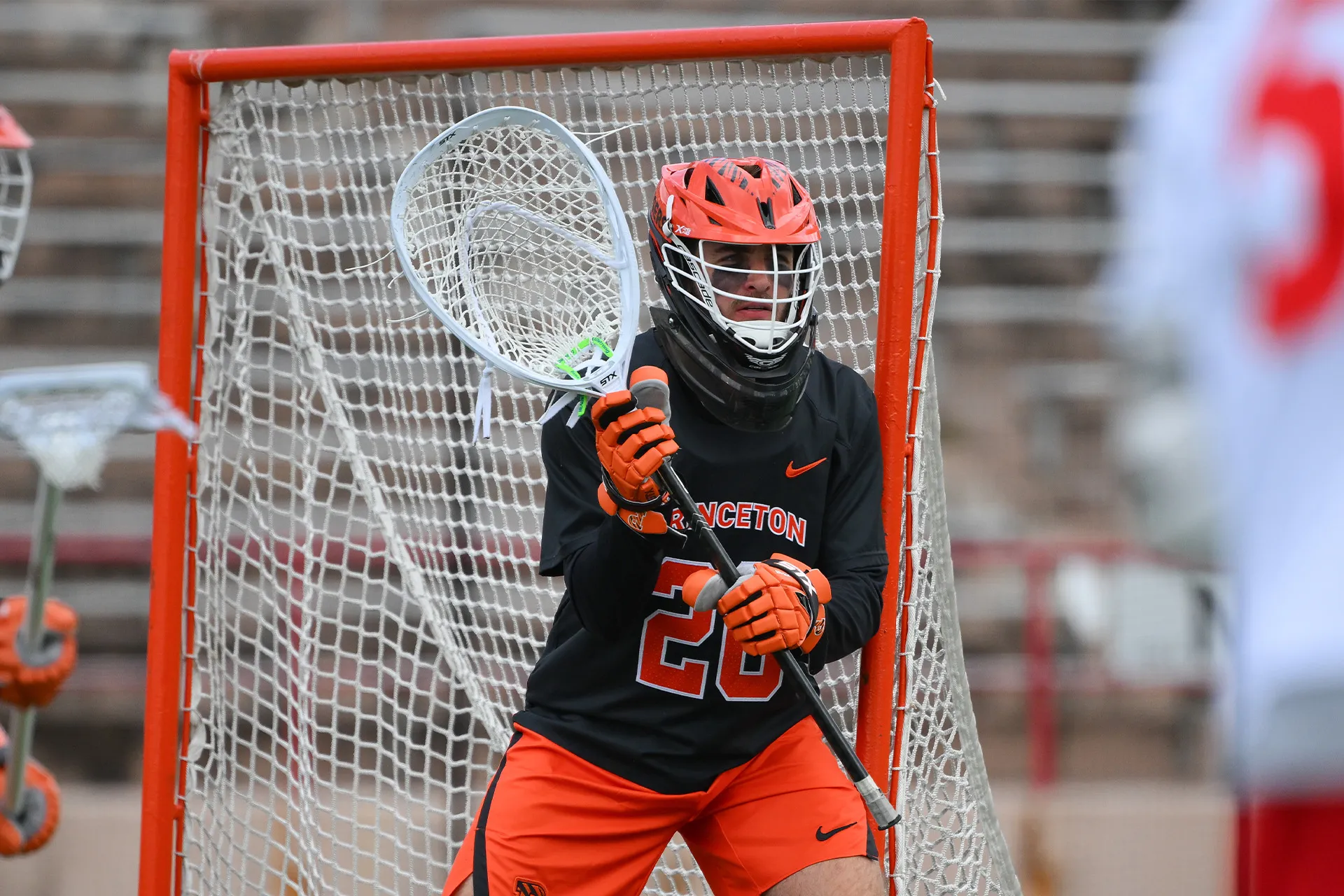
Princeton’s Matt Madalon, a goalie-turned-head coach, has one of the nation’s top netminders. (The Tigers’ Ryan Croddick missed the arbitrary 15-save cutoff by one, but he also didn’t play the final 8:42 of a 17-8 rout of Marist.) Madalon’s first instinct was to recognize how deftly teams can pepper the cage.
“When we think of our guy having great games, it’s because we’re facing great offenses,” Madalon said. “We take a lot of pride in great defense, but there’s no no-shot defense. These offensive coordinators and offensive groups seem to get shots off in a thousand different ways.”
The more Madalon thought about it, the more he could see multiple influences. Lacking the data at the time, it was difficult to nudge the conversation along further.
The stats were available; they just needed to be laboriously plugged into a spreadsheet. What better way could there be to burn off a couple hours in the service of a trend story?
To make the data as relevant as possible, it made sense to stick to the shot clock era, which began in 2019. And while it wouldn’t have been that difficult to include every game, the point was to stick to the postseason.
ALL TOURNAMENT GAMES
YEAR | GAMES | SAVES | GA | SAVE% | SHOTS | S/G | G/G | SVS/G |
|---|---|---|---|---|---|---|---|---|
| 2019 | 16 | 349 | 456 | .434 | 1326 | 41.44 | 14.25 | 10.91 |
| 2021 | 15 | 384 | 347 | .525 | 1184 | 39.47 | 11.57 | 12.80 |
| 2022 | 17 | 472 | 394 | .545 | 1389 | 40.85 | 11.59 | 13.88 |
| 2023 | 16 | 370 | 433 | .461 | 1275 | 39.84 | 13.53 | 11.56 |
| 2024 | 16 | 322 | 375 | .462 | 1201 | 37.53 | 11.72 | 10.06 |
| 2025 | 17 | 356 | 405 | .468 | 1286 | 37.82 | 11.91 | 10.47 |
| 2026 | 10 | 239 | 228 | .512 | 803 | 40.15 | 11.40 | 11.95 |
Shots are up by more than two per team a game over last year, goals have dipped slightly and saves are up 14 percent per game. And after three postseasons of the save percentage hovering between 46 and 47 percent, goalies have stopped 51.2 percent through the first two rounds.
That would seem to lean toward the good-goalie-year hypothesis. But since the aim is an apples-to-apples comparison, why not limit each year to the play-in games and the first round?
FIRST TWO ROUNDS
YEAR | GAMES | SAVES | GA | SAVE% | SHOTS | S/G | G/G | SVS/G |
|---|---|---|---|---|---|---|---|---|
| 2019 | 9 | 196 | 247 | .442 | 708 | 39.33 | 13.72 | 10.89 |
| 2021 | 8 | 218 | 186 | .540 | 636 | 39.75 | 11.63 | 13.63 |
| 2022 | 10 | 261 | 241 | .520 | 792 | 39.60 | 12.05 | 13.05 |
| 2023 | 9 | 212 | 261 | .448 | 746 | 41.44 | 14.50 | 11.78 |
| 2024 | 9 | 182 | 227 | .445 | 680 | 37.78 | 12.61 | 10.11 |
| 2025 | 10 | 203 | 237 | .461 | 739 | 36.95 | 11.85 | 10.15 |
| 2026 | 10 | 239 | 228 | .512 | 803 | 40.15 | 11.40 | 11.95 |
Some of the numbers didn’t change too much, but the year-over-year bump in saves is now 17.7 percent. Only so much of that can be due to an uptick in shots (8.7 percent).
Still, that’s probably some of it, and a welcome development.
“When you’re playing a playoff game against a good team and there’s a shot clock, they’re here for a reason,” Kessenich said. “They’re here because their offense can operate. They’re here because they are dangerous and they’re going to get some shots off. You know going into this game that this is not going to be a rock fight, for the most part. You’re going to have opportunities.”
And to be sure, not every team received exemplary outcomes in the net last week. Six teams checked in at less than 40 percent in the first round, and of those, only Johns Hopkins and Duke advanced.
Neither the Blue Jays nor the Blue Devils had a second-half stop. In an even bigger statistical quirk, Hopkins became the first team to win a tournament game with three saves or less since Loyola had two in a 17-5 rout of Canisius in the 2012 first round. (Notre Dame was the most recent team to have three in the postseason, in a first-round loss at Denver in 2018.)
Still, there were a surplus of stellar performances, too. Moore offered a reasonable guess: The recruiting classes that produced current juniors and seniors had some well-regarded goalies. Sure enough, the top two goalies in Inside Lacrosse’s class of 2022 rankings were Ricciardelli and McCool. The following year, both Tully and Moore cracked the top 10 overall in the rankings.
And we might just be seeing the payoff of those guys — and a few others — developing in programs that are postseason regulars.
“I love the fact goalies are playing well,” Madalon said. “As the hockey saying goes, you can ride a hot goalie all the way to the Stanley Cup finals, and you can kind of ride a hot goalie through the playoffs. That’s cool for a lot of teams. I think those are special performances, especially in any NCAA playoff game.”