
600 and Still Building: Cindy Timchal Just Keeps Winning
Cindy Timchal won’t lie. She was a “little nervous” with Navy and Jacksonville deadlocked at 10 early in the fourth quarter of their game Tuesday, March 10.
Timchal knew the Dolphins were better than their more recent outing at Towson, but the physical game was a little too close for comfort until Alyssa Chung’s three straight goals sealed a 13-10 victory for the Midshipmen.
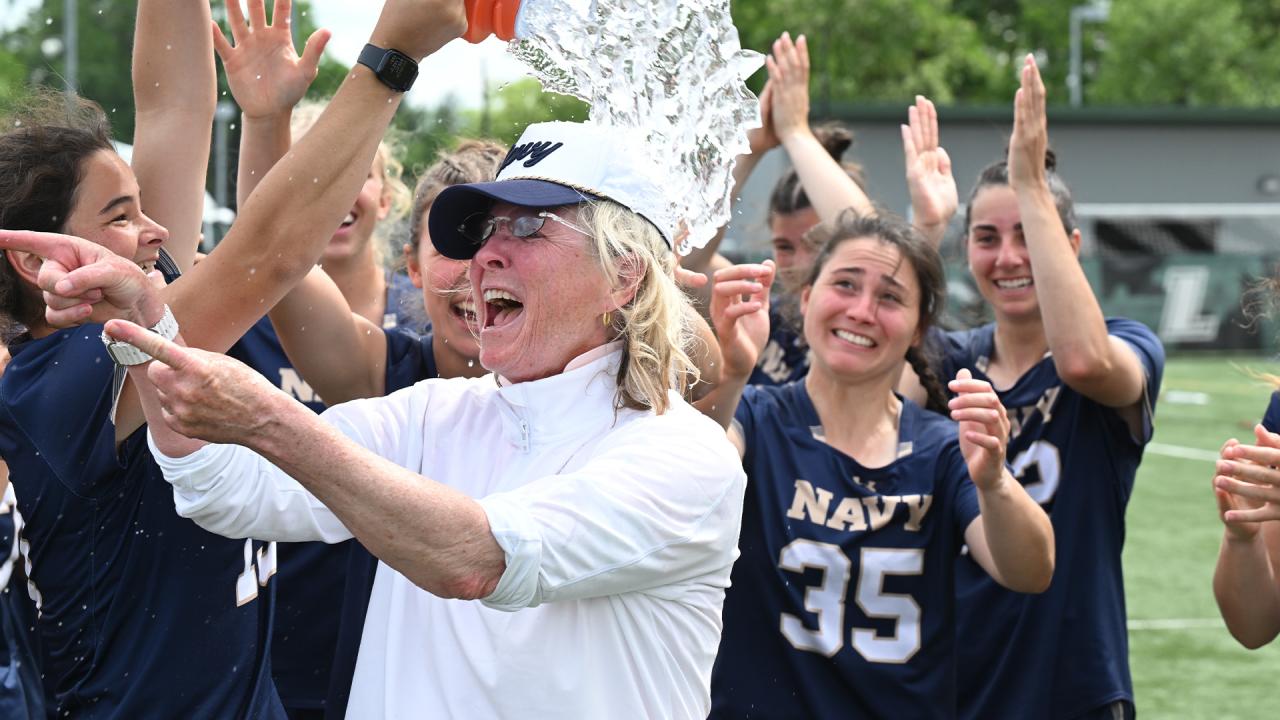
Navy escaped, but Timchal couldn’t as the team doused her with icy water from the cooler on the sideline at Navy-Marine Corps Memorial Stadium. She hasn’t gotten a Gatorade bath after every win. That would be, well, bonkers, considering this was the 600th of Timchal’s unparalleled career.
The players ambushed Timchal again when she entered the locker room. They emptied plastic water bottles on her and propped up gold balloons forming the number 600. They danced to DJ Khaled’s “All I Do Is Win.”
It was a fitting celebration. No one has won like Timchal has, at least not at the Division I level. She is the first head coach, man or woman, to reach the milestone. “600 wins is amazing,” said Syracuse men’s lacrosse coach Gary Gait, who spent nine seasons as Timchal’s assistant at Maryland. “How do you do that?”
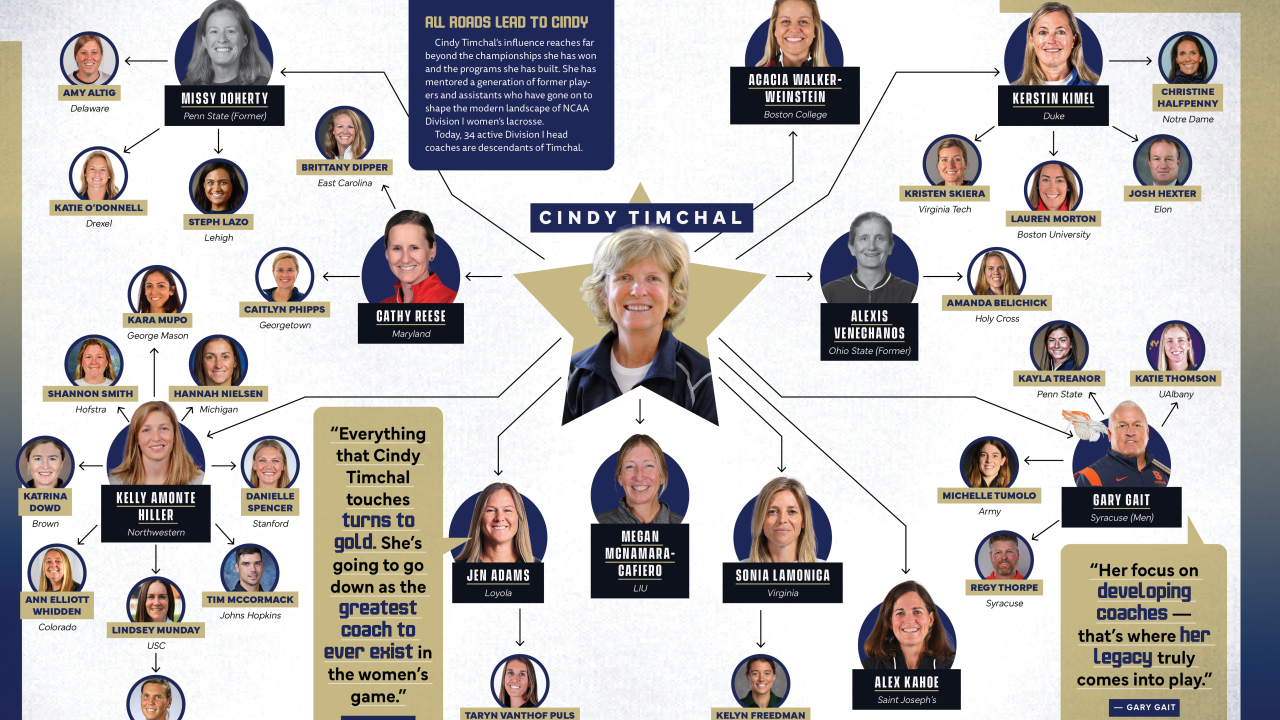
Best known for leading Maryland to eight NCAA championships, including seven straight from 1995-2001, Timchal has been inducted into eight different halls of fame. But with all due respect to Khaled, she’s done more than just win. She’s revolutionized the game. She brought Gait to College Park. He went on to coach Michelle Tumolo and Kayla Treanor, the sport’s first YouTube icons, at Syracuse. She mentored Cathy Reese, who succeeded her at Maryland and has added five more NCAA titles to the Terps’ expansive trophy case. She unleashed Kelly Amonte Hiller and brought Jen Adams across the world from Australia. She coached Acacia Walker-Weinstein, who helped develop Charlotte North into Char-lotte North.
“She is the Godfather of women’s lacrosse,” Navy senior midfielder Maggie DeFabio said. “Every player, every coach, everybody in the game somehow has a connection to Cindy. All roads in this game lead back to her.”
For Timchal, however, the road did not start in Maryland. It started in the Philadelphia suburb of Haverford, where Timchal attended high school. She did not play lacrosse before she went to West Chester, where she also played tennis and ran track and field. West Chester had two freshman teams, a JV team and a varsity team. Timchal gave it a shot.
“You fall in love with lacrosse, and you want to keep playing it,” Timchal said. “You love the people who are involved.”
She is the Godfather of women’s lacrosse.
Navy senior midfielder Maggie DeFabio
Timchal started her career as the field hockey, lacrosse and basketball coach at Unionville High School before entering the collegiate scene as an assistant lacrosse and field hockey coach at Penn in 1979.
Ahead of the 1981-82 school year, Timchal got an offer to become Northwestern’s inaugural head coach. A friend of hers, field hockey coach Nancy Stevens, was heading there, too. That connection proved crucial.
“When I went out to Chicago to coach a lacrosse program, we had no scholarships, and there were no teams out there,” Timchal said. “The fact that we were able to survive at that level is remarkable. We used field hockey players, predominantly.”
On March 24, 1982, Timchal got her first win, 12-11, over Dartmouth. She won 76 games with the Wildcats, making NCAA tournament appearances in 1983, 1984, 1986, 1987 and 1988. Timchal departed for Maryland after the 1990 season, attracted by the scholarships the Terps provided.
“I really wanted to win,” she said. “It didn’t mean I couldn’t win at Northwestern, but the level of support at that time was different.”
Northwestern discontinued sponsorship of women’s lacrosse after the 1992 season. One of Timchal’s greatest disciples, Amonte Hiller, later resurrected the program and built a dynasty of her own.
In College Park, Timchal’s own legend grew. She drew comparisons to college basketball icons John Wooden and Pat Summitt. Like them, Timchal has created a legacy rooted less in the wins and championships than her embrace of unorthodox methodologies. She had the guts to hire Gait, the gumption to recruit Adams and the foresight to add a sports psychologist to the staff before it was en vogue to do so.
“Cindy Timchal, she’s such an influencer,” said Walker-Weinstein, the Boston College and U.S. Women’s National Team head coach. She played at Maryland from 2002-05. “I love how she coaches the whole human — mind, body and spirit.”
These days, you can find sports psychologists on most athletics departments’ staff directories. But in the mid-1990s, psychologists were sometimes seen as part woo-woo, part sign of weakness — someone you went to if you couldn’t deal with failure.
Even Reese recalls opening one eye and looking at her teammates as if to say, “What are we doing?” when Dr. Jerry Lynch began leading visualization, affirmations and meditations. “The power of those mental techniques, it advanced our whole team’s game at that time,” she said. “It was cutting-edge.”
Timchal still talks to Lynch weekly, and she thinks sports psychology is still misunderstood, even with its Instagram fame.
“Many times in sports psychology, it’s, ‘List the three things you wish you could do,’” Timchal said. “That’s fine, but we dig deeper into the why. Why compete for each other? Why all the sacrificing and suffering to be part of something special? Then, you retain a connection as a team.”
Maryland was automatic for nearly a decade under Timchal, at one point winning 50 straight games. When she wanted a fellow innovator, she called Gait, who with his twin brother, Paul, captured the imagination of lacrosse fans like no others before them when they played at Syracuse. He was the Michael Jordan of lacrosse.
Gait had never played and barely watched the women’s game. Maybe half of the North-South Senior All-Star Game in 1990, he said. Timchal called him anyway. He lived in Baltimore, played professionally and worked at STX at the time.
“I thought he could connect with a team invested in being good,” she said. “I thought that would be a good match.”
Gait had just had a daughter, Taylor.
“I said, ‘Maybe one day I’ll coach my daughter. That might be something fun to try,’” he said.
Gait knew Timchal understood what it took to win, and liked that she was willing to think outside the box — not just for calling him, a male, to coach. “The women’s game at the time was where it was because it was built on tradition,” he said. “She was willing to go against the grain and look at other ways to coach.”
With Timchal’s blessing, Gait set out to transform the women’s game, significantly through stickwork, teaching creativity like around-the-world shots and ushering in plastic sticks instead of wooden ones.
“Our stickwork in the 90s was the best in the game,” Reese said, “We focused so much on it, and [Gait] elevated our levels at Maryland from things that we didn’t even know we could do. It was about finding twists and bringing them in from the men’s game to the women’s game, and that why he and Cindy worked well together.”
But August 5, 2006, marked the end of an era. After 260 wins, Timchal announced she was leaving Maryland to start a program at Navy. Two years later, Gait started as the Syracuse women’s head coach. He’d go on not only to coach Tumolo and Treanor but also to realize his dream of coaching his daughter, Taylor, who played for the Orange from 2015-18.
“Cindy helped make that come true,” he said.
The call from Navy came from the father of a one-time recruit, Julie Gladchuk. She went to North Carolina, but her father, Chet, was Navy’s athletics director.
“I always admired the Naval Academy and the ethos of serving,” Timchal said. “To be here in Annapolis, the capital of Maryland, and play in Navy-Marine Corps Stadium, was a big appeal for me. It was a leap of faith, but an opportunity.”
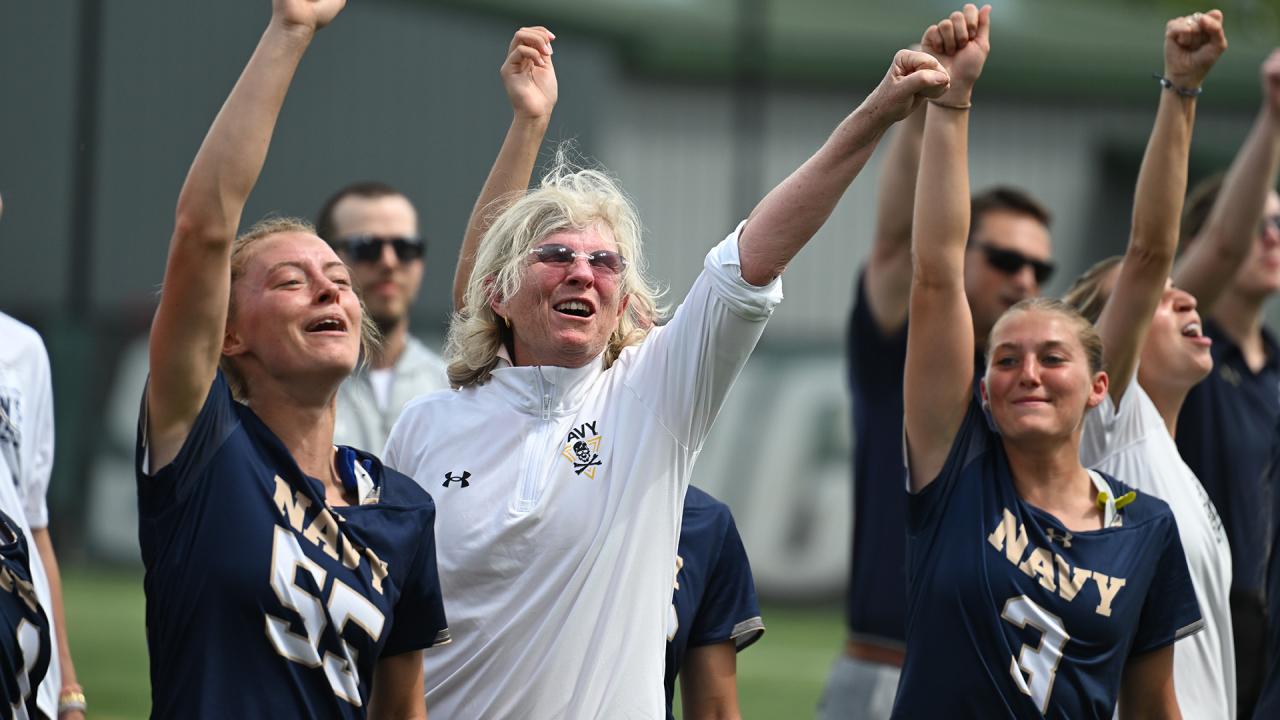
Timchal was confident in her ability to start a program, having done so at Northwestern. But Navy presented a different set of challenges. Unlike at Maryland, where players can dream of playing for a national team (or, these days, the WLL) or a career in finance after graduation, the Naval Academy has a five-year service requirement.
Timchal sees it as a selling point. “All women are inspired by greatness,” she said.
Players can’t redshirt and Timchal can’t turn to the transfer portal to acquire talent. But she’s at her best when she’s forced to find a different way. “We do get full scholarships,” she said. “But now you have NIL, the portal and a landscape where players are getting paid. In that landscape, we understand that we just have to work a little bit harder.”
Kelly Larkin was called to serve, but she also got on the phone to talk to Timchal about playing lacrosse at Navy.
“Everybody knows the legend of Cindy,” Larkin said, “It’s not a coincidence that every school and every program that she has taken over has turned into a national powerhouse.”
Navy was an immediate success, going 13-4 in year one. But the Midshipmen were not yet nationally renowned. That changed in 2017, Larkin’s freshman year. Navy beat Loyola in the Patriot League championship game to earn the conference’s automatic qualifier to the NCAA tournament, then upended No. 7 Penn in the first round, UMass in the second round and No. 2 North Carolina in the quarterfinals to advance to its first-ever final four.
All four NCAA semifinalists that year were coached by women who played for Timchal at Maryland. Reese had the Terps there as the top seed. They defeated Penn State, coached by Missy Doherty, in the semifinal and Walker-Weinstein’s ascendant Boston College team in the championship game at Gillette Stadium in Foxborough, Mass. Navy bowed out in a 16-15 loss to BC, which made the first of seven straight national championship game appearances.
It could have marked a poetic swan song for Timchal, an official passing of the torch. Some espoused that narrative after 2017. None of them was Timchal. Since then, Navy has captured two more Patriot League championships and made three NCAA tournament appearances. Timchal now has more wins at Navy than at any other stop of her career. And this might be her best Navy team yet. At the time of publication, Navy was 8-0 and No. 4 in the national polls.
“At the end of the season, we want to be 24-0,” DeFabio said, calculating how many wins it would take for Navy to sweep the Patriot League and capture its first national championship. “There’s been a culture shift in joking about being in the elite eight or final four to being like, ‘We could be there.’ We believe and buy into that.”
“We’re practicing as if we’ve never won, and playing as if we’ve never lost,” Timchal said.
We’re practicing as if we’ve never won, and playing as if we’ve never lost.
Cindy Timchal
Mindset and buy-in have long been part of Timchal’s playbook. Slowing down has not, and so it does not surprise Larkin that 2017 was not the Hall of Famer’s final act.
“Her energy is unmatched,” Larkin said. “You would think that over the years, somebody who has been coaching for so long would get more tired of it. But the level of energy that Cindy brought to every practice was what got the whole team so fired up to go into every day.”
Timchal, 71, doesn’t funnel her energy only into building sustainable programs. She wants to prop up women’s lacrosse at a time when schools are starting to subtract sports again, rather than add them. She’s a student not just of lacrosse, but of multiple sports. Catch her during basketball’s March Madness, and she can rattle off which teams are relying on transfers, dovetailing into a conversation about the portal and revenue sharing. She’ll muse on the Caitlin Clark effect. She thinks about how lacrosse can avoid the pitfalls of other sports and find models for success.
“She calls us and says, ‘Did you see that? We need to do that,’” Amonte Hiller said. “And I’m like, ‘You’re absolutely right, Cindy.’ She mobilizes her people so we can help move our game forward. Having a female leader like that in our sport is huge.”
Timchal regularly talks about the importance of promoting Charlotte North and Chloe Humphrey — whose raw power and rare skill, respectively, had her slack-jawed as she observed U.S. Women’s National Team training camp last summer. She admires how Ally Mastroianni has become an advocate for growth. She wants to see lacrosse in Texas, and momentum is building toward the Los Angeles 2028 Olympic Games.
“We have to take advantage of the moment and the appeal of women playing at the highest levels,” Timchal said.
When it comes to rounding up the troops, Timchal has an army from which to choose. More commonly, it’s referred to as the Timchal Tree. Thirty-four active Division I head coaches are Timchal descendants. In addition to Gait, Reese, Amonte Hiller and Walker-Weinstein, there’s Adams (Loyola) and Kerstin Kimel (Duke). Amonte Hiller’s branch is a heavy one, with the likes of Hannah Nielsen (Michigan), Lindsey Munday (USC) and Danielle Spencer (Stanford).
“Her focus on developing coaches — that’s where her legacy truly comes into play,” Gait said. “She’s helped change the way the game is taught and played. She ran camps back in the day. Players and coaches learned her techniques. We went from wood sticks and traditional teachings to players being able to play at a whole other level. It wasn’t one-and-done through one team or program. It was done through coaching players who go on to become coaches.”
Reese, too, has mentored her share of greats as players and coaches. She had Adams on her staff at Denver. She recruited Taylor Cummings, the only player (male or female) ever to win the Tewaaraton Award three times, who then won multiple IAAM titles at her high school alma mater, McDonogh (Md.). Another Tewaaraton winner, Caitlyn Phipps, spent 12 seasons as Reese’s assistant at Maryland before becoming the head coach at Georgetown.
“Cindy gave me my first job and saw something in me,” Reese said. “Kelly, Jen Adams, Kerstin, Acacia — there’s a lot of Terps out there, and they keep going, spreading and growing the game. A lot of that is because of how much we loved our experience playing at Maryland under her. She had this fire for women’s athletics, and it’s continued to spider-web throughout the game.”
Timchal could call it quits at any time. She doesn’t want to. She doesn’t envision a life after lacrosse or a life without lacrosse, even if she may one day retire from coaching.
“Lacrosse is always going to be a big part of my life,” Timchal said. “I just want to continue to coach while I can, and while the team is doing well.”
Navy has eyes on its first Patriot League regular season championship and fourth conference tournament title under Timchal. The Midshipmen will have to go through Army (Tumolo) and Loyola (Adams).
“Everything that Cindy Timchal touches turns to gold,” Adams said. “It’s what she does. She’s going to go down as the greatest coach to ever exist in the women’s game, and it’s going to take people an impossible amount of time ever to try to catch up to her.”
And if anyone does ever catch up to Timchal, chances are their road there in some way leads back to her.
Beth Ann Mayer
Beth Ann Mayer is a Long Island-based writer. She joined USA Lacrosse in 2022 after freelancing for Inside Lacrosse for five years. She first began covering the game as a student at Syracuse. When she's not writing, you can find her wrangling her husband, two children and surplus of pets.


Related Articles