Syracuse women’s lacrosse has produced a lineage of offensive stars since the aughts — the quietly potent Katie Rowan (now Thompson), YouTube icons Michelle Tumolo and Kayla Treanor, the sometimes down but never out Emily Hawryschuk, The Meg Show (Meaghan Tyrrell and Megan Carney) and Emma Ward.
Defense wasn’t necessarily the Orange’s calling card. That is, until this year. The Cuse defense has let in double-digit goals twice in 13 games: Against North Carolina (13) and Louisville (10).
It’s not that the unit was ever the program’s Achilles’ heel. Syracuse surrendered fewer than 10 goals per game in 2024. The offense just constantly took center stage. Perhaps that’s what happens when you have two of the greatest offensive players ever to play the sport — Gary Gait and Treanor — as your head coach.
This year, the Orange brought back Regy Thorpe, an All-American defenseman in the 1990s for Syracuse and a former Gait assistant. As the associate head coach at Florida in 2025, he helped the Gators rank 12th in scoring defense at 9.43 goals per game.
This season, the Orange ranks third nationally in scoring defense, allowing 7.0 goals per game.
“Our defense has been our anchor all year,” Thorpe said. “They’ve been carrying us. They’ve given us a chance in every single game. Even in our first three games [and losses], we had a chance going into the fourth quarter, and the defense gave us that chance.”
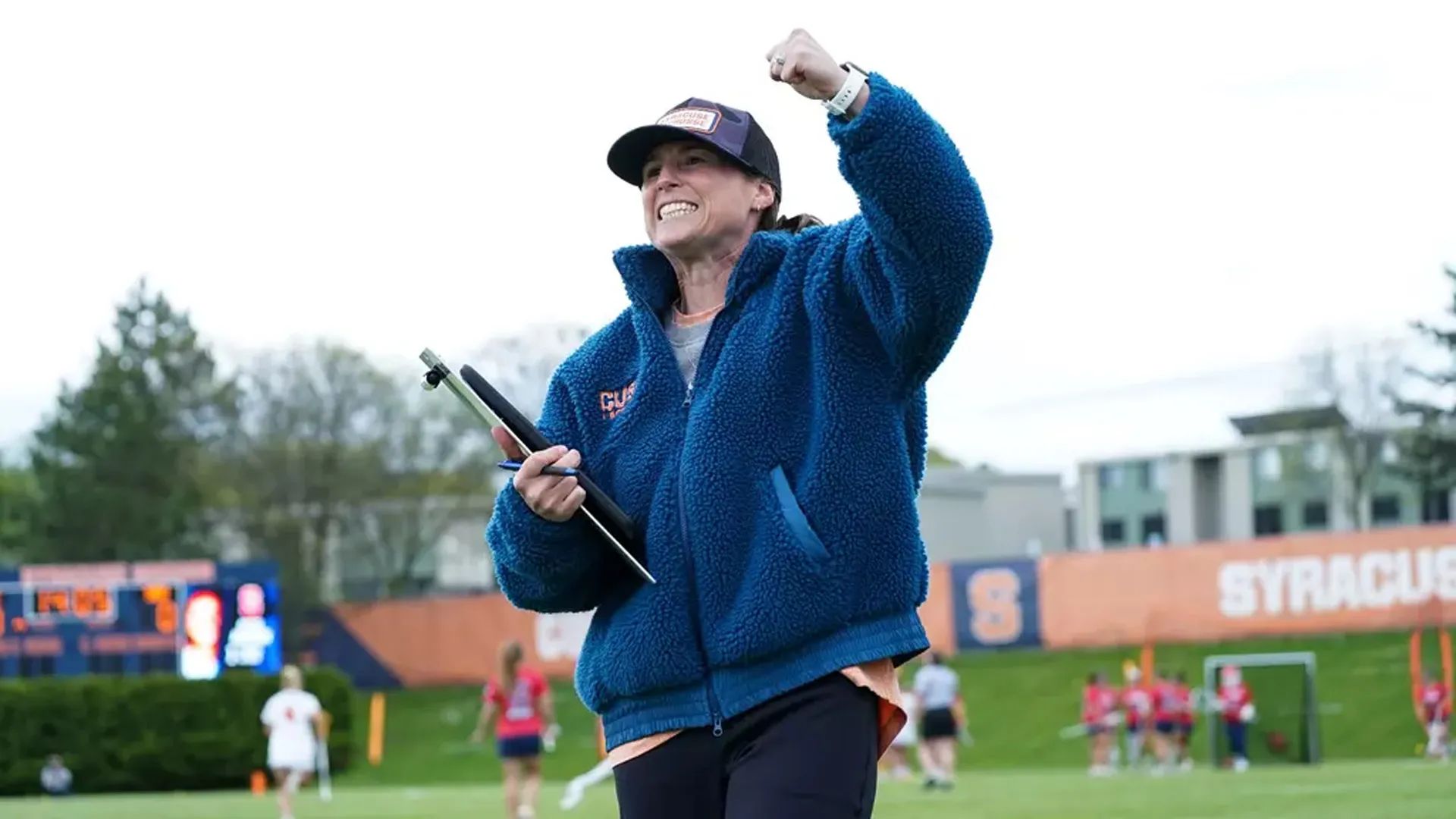
Thorpe may be in his first year as head coach, but defensive coordinator and associate head coach Caitlin Defliese Watkins joined the Orange staff in 2016. She and Thorpe worked together under Gait, and Defliese Watkins stayed on under Treanor.
“I love Syracuse and how important lacrosse is up here,” Defliese Watkins said. “I don’t think there’s anything quite like it in the whole entire country. We have almost 3,000 fans at our games, and that’s what these kids are getting an opportunity to play in front of.”
Thorpe has long been a fan of her work.
“She’s very good on the fly with in-game adjustments,” Thorpe said. “She’s collaborative and open-minded. There’s an appreciation for defense, and she does a good job game to game, whether we’re playing man, zone — and it changes.”
Defliese Watkins knew she wanted to be a coach for as long as she could remember, having worked camps with her father while growing up on Long Island. She went to Adelphi to become a teacher (and maybe a high school coach) when she joined with then-women’s lacrosse head coach Joe Spallina.
Together, the two employed a backer zone, a version of the zone with a floating “backer” who can slide. Spallina saw it done in the men’s game. The backer zone helped Adelphi win a trio of national championships, and Defliese Watkins mentored the defense to a nation-leading 5.95 goals-allowed per game in their final season (2011).
“
They’ve been carrying us. They’ve given us a chance in every single game
Defliese Watkins followed Spallina to Stony Brook, as did the backer zone. People didn’t think it would work — not at the Division I level and certainly not against top-10 opponents with the best athletes in the game. Yet Defliese Watkins and Spallina liked how it would meet the moment at Stony Brook.
A backer zone felt more teachable than a traditional 1-v-1 defense, which required more athleticism. It let the Stony Brook program, which famously turns no-star recruits into All-Americans, level the playing field and rise to national prominence.
As for those athletes at Maryland and Northwestern? It became more challenging for one of them to take over a game and consistently beat the defense by dodging and weaving through the unit. Defliese Watkins and the backer zone became as lauded as the Seawolves’ offensive stars, which eventually included the likes of Kylie Ohlmiller, Dorrien Van Dyke and Courtney Murphy.
Stony Brook consistently led the nation in scoring defense. Teams started reaching out to Spallina and Defliese Watkins for advice on how to implement their own.
“I appreciate that I got the opportunity to be with Joe and learn from him — the schematics, the work ethic and the toughness,” Defliese Watkins said. “From a development standpoint, we didn’t have these five-star kids. We had hard-working players who had a desire to win and do something different.”
Gait came calling in 2016, and Defliese Watkins had the opportunity to learn from one of the game’s greatest minds on one of the sport’s biggest stages. She’d also get to recruit and coach multi-star recruits. The grittiness and flexibility came with her, but she also grew in other ways.
“I learned from Gary how to be a bit more creative and scout teams differently,” Defliese Watkins said.
Creativity is a common refrain used to describe Gait as a player and coach (ask his former Maryland stars about who helped develop their stickwork). These days, though, sure, the Orange can slip into man at any time (and did so more often during the Treanor years), but there’s a point of pride in the zone and proof that it can benefit teams even with highly athletic players, like Coco Vandiver.
“My freshman year, the seniors instilled a sense of pride in our zone and passion, and I want to instill that in the rest of our unit now that I’m a senior,” Vandiver said. “We’re passionate about our zone, and it is a huge part of the Syracuse identity. We have that culture — the zone is something we want to protect. When we [go player down], we see it as a challenge and chance to prove our zone is insane.”
Thorpe described Vandiver as the defensive quarterback. She’s a playmaker who makes opposing attackers panic. She can slip into 1-v-1 easily and serves as a coach on the field.
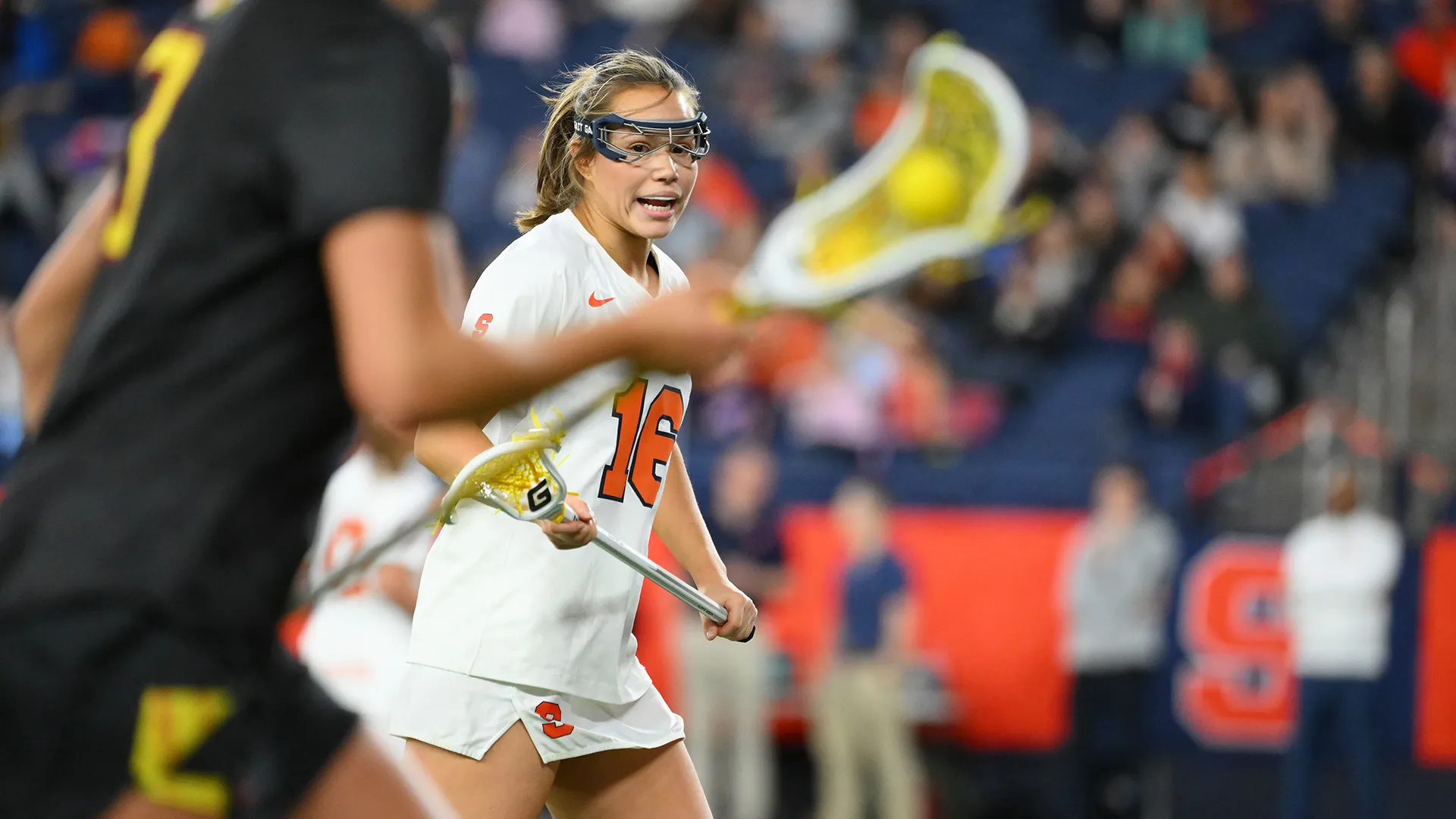
Junior Izzy Lahah, a scout player for much of last season, has also emerged as a defensive stalwart this season, leading the Orange with 35 caused turnovers.
“She’s a great athlete with unbelievable hands and such a high IQ,” Defliese Watkins said. “She was such an important part of our team when she was on the scout team, and she’s risen to the occasion [as a starter].”
Should teams penetrate the zone, which also includes Mackenzie Salentre (14CT) and Kaci Benoit (12CT), they’ll need to get past Dan Guyette. The Orange starter has a 6.88 goals-allowed average GAA and is stopping shots at a .475 clip. In a battle of ranked teams against Yale, Guyette turned back 10 shots and allowed only five goals, helping Syracuse secure a 6-5 win.
“She’s been steady all year,” Thorpe said. “She stays engaged, makes plays and gets ground balls aggressively. She’s been good on the clear for us, too.”
Midfielders like Joely Caramelli (14CT) are also committed to getting back and playing defense, a departure from today’s landscape, where midfielders are mostly attackers with the letter “M” next to their names in the box score. In short, Cuse is bought in on defense, and it’s shown from the jump.
Syracuse started 0-3 with losses to Maryland (9-5), North Carolina (13-9) and Stanford (8-6), all teams that have spent weeks in the top two of the USA Lacrosse Division I Women’s Top 20, presented by CWENCH Hydration.
“We all felt we could have won those games,” Vandiver said. “They were tight games. Knowing that, we immediately started talking about it with our team, especially as captains. We were like, ‘We basically showed that UNC is not this crazy 21-0 team.’ Weirdly, the games gave us confidence. We kept being like, ‘Alright, no one wins a national championship in February.’ The trajectory we’re going on is much better.”
The Orange haven’t lost since, most recently topping Cornell 10-8 in Ithaca Tuesday night to extend their winning streak to 10 games. Duke awaits on Saturday.
The Orange are confident in their ability to make in-game adjustments, especially as teams learn their tendencies. But what about the offense? The constant need to be “on,” the consistently close games and the physicality of the sport can wear on a unit. Vandiver isn’t concerned.
“For a lot of Syracuse history, we’ve been a high-powered offense,” Vandiver said. “I know that was certainly the case in my early years. So, being a part of the storyline that is a defensive year is something we thought was fun. We took a lot of pride in it. We have more veterans on defense than on offense. As upperclassmen, we have that big sister mentality. We’re going to have their backs and protect them so they have room to grow.”
Thorpe isn’t worried either, in large part because he sees the offense, like the Orange as a whole, as growing as they go.
“We’re getting the looks we want,” Thorpe said. “It’s just burying it. If we weren’t doing the fundamentals well offensively, I’d be more concerned. It comes down to our players shooting a bit better, and that’s starting to trend up. Players are taking more responsibility and taking an extra half-second in front if they have more time, so they can shoot the ball a little better.”
If anything, Vandiver thinks the pressure can turn into a privilege as the calendar flips to April (and May).
“We’re one of the toughest teams out there,” she said. “We’ve been battle-tested. We want to win every game. There’s a lot of history with our program, and our alumni program is amazing. We have people supporting them and playing for them and the rest of the seniors.”
As does writing a modern-day history of a nearly impenetrable defense.