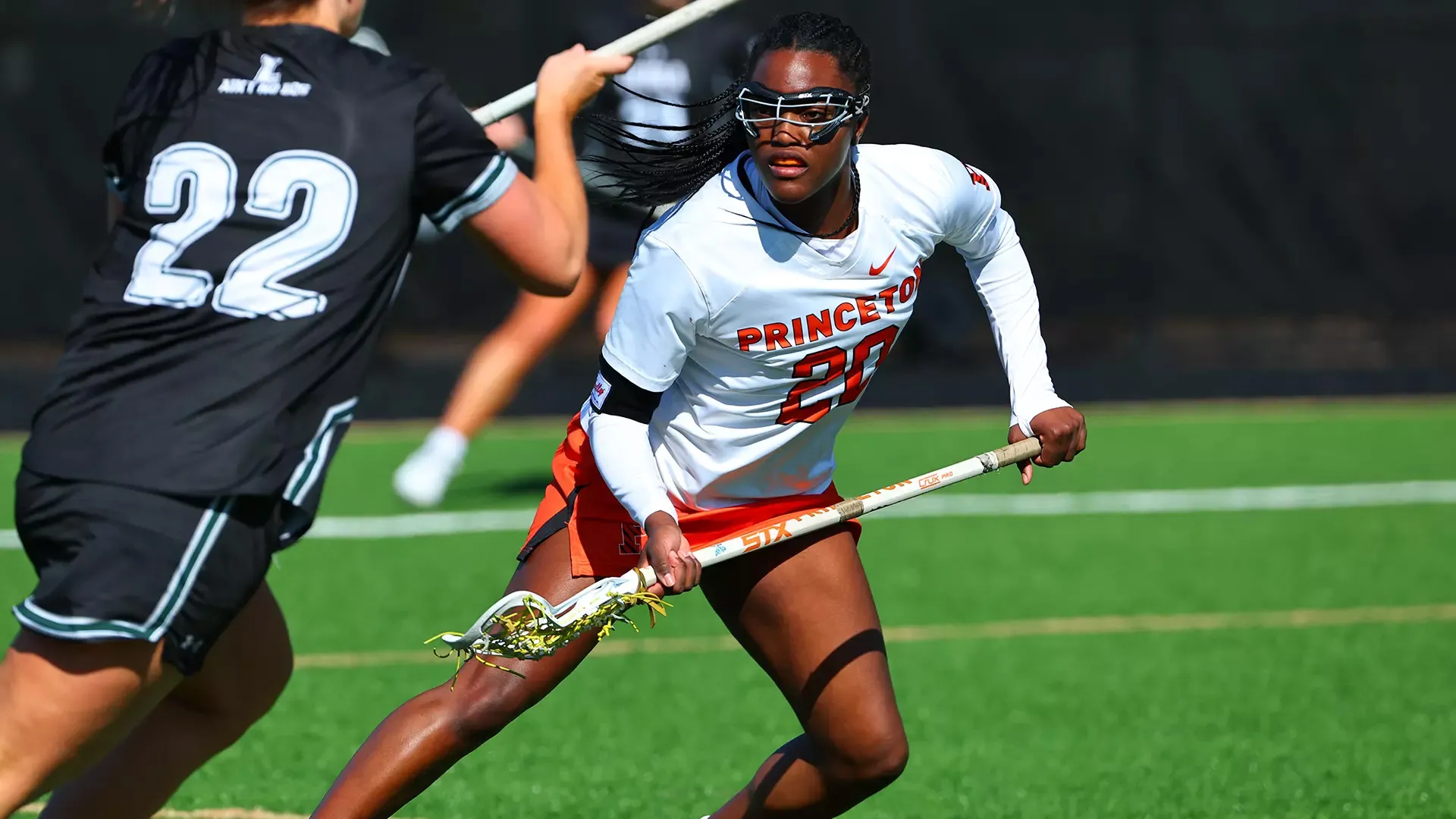
Dylan Allen started dabbling in sports from a young age — basketball (which her father, Samuel Allen, played at RIT) and soccer. She picked up a lacrosse stick at 4 years old and quickly progressed from running the wrong way on the field (like every preschool athlete ever) to showing an athletic prowess well beyond her peers.
When she looked for a Black athlete for inspiration, she found herself drawn to Serena Williams.
“She was one of the few Black women who was praised for her dominance in her sport, and I appreciate that,” she said.
But it was lacrosse, not tennis, that Allen couldn’t stop playing. She had to find her inspiration from within.
“Lacrosse wasn't the sport that I could look up to that many people, especially those who looked like me,” she said.
Certainly, other Black women have played lacrosse. But the inaccessibility of streams until recently made them harder to watch. And it doesn’t take eagle eyes to see that the sport has been predominantly white, though there are efforts to change that.
Today, young Black players can see themselves in Allen, a Princeton defender and captain. She ultimately found a role model in Natasha Blackburn, a former player at Ohio State who coached her in club ball. She didn’t know much about Blackburn’s history or playing style, but she admired her confidence.
“
Lacrosse wasn't the sport that I could look up to that many people, especially those who looked like me.
Allen quickly received a vote of confidence from Shannon Smith, the Northwestern legend turned Hofstra coach and the director of Long Island Top Guns girls lacrosse club. Around junior high, the Allen family travelled to Long Island for a clinic. Smith approached Allen’s parents and told them their daughter had the passion, lacrosse IQ and athleticism to go Division I.
The Allens were encouraged by what Smith said. Yet it ran starkly in contrast to what they faced at tournaments.
A referee once told Allen she could no longer score from inside the 8-meter after she poured in her seventh goal, something parents from both teams disagreed with. One coach never kept Allen and her Black teammate on the field at the same time. Other parents raised eyebrows then, too.
Other times, the adults were cruel. Samuel Allen recalled the whispers, looks and direct comments that his daughter was “Not that good.” She once switched from an “A” team to a “B” team to be around players who were nice to her.
“I can't really say much back because I turned into the angry Black man, so I'm handcuffed,” Samuel Allen said.
But he could say a lot directly to his daughter — and from a young age, he did.
“My dad taught me Black people in general, but Black women specifically, cannot afford to be mediocre,” she said.
It sounds harsh to those who haven’t walked a centimeter in a Black person’s shoes. But it’s a harsh reality for people who walk through life Black.
“As a Black person in America, we get the short end of the stick, regardless of what our qualifications are because of what we look like,” Samuel Allen said. “So, we always preach to her, ‘It’s really not going to help you to be just as good as your counterpart. You’re actually going to have to be better. You’re going to have to work harder just to get the same recognition.’”
Her parents recognized her struggle, having experienced it their entire lives. The hard truths were delivered with the promise that they’d remain a safe, secure and soft landing.
“My parents and my family, just as a whole, have been really supportive in my journey,” Allen said. “I always remember who’s here to support me, who has been here from the beginning and who will be here ’til the end. [That] has always been the way that I can carry on with lacrosse.”
Samuel Allen also urged his daughter with a simple but impactful message: “Don't let anyone else stop you from being great.”
“That mindset has probably helped me get to where I’m at now,” she said.
“
My dad taught me Black people in general, but Black women specifically, cannot afford to be mediocre.
Allen’s road to where she is now continued to have some bumps. Her recruiting cycle was affected by the COVID-19 pandemic. She also took two years off from club lacrosse in high school, though she played for Choate Rosemary Hall (Conn.).
“The sport of lacrosse, in general, is extremely expensive and it can be really difficult at times for your average working-class families to afford both tuition for school on top of club lacrosse,” Allen said. “I would go to my high school coaches and be like, ‘How do I get scouted? I can’t afford to pay for club lacrosse and this at the same time.’”
In the end, Allen answered her own question. She began emailing college coaches with film. Chris Sailer, then the head coach at Princeton, was the one who responded.
It was the middle of the pandemic, and there wasn’t much Sailer could do at the time, but she invited Allen to a camp the Tigers hoped to have when things got better.
Allen accepted the invitation. Restrictions were lifted, and Princeton held the camp. On the third day, the coaching staff made her an offer she would not refuse.
Allen recalled calling her parents and saying, “‘This is it. They want me. It’s over. I'm going to be a Tiger.’”
Her parents knew the recruiting process might be over, but the micro and overt aggressions around race and gender were not. Few universities have the best track record on race, and the Ivy League, some of the nation’s oldest institutions, have some of the most checkered.
“There were concerns,” Samuel Allen said.
They were worried about students who used the guise of free speech to excuse racism. The Allens discussed pushing their daughter to consider an HBCU more seriously. Kesha, her mother, attended one and had a different experience from her husband’s at RIT.
But they also knew that Princeton allowed their daughter to play for a top-10 lacrosse program that annually played well into May. So, the preparations began.
“We're like, ‘You’re about to go into adult life where there’s no parents involved anymore,’” Samuel Allen said.
Princeton was, at the very least, in the same state as the Allens’ New Jersey home. They’d be able to attend most of her games, and they have. Game day or not, her soft landings have always been just a phone call away.
But no parent can shield their Black daughter from the harsh realities of the unfair burdens faced by people for merely existing with darker skin. And Allen has carried them during her time at Princeton.
“The challenges of being a Black woman in this sport at this level are that you are quite literally overlooked and undervalued in every room you step in simply because of the way you look,” she said. “I can step into a classroom, be the smartest person in the room, but no one’s going to assume that I’m playing Division I lacrosse at Princeton University.”
These days, Allen is pushing back on the microaggressions as she confidently steps into her power.
“I take pride in knowing, ‘Oh, no one knows who I am. I will show you who I am,” Allen said. “I think that it’s fun, and it surprises people. It can hurt you, and it could challenge you. But it’s a good challenge and it’s definitely pushed me to be who I am today.”
And that challenge, along with the ingrained mindset that she always had to be two cuts above her peers, prepared Allen well for another (and, in her case, contradictory) standard for Princeton student-athletes.
“At Princeton or any Ivy League, you’re expected to be your best on and off the field at all times,” she said. “And you’re probably not going to always be able to do that, but you are giving your 110 percent in everything you’re doing.”
The all-out effort has paid off. She gradually worked her way up the Tigers’ depth chart: 11 appearances and three starts as a freshman, 15 appearances and six starts as a sophomore.
“I just was so shocked that I even got recruited by Princeton in the first place, so I was like, ‘I'm happy I get to wear the P on my chest,’” Allen said. “Then, slowly, I realized, ‘Oh, I’m actually a great player myself, and I can become even better just by being around those who want to be great.’ I wasn’t coming in as the top recruit in the country. That wasn’t my story. But when you get to play with the top recruits in the country, you get pretty good yourself as well.”
The 2025 chapter of Allen’s story saw her make 20 starts and finish third on the team with 21 caused turnovers, helping Princeton claim the Ivy League regular-season crown for the first time since 2022. She earned third-team IWLCA All-America and first-team All-Ivy League status.
“I cry all the time when I think about how well she’s doing, how well she’s managing her life at such a young age,” Samuel Allen said.
The Allens have plenty to smile about with their daughter now in her senior year. She’s a team captain and preseason All-American. The Tigers, ranked fourth in the most recent USA Lacrosse Division I Women’s Top 20, are favored to win the Ivy League and make another run in May.
“I’m in a position of more power this year,” Allen said. “Specifically, as a captain, I want to make sure that you know when I’m having maybe an off game, I’m not [going to let] that out on my teammates, especially for performing well as a whole. Our coach always talks about leaving a legacy behind. I want to come back to games next year and watch the [players] that I helped grow their game be great on the field.”
Perhaps Allen’s greatest legacy is the one she’ll give to the young Black girl watching in the stands or on a screen who, unlike her, can see their whole self in someone else.
“I hope my story shows that mental resilience is always going to outwork physical resilience,” Allen said. “That feeling of, ‘I don’t know if I belong,’ it makes you squirm a bit, but it can really push you to break a lot of boundaries. I want to create a legacy for myself, but I don’t want to be the only one who looks like me creating this legacy. I just want to be the start.”