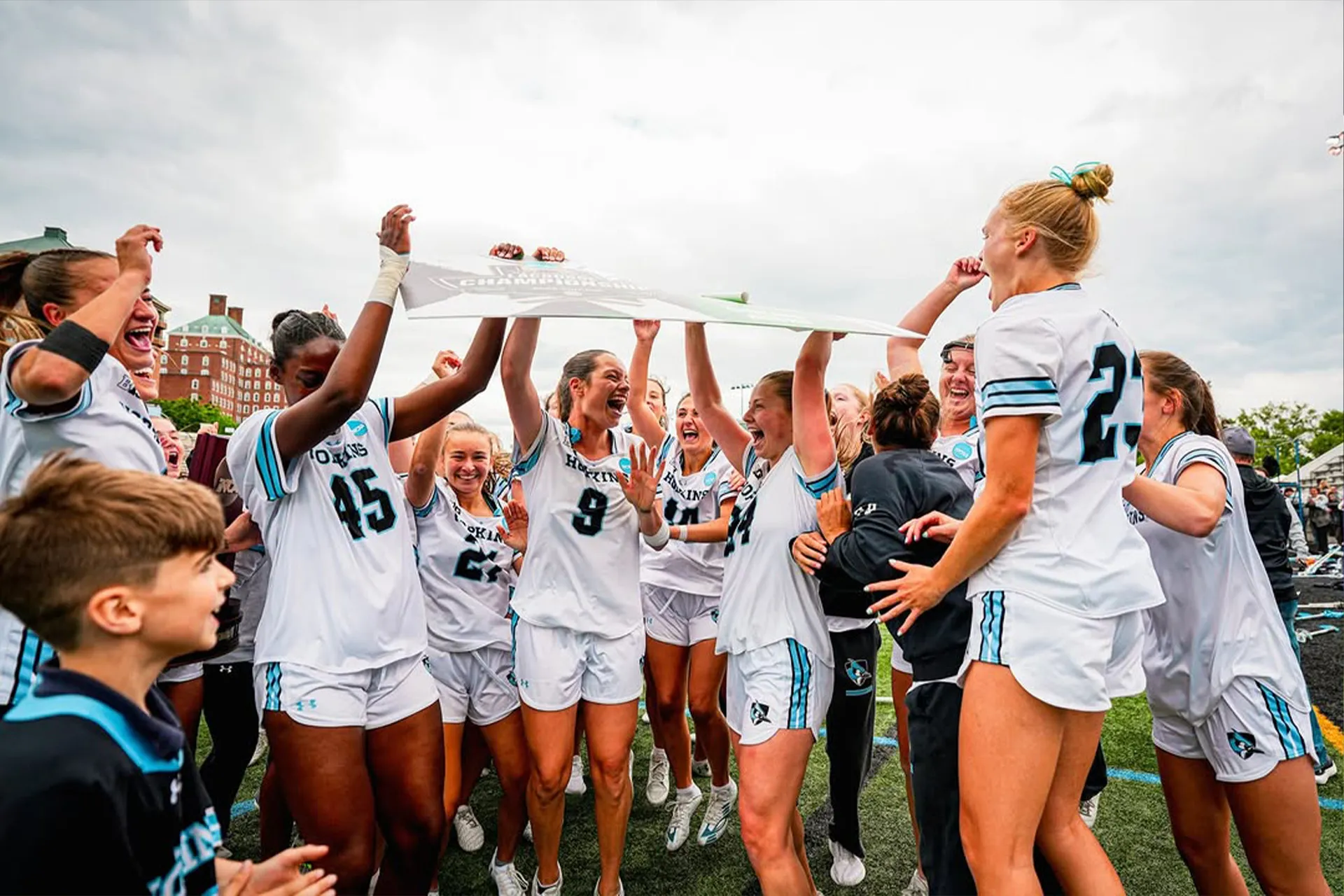
BALTIMORE — It’s not common in sports for both the winning and losing sides to feel a similar emotion at the conclusion of a game. After Thursday’s NCAA quarterfinal at Homewood Field, Johns Hopkins head coach Tim McCormack and Stony Brook head coach Joe Spallina felt shades of the same thing.
Disbelief.
Because in one second, everything can change. And one second is all Johns Hopkins held a lead for — but it was the most important one second there is in sports.
Stony Brook, which appeared well on its way to finally breaking through to the NCAA semifinals for the first time in program history, only had to clear the ball and kill nearly all the remaining 1:39 following a timeout.
Triple-teamed out of the huddle at her own endline, Isabella Caporuscio lost the ball when Reagan O’Brien poked the butt of her stick. Taylor Hoss controlled it and found Paige Willard, tying the score with 1:28 to play.
Lacey Downey won the draw for the Blue Jays, but with 37 seconds left, Julia Fusco caused a turnover and picked up the ground ball. The Seawolves cleared with 16 seconds left with a chance to win it.
Then O’Brien did it again, causing another turnover that was picked up by Downey with 10 seconds to go. Hopkins had no timeouts left, but McCormack had already told them what to do.
It’s what the Jays always do.
Push the ball.
The Jays played tic-tac-toe, letting the ball do the work to travel the length of the field. It landed in Ava Angello’s stick with a defender close by. Stony Brook slid, leaving Hoss open on the crease. Angello didn’t miss the pass. Hoss didn’t miss the shot.
“I was wide open on the crease and I was like, ‘Please, God, just let this go in,’” Hoss said.
Hoss buried the game-winning goal with just a second on the clock, and the officials let the lone second tick away without another draw. Johns Hopkins won 13-12 to advance to its first NCAA semifinal as a Division I program.
“No surprise that both of those moments, when you need it most, come from Reagan O’Brien,” McCormack said of the senior defender who set the NCAA’s all-time caused turnover record earlier this spring. “What a year. What an impact to have on your team.”
Johns Hopkins, a team often criticized for struggling to put together complete 60-minute efforts, needed every single second of Thursday’s 60 minutes to come from behind and dispatch a Stony Brook team that held an 11-7 lead when Caporuscio scored with 5:04 left in the third quarter.
A three-goal run got Hopkins back within a goal at 11-10, then Caporuscio scored on a woman-up possession to get the Stony Brook lead back to two.
Angello answered not long after. With 11:03 left, she converted a feed from Hoss to make it 12-11. Angello set Hopkins’ career goals record during the game. Hoss set the program’s single-season assists record.
With a one-goal lead and still more than 10 minutes to play, Spallina had to straddle using as much clock as possible while still taking advantage of offensive chances. The Seawolves had a few that came up empty.
After forcing a shot clock violation, Stony Brook cleared with 5:38 remaining. They worked the ball around until Caporuscio crashed through the defense and unleashed a shot to the lower-left corner. Ashley Langdon stuck out her right leg and deflected the ball off her shin.
It landed in the stick of Katie Walsh, who then tried a shot of her own. Langdon again got her body in front of it to deny the Seawolves’ scoring chance.
Those were the final two shots taken by Stony Brook the rest of the game.
That sequence was one Spallina wished his offense could have back.
“There was a play when we were up four. Their goalie made a really good save where she went across and dug one out. That would have put us up five,” he said. “Then those plays in the fourth quarter, that double-save sequence.”
Advancing through to the NCAA semifinals has long been Spallina’s white whale. He and the Seawolves have come oh, so close several times during his 15-year tenure. A loss like Thursday’s felt eerily similar to the one suffered by the Seawolves in the 2017 quarterfinals against Maryland in College Park, which also saw Stony Brook fall 13-12 after leading 11-7 with under 15 minutes to play.
Stony Brook led 11-8 in the 2018 quarterfinals with 15:59 left before losing 12-11 to Boston College. The Seawolves had North Carolina on the ropes in 2021’s quarterfinal with an 11-9 lead and 8:41 to go. They lost 14-11. In 2022, Stony Brook held a 4-3 halftime lead on UNC in the quarters but lost 8-5.
Somehow, after all those heartbreaks, Thursday’s might be the worst of them all. Because Stony Brook had never been closer than this.
“It’s a heartbreaker. There’s no other word for that,” Spallina said. “They played their guts out. … This is one I’ll take to my grave with me.”
He thinks the athletes will, too.
“I don’t think you’re an athlete if you live through that and don’t carry it with you,” Spallina said. “That’s a scar. That’s one that digs deep.”
Hopkins, on the other hand, saw their disbelief turn into elation as players slapped the “Johns Hopkins” sticker onto the next stage of the bracket and took pictures with a “Chicago Bound” sign provided by the NCAA.
McCormack, who took over the program from legendary head coach Janine Tucker prior to the 2022 season, inherited a team in need of an identity but one with strong backing. Tucker stayed close by and has been a resource for McCormack, helping rally the alumni around what he and the Jays have tried to build since he took the job. She was at the game Thursday.
McCormack’s intentions for the team were always clear. He wanted to play creatively and fast. He wanted to use transition as a weapon. Most importantly, he wanted to build belief in a program that hadn’t reached a new level since transitioning to Division I in 1999.
“I’ve got to give Janine Tucker immense credit for providing us the roadmap to say to [the alumni], ‘Trust this. Believe in this group,’” McCormack said. “To give that nod, words can’t describe it.”
In the program’s 50th year and on its home turf, Johns Hopkins made history. And it lived up to the name it made for itself in 2025, a name that spawned from the Blue Jays’ penchant for close games.
Eleven of their 41 games, or 26.8 percent, since the start of last season have been decided by one goal. They’re 8-3 in those games.
“We don’t get called the Cardiac Jays for nothing,” Angello said. “We love a little excitement.”