
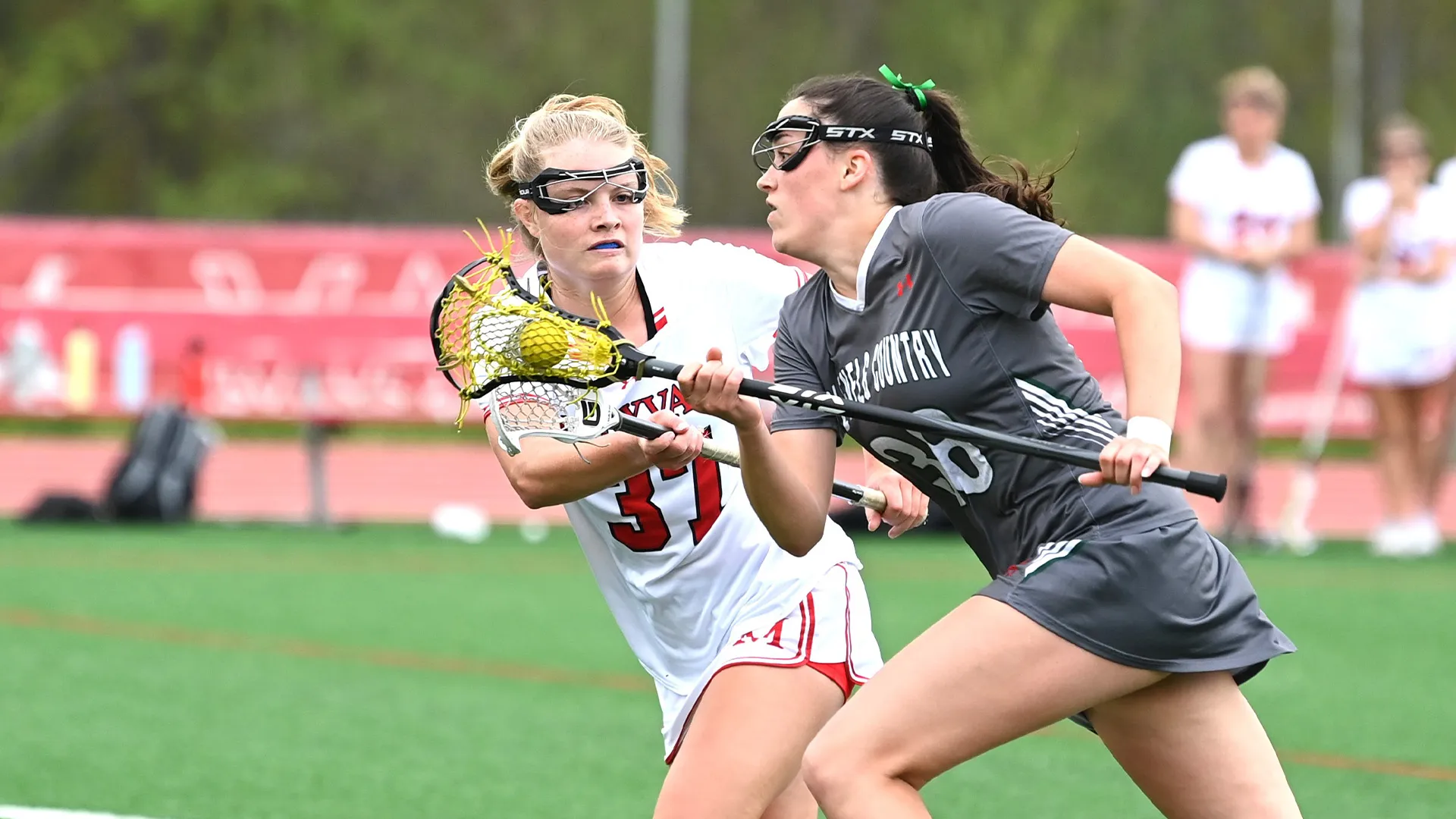
The USA Lacrosse Rules Committee, working in conjunction with the National Federation of State High School Associations (NFHS), has announced the girls’ lacrosse rule changes and points of emphasis for the 2026 season.
Key rule changes include the following:
Rule 2-4-5 — Stick checks may be requested at any point during a quarter break, halftime, a team timeout, prior to the start of an overtime period, prior to the start of a draw, and immediately following goals in regulation and overtime periods.
Rule 2-8-3 (NEW) & PENALTY — No on-field player can wear an audio or video device during the game.
Rule 4-3-3d, e — If a possession timeout is called when the goalkeeper has possession of the ball in the goal circle, play will resume at the closest dot and any player may restart play.
Rule 5-2 PENALTY 1 — When one player draws illegally, the free position may be taken by any player on the opponent’s team at the spot of the ball
Rule 7-3 PENALTIES 1a, 3a — When a goal circle foul is committed, the offending player shall move 4 meters away from the player taking the free position instead of behind.
Additionally, points of emphasis have been identified for both high school and youth play for the 2026 season.
Points of emphasis for high school include:
- Identifying and Managing Fouls During Scoring Plays
- Due to the risk of unsafe play, officials need to see and call fouls by both offensive and defensive players.
- Efficient Draw Administration
- With the intent of keeping the game moving, officials will encourage players to move promptly to the draw position after goals and to quickly make stick exchanges. Penalties will be assessed to uncooperative players who slow down the draw set up and delay the game.
- Delay of Game and Use of Green Card
- Officials will prioritize minimizing delay of game situations, including common violations such as defenders failing to promptly move 4 meters from a free position and teams not returning promptly to the field after a timeout or end of quarter.
“One of this year’s points of emphasis is identifying and managing fouls during scoring plays,” said Liz Brush, manager of officials’ development at USA Lacrosse. “Often when players are heading to goal, they are in a high traffic area of the field and both attackers and defenders are intensely focused on their objective, to either score or stop the opponent from scoring. These two aspects of the play can create higher risk for dangerous play, and officials should have an awareness of common fouls in these situations, by both the attacker and defenders.”
Points of emphasis for youth include:
- Treatment of Officials
- Disrespectful and inappropriate treatment of officials remains a persistent issue, particularly at youth games, where the impact is most damaging. Poor sportsmanship, verbal abuse, and harassment directed at officials by coaches, players, or spectators will not be tolerated. Such behavior directly contradicts the values we aim to instill in our athletes: integrity, respect, and fair play. USA Lacrosse is committed to fostering a safe and positive environment for everyone involved in the game. That begins with holding everyone accountable for how they treat those who uphold the rules.
- Illegal Stick to Body Contact
- Proper and safe use of the crosse is essential to minimizing player risk and preserving the integrity of girls’ lacrosse as a sport played with limited protective gear. Players must not use their stick to initiate contact with an opponent’s body by hitting, pushing, or displacing them. Coaches should reinforce this with their athletes, as officials are responsible for identifying and penalizing illegal stick-to-body contact in accordance with the rules.
- Officiating 3 Seconds, Good Defense
- This rule applies to a player with the ball. If the offensive player with the ball holds it for more than three seconds while being closely guarded, the whistle will blow, and the ball will be turned over to the defender. To be considered “closely guarded,” the following three conditions must be met:
- The defender is within a stick’s length of the offensive player with the ball
- The defender has both hands on their stick
- The defender is in a position to legally check the ball carrier, if checking were allowed at that level of play
- For the offense, this rule encourages the development of stick handling skills like cradling, changing hands, and moving with the ball to avoid the foul. For defenders, it provides an opportunity to be rewarded for their hard work and proper positioning. While this rule is often confused with the "3 seconds in the 8M" defensive foul, the key difference is that the "good defense" rule applies to the player with the ball, while the "in the 8M" foul applies to a defender who is in the 8-meter arc without guarding an opponent.
- This rule applies to a player with the ball. If the offensive player with the ball holds it for more than three seconds while being closely guarded, the whistle will blow, and the ball will be turned over to the defender. To be considered “closely guarded,” the following three conditions must be met:
- Officiating Forcing Through
- The rule regarding “forcing through” is frequently misunderstood and misapplied by officials. “Forcing through” is a major foul that occurs when a player in possession of the ball attempts to force their crosse through the crosse of one or more opponents. This is distinct from a charging foul, which involves a player using their body to charge or push an opponent’s body or crosse. Importantly, forcing through is a foul committed by the attacking player and must be called against the offensive team. Defenders who are in a legal position should not be penalized when an opponent initiates contact by forcing their crosse through the defenders’ crosses.
The rules of the game are designed to do two things — promote fair play and keep players safe. USA Lacrosse is committed to constantly reviewing and updating the rules of the game to ensure that those goals are always satisfied.
USA Lacrosse writes and publish a stand-alone youth rule book for ages 14U and below, and works in collaboration with the NFHS on the rules for high school girls' lacrosse.
For questions, interpretations or suggestions about the USA Lacrosse rules, please contact girlsrules@usalacrosse.com.