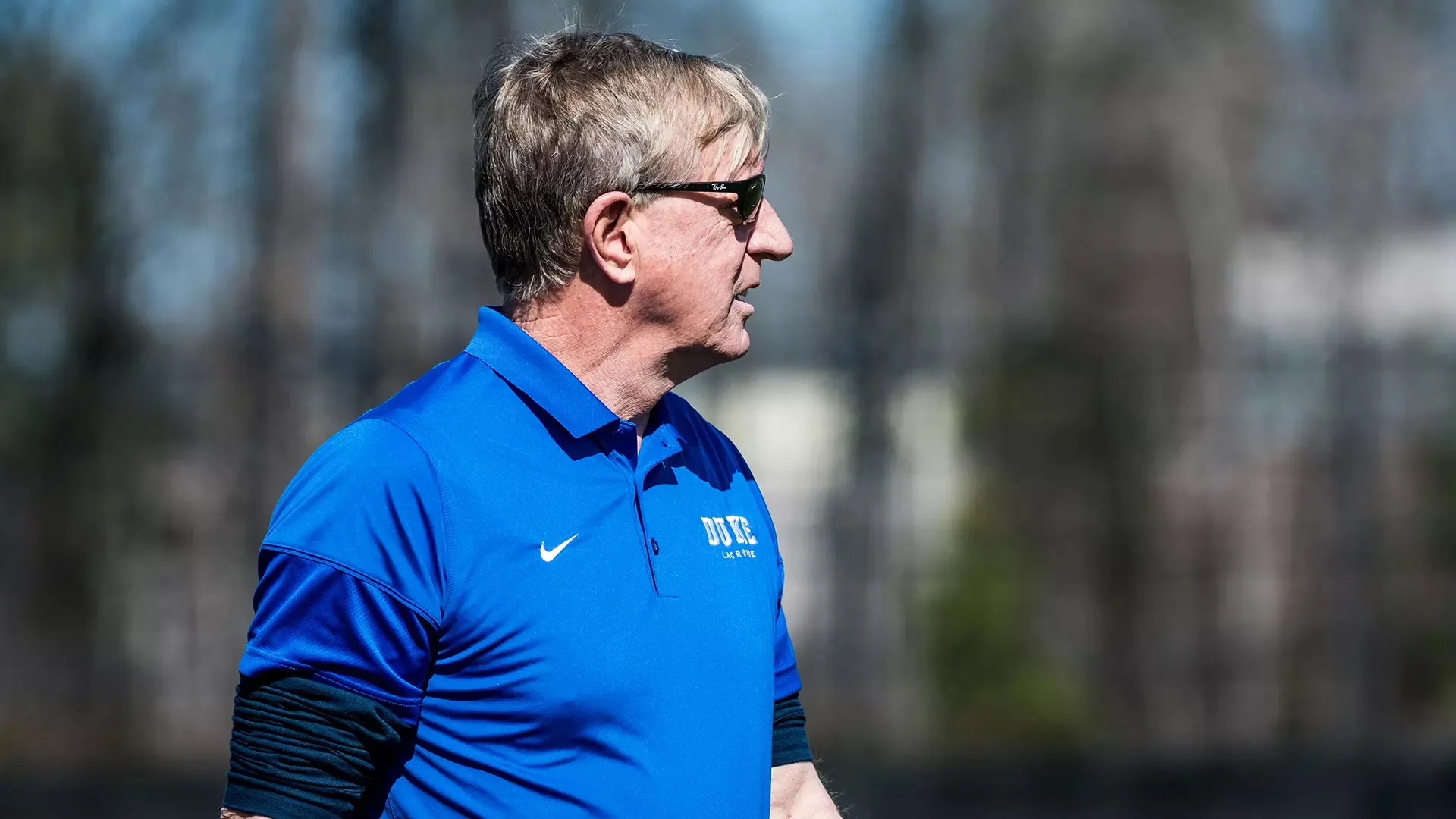
When the recruiting dead period hits Wednesday for men’s lacrosse and Thursday for women’s lacrosse, it could give college coaches a little extra time to digest and strategize around the latest NCAA rule change.
“It’s something that we’ve been discussing,” Duke men’s coach John Danowski said, “and all the ramifications and all the possibilities are really endless.”
Last Wednesday, the Division I Cabinet meeting concluded after resetting the rules to allow up to five years of eligibility over five years for student-athletes enrolling in college in the academic year after they turn 19, or sooner. It was adopted to limit redshirting, waivers and exceptions and to bring more uniformity to athlete eligibility.
“In the evolution of the NCAA, one of the better things that’s occurred is that we stopped painting everybody with the same brush,” Notre Dame men’s coach Kevin Corrigan said. “And then we went back and did it in this thing. This is a football and basketball issue that they turned into an everybody issue.”
Simplifying the rules, offering potentially higher educational opportunities while finishing their college playing careers and in essence opening the door for players to return from injury midseason without costing them a season of eligibility are all positives.
“There’s kids that may be slowly returning from injury that you could play now to get some experience under their belt without kind of blowing a year of eligibility,” Maryland women’s coach Cathy Reese said.
But there are also new unintended consequences. On the heels of the implementation of last year’s House settlement legislation, the new “5-in-5” rule has coaches trying to sort through several freshly raised questions with it going into effect immediately this fall.
“I’m sure everyone’s trying to do the same thing, but a lot of it is still unknown,” Reese said. “I think the unknown pieces are just how they’re going to handle those roster limits that are in place.”
“
In the evolution of the NCAA, one of the better things that’s occurred is that we stopped painting everybody with the same brush. And then we went back and did it in this thing.
The NCAA is not offering any relief on the roster limits of 48 for men’s and 38 for women’s programs that opt into the House settlement guidelines at this moment. The NCAA also has so far not offered the sort of designated student-athlete label that it created to preserve eligibility for student-athletes that had to be cut from a program’s roster to meet the new limits in 2025.
Now with this upcoming year’s college seniors eligible for another season beyond 2027 and the high school players already committed, coaches are fearful they’ll have to make cuts.
“We never have,” Corrigan said. “And now between the roster limits and the fifth-year thing, I don’t know any way we’re going to avoid it in the next couple of years.”
It’s one of the biggest problems with the rapid implementation of the new rule. For a sport like lacrosse that recruits two years out, it’s a short window of time to reduce class sizes. They’ll be offering high school Class of 2028 student-athletes in early September.
“If we were recruiting seniors, we might be able to budget for it,” Duke women’s coach Kerstin Kimel said. “But given that we’ve got kids that have been committed for what will be two years, that could make things challenging if they don’t give us a way to be flexible with our rosters as this new legislation rolls out.”
It could even affect this year’s high school seniors.
“I’ve heard rumblings of some of the committed 2027s that teams have, they may let some guys go just to make the numbers work,” Maryland men’s coach John Tillman said. “And if those guys are committed, obviously that’s a tough situation for those guys to be in.”
It’s going to be a math problem. College coaches have already begun talking to players on their current rosters since everyone is eligible to stay for five years, asking their intentions so they can try to sort out how many roster spots they can expect to have each year to budget space and money.
“The only thing that I can relate to this is COVID when they gave everybody an extra year,” Boston U men’s coach Ryan Polley said. “We’ve had this model for years, and now all of a sudden, we’re shifting to five.”
The Class of 2028 is expected to see reduced opportunities to play at Division I lacrosse schools that opted into the House settlement roster limits. Teams with roster limits will have to lower their average number of players per class.
“You’re just going to reduce the number of kids you recruit every year,” Corrigan said. “Roster management is going to become really interesting, and it’s going to be hard because some kids are going to want to make a five-year decision coming in.”
Recruits could try to ask for five-year guarantees, and Corrigan expects that to be addressed player by player. Players will be eligible — not entitled — to a fifth year at their schools.
“We’ll see how different schools approach it and how people handle that because if you sign a kid to five years, then obviously you’re locked in and obligated to that, whether or not they’re contributing to your program or not,” Reese said. “So, some schools will probably change whether they do things year to year or four years or five years.”
“You love to have as many guys as possible stay an extra year just because you enjoy those guys and you’ve built relationships with them,” Tillman said. “But also, then it’s, ‘Well, now how are we going to manage all this?’ Do you have to pick and choose who can come back and who can’t? And that was problematic during COVID. I just feels a lot like that again.”
Five classes means deeper competition within teams and makes it more important for programs to select strong prospects and to develop them into contributors. Players will have to have more patience than ever.
“What it really kind of hurts,” Danowski said, “is it used to be that with four classes, if I’m coming as a freshman, all right, I can sit and wait a year and then by my sophomore year, I’m gonna get some playing time. And then my junior and senior year is when I’m really gonna grow into those roles, whatever they are. Well, now you’re talking about maybe sitting two years.”
It could further fill the transfer portal that is already feared to become even more popular with players having an extra year of eligibility across the board. Kimel worries that it’s going to become more transactional.
“You’re going to have everybody who’s going to be in that situation,” Corrigan said. “Every kid that doesn’t play for you is going to be in the situation of being able to say, ‘Well, if I can find somebody that wants me, I can play my fifth year and still kind of fulfill my obligation and get my degree from the school that I wanted to get my degree from initially.’”
Schools that did not opt into the House settlement could take advantage of having unlimited roster spots to bring in more players than other teams. Ivy League and Patriot League teams are in that boat, and they also tend to take few transfers.
“There’s an opportunity if your program can be known as one that’s not going to dive heavy into the transfer market, you’re going to recruit your kids, you’re going to develop them and give them an opportunity to go for five years,” Polley said. “I think that’s an opportunity.”
“
There’s an opportunity if your program can be known as one that’s not going to dive heavy into the transfer market, you’re going to recruit your kids, you’re going to develop them and give them an opportunity to go for five years.
Of course, the curricula is different at every school. Schools like Notre Dame and the Ivy League expect students to graduate in eight semesters. Duke permits nine. Tillman thinks that stretching out an undergraduate education over five years could help some students in majors that require higher credit loads at Maryland.
Schools, too, will have some say in what they can offer students. The Ivy League did not allow graduate students to compete athletically, even after the COVID year.
“We’ve got some grad programs that allow us to bring kids in the last few years and that our teams have used for kids who did have an extra year of eligibility from injury or whatever,” Corrigan said. “But it’s not going to be a thing where they’re going to say, ‘Hey, are you going to take four or five years to graduate?’ It’s going to be like, ‘No, you’re going to graduate in four years, and we can figure out what that fifth year looks like.’”
Changing interests and plans only add to the difficulty of mapping it out. It’s all part of an academic side that will take on new strategic planning around whether students want a fifth year of school, whether their same school offers continuing education or advanced degrees, and whether they offer studies beyond their undergraduate degree in a field of interest.
“There’s a lot of young men and women that four years, and they’ve had enough of college, they’re ready for the real world,” Danowski said. “And there’ll be some that want to play another year, and there’ll be some that want to go to school and play.”
Entry into college could be pushed back for some high school graduates asked to consider a post-graduate year — a potentially expensive proposition — if they won’t turn 20 before enrolling in college. In some instances where colleges limit undergraduate semesters, college students could take off a fall semester, then return to classes and the team in the spring for a season of eligibility.
It’s happened at Ivy schools in instances like Cornell’s CJ Kirst and Penn’s Sam Handley, and it could be a way for players only interested in completing an undergraduate degree to play for a school and remain under its maximum semester limits.
“To me, that’s the antithesis of team building,” Danowski said. “You build your team, your culture, your group dynamic in the fall.”
There’s also a financial piece of it. Programs may not be able to support a player’s fifth year or graduate studies. And for a family, asking to pay for another year of college in an era when some schools are exploring three-year undergraduate options to reduce the costs of higher education seems tone deaf.
“It’s going to be a big shift in our culture and our mentality for kids who want to play Division I collegiate athletics,” Kimel said. “And I think that’s going to be interesting to see when you’re 16 years old right now, if you’re thinking five, six, seven years ahead.”
Continuing a line of communication about future plans will be a yearly conversation for every player in a program and its recruits. It might be the most important part of the puzzle as coaches and players navigate who wants to stay for a fifth year, what sort of education is desired, and how to support their plans financially.
“It’s going to be the challenge of making sure that you and your players and the parents and the people at your school and their grad programs and everything else are always kind of well aware of what’s going on,” Corrigan said, adding, “Your expectations have to match those of your recruits and their parents.”
It’s all happening quicker than coaches would like. The latest rule change by the NCAA is going into effect within two months. Programs, coaches and players will have to adjust to the new norm. How each handles the changes will be closely followed, as will their impact.
“It’s going to be very fluid,” Polley said. “And I think we’re just going to try to have as many direct and open conversations that we have and be up front with people in the beginning that this isn’t going to be perfect. This is all new to us, and we’re managing a lot of different people and families and situations. And we’ll try to be as fair as we can to everyone and be up front and be transparent and do the best we can at managing something that has a lot of moving pieces.”