
It’s time to look ahead 2027, even if next season’s first lacrosse game is more than six months away.
USA Lacrosse Magazine will spend the week counting down a far-too-early top 25(ish), continuing today with, continuing today with five NCAA tournament teams hoping to make it to the season’s final weekend after not doing so last spring.
10. YALE
2026 record: 9-6 (4-2 Ivy League)
Last seen: Falling a goal shy at the Dome of forcing overtime against Syracuse in the program’s return to the NCAA tournament after a two-year postseason hiatus.
Projected starts lost: 53 of 150 (35.3 percent)
Projected scoring departing: 42 of 289 points (14.5 percent)
Initial forecast: Yale had a bit of a throwback team last spring, clearly not on the level of its 2018 national champion and 2019 runner-up squads but undeniably intriguing. With only a handful of proven options, the Bulldogs pinned down the last at-large spot in the field and had a host of untested players blossom throughout the spring.
Junior Connor Gately (25 goals, 32 assists) and the Ivy League’s 2026 Rookie of the Year Sean Grogan (30 goals, 21 assists) are going to be the headliners, though there’s an abundance of continuity. Yale’s top six scorers are set to return. So is goalie Ben Friedman, who wasn’t at his best against Syracuse but stopped more than 50 percent of the shots on net in eight of his previous nine games and finished his sophomore year with a commendable 54.2% save percentage.
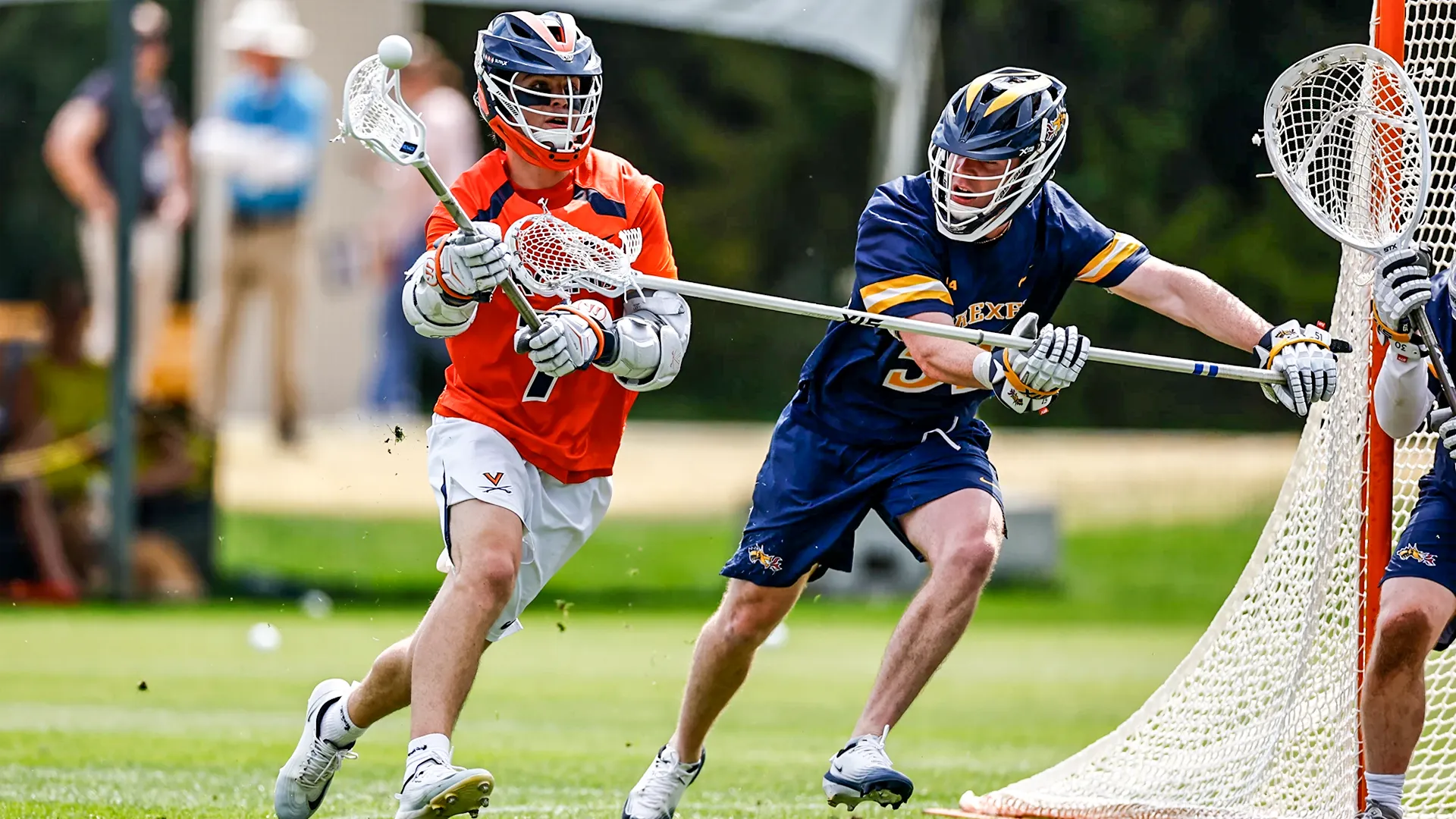
A big question the last few years was whether the Bulldogs could regain the defensive verve from their peak years almost a decade ago. Yale took a major step forward on that front, but also graduated all three starting defensemen. If there isn’t much drop-off from their replacements, a return to Memorial Day weekend isn’t out of the question. The Bulldogs took a big leap this spring, and might have another in them in 2027.
9. VIRGINIA
2026 record: 10-7 (2-2 Atlantic Coast)
Last seen: Spending much of a 14-10 NCAA tournament first-round loss to Georgetown throwing the ball away and a chunk of the fourth quarter jumping offsides in what proved to be former coach Lars Tiffany’s swansong in Charlottesville.
Projected starts lost: 41 of 170 (24.1 percent)
Projected scoring departing: 89 of 402 points (22.1 percent)
Initial forecast: Offensive coordinator Kevin Cassese was promoted eight days after the school announced Tiffany’s departure, and he’ll have a lot of familiar faces to work with.
Six of the seven Cavaliers with double-digit points are back, including brothers McCabe Millon (31 goals, 46 assists) and Brendan Millon (34 goals, 43 assists), fifth-year options Ryan Colsey (36 goals, 10 assists) and Joey Terenzi (14 goals, 12 assists), the fast-emerging Ryan Duenkel (20 goals, 11 assists) and senior Chase Band (16 goals, five assists).
The entire close defense is set to be back for new coordinator Chris Feifs, with fifth-year John Schroter once again serving as Virginia’s top cover guy. Goalie once again appears to be an area of uncertainty, with Kyle Morris (42.9% save percentage) going in and out of the portal after going in and out of the starting lineup last season and former Syracuse reserve Michael Ippoliti (57.7% save percentage in eight games over the last two years) transferring in.
But the big puzzler with the Cavaliers is this: Can they be the best version of themselves more frequently? Optimal Virginia was more than a handful in 2026; just ask Notre Dame. Does a team that loses only two starters (attackman Truitt Sunderland and goalie Jake Marek) become steadier with experience, or will the Cavaliers be a difficult-to-predict bunch like this past spring?
That variable, along with any philosophical shifts that come with a coaching change, makes Virginia one of next season’s most intriguing teams yet again.
8. GEORGETOWN
2026 record: 11-5 (5-0 Big East)
Last seen: Uncorking the most disappointing of its four consecutive NCAA quarterfinal losses with a lethargic showing in a 16-6 loss to Duke.
Projected starts lost: 35 of 160 (21.9 percent)
Projected scoring departing: 114 of 341 points (33.4 percent)
Initial forecast: The Hoyas keep hitting the wall in the quarterfinals, which is why placing them somewhere between No. 5 and No. 8 feels like the fairest thing to do in this exercise. But the thing about annual quarterfinal losses is that it means Georgetown keeps winning games the first weekend of the tournament, bouncing Yale, Penn State, Duke and Virginia the last four years.
Clearly, the Hoyas have something good cooking, and plenty of it happens on the defensive end. That should be a strength next year, with defenseman Ty Banks (team-high 23 caused turnovers) and goalie Anderson Moore (55.6% save percentage) both heading into their fourth years as starters and defenseman Robert Plath and long pole Evan MacFarland both coming off second team all-Big East seasons.
While finisher Rory Connor (54 goals, 14 assists) is gone after a grad year stopover on the Hilltop, his brother Liam (22 goals, 54 assists) has one more year and Georgetown still has three other 20-goal scorers in Jack Ransom (23 goals, eight assists), Jack Schubert (20 goals, 7 assists) and Kevin Miller (20 goals, three assists) as well as Jake Bickel (18 goals, 11 assists), the Big East Freshman of the Year.
It’s no surprise the Hoyas cleaned up on conference honors in a down year for the rest of the league, and they’ll have a real chance to win a ninth consecutive Big East tournament in 2027. That consistency doesn’t guarantee anything in the future, but it certainly makes discounting Georgetown a perilous course of action in the present.
7. JOHNS HOPKINS
2026 record: 10-6 (3-2 Big Ten)
Last seen: In Notre Dame’s rear-view mirror after the Fighting Irish dominated the second half of a 15-9 NCAA quarterfinal decision.
Projected starts lost: 16 of 160 (10 percent)
Projected scoring departing: 46 of 286 points (16.1 percent)
Initial forecast: The Blue Jays come off their third quarterfinal appearance in the last four years, and the ethos of the Peter Milliman era at Homewood is now plainly apparent. Hopkins is going to be a whole-is-greater-than-the-sum-of-the-parts team, and it is going to gain advantages through player versatility, patience that sometimes flirts with stubbornness and by doing everything possible to gain marginal (or better) advantages from roughly its 15th through 30th men on the roster vis-à-vis its opponents.
The Blue Jays don’t have many holes to fill besides the pole-commanding midfield spot occupied by Matt Collison (30 goals, 16 assists) the last four years. Five of the six offensive starters are back, a group led by Hunter Chauvette (40 goals, seven assists) and Chuck Rawson (24 goals, 16 assists), and the whole starting close defense unit (Carson Brown, Luke Martin and Quintan Kilrain) is back along with fifth-year goalie Oran Gelinas (52.5% save percentage).
Toss in some useful transfers — short stick Jameson Coffman (first team All-America East at UMBC), long pole Konrad Miklaszewski (second team All-Ivy at Yale) and Walter Zhao (Faceoff Specialist of the Year in the America East while winning 66.1% of his draws at Vermont) — and Hopkins might just have enough to push for its first trip to the NCAA semifinals since 2015.
6. CORNELL
2026 record: 11-5 (5-1 Ivy League)
Last seen: Falling in overtime at home in the first round of the NCAA tournament to Johns Hopkins, bringing a rugged conclusion to the Big Red’s title defense.
Projected starts lost: 53 of 160 (33.1 percent)
Projected scoring departing: 47 of 321 points (14.6 percent)
Initial forecast: Cornell’s 2026 season might have ended with a thud — a blowout loss at home against Princeton in the Ivy League final, followed six days later by a 9-8 setback against Johns Hopkins — but it followed a relatively predictable trajectory up until that point given the huge senior class that departed after the Big Red’s 2025 national title. After an uneven start, Cornell won eight out of nine, and in the process the next batch of Big Red stars settled into major and/or elevated roles.
Five of the Big Red’s six double-digit scorers are set to return, including Tewaaraton finalist Willem Firth (52 goals, 29 assists) and ace facilitator Ryan Goldstein (34 goals, 33 assists). Ivy League Midfielder of the Year Jack Cascadden (four goals, four assists, 62.7% faceoff percentage) is back for a fifth year, and goalie Matthew Tully (54.5% save percentage) is back with a full season of starting experience capped by a 17-save outing in the postseason.
Cornell’s defense was ahead of its offense early this spring, a situation likely to be reversed in 2027 with the graduation of defensemen Matt Dooley and Brendan Staub, long pole Eddie Rayhill and short stick Charlie Box. Nonetheless, the Big Red will be well-equipped to outscore most foes if need be, and the famed Cornell culture is a good bet to accelerate development and cohesion. Bank on Ithaca being home to a serious threat to reach Memorial Day weekend.