
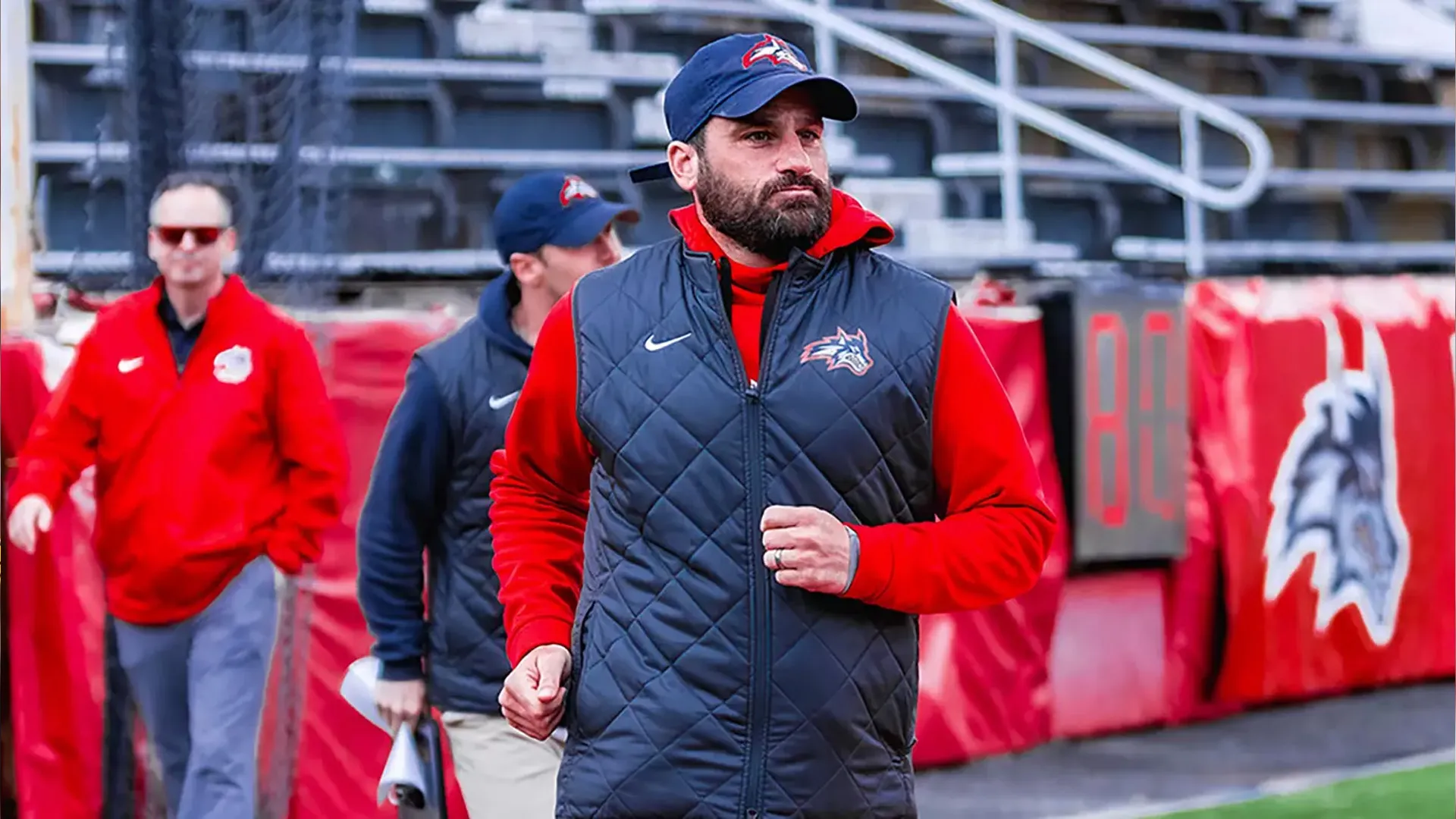
Anthony Gilardi mischievously considers himself “an agent of chaos,” the sort of man more likely to embrace a family vacation at a hectic theme park instead of a leisurely week at the beach.
The ability to adapt to constant change and unpredictability turned out to be a keystone job requirement in Gilardi’s seven seasons as Stony Brook’s head coach. And it’s been exceptionally valuable this spring as the Seawolves constructed an unconventional coaching staff and helped a youthful team blossom at the right time.
Stony Brook will make its fourth NCAA tournament appearance thanks to Saturday’s 13-11 victory at Towson, where Gilardi worked for eight years as an assistant before returning to his native Long Island. The Seawolves (10-5) visit Marist on Wednesday night, with the winner earning a trip to top-seeded Princeton on Sunday.
“We had so many great teams here,” Gilardi said while standing in a hallway he’d undoubtedly passed through hundreds of times at Towson less than an hour after Stony Brook earned its first postseason trip since 2012. “Just like when we were here, it just felt like it was meant to be.”
In both the broad sweep of Gilardi’s tenure and just a look at the last year, it probably wasn’t easy to see to coming. Then again, no one could have guessed what was lurking around every corner over the last seven years.
It would be challenging to dwell on any prior season when they were all unusual in their own way. At least the first two — Covid-shortened 2020 and the pandemic protocols of 2021 — affected everyone.
By the next season, the Seawolves knew they would be on their way to the CAA, and America East rules dictated they would be ineligible for the conference tournament. Stony Brook went 9-5 anyway, despite knowing from the start a postseason berth was unlikely.
The jump up to the CAA went relatively smoothly, with a trip to the league final in 2023. But injuries ravaged the Seawolves the following spring, and everyone in the program figured 2025 would be something of a rebuilding year. They were right; Stony Brook went 7-7, lost five games by a combined six goals (and three in overtime) and missed the CAA tournament.
“We just always felt like we’d been dealt this weird hand,” offensive coordinator Mike Chanenchuk said. “It’s like, ‘This isn’t normal. Just give us a normal year’. I give [Gilardi] a ton of credit. He’s very level-headed. Sure, it’s been super chaotic, but he comes in every day and in a great mood and it’s fun to work here. We could be dealt the worst hand, and it’s, ‘Next play, next step, let’s figure it out.’ I think karma kind of comes around. We were just waiting — ‘When are we going to catch a good break?’”
This year brought its own quirk, albeit one delivered early. J.P. Brazel, the Seawolves’ defensive coordinator the previous six seasons, took a leave of absence last summer and ultimately stepped away from college coaching.
The timing was unusual, and compounded by the fact Gilardi was half a world away, working as an assistant to his old boss Shawn Nadelen as part of the United States’ run to a silver medal in the U20 World Championship in South Korea.
As part of the scramble to find a solution, he came across the Instagram page of former Boston University defenseman Quintin Germain. So Gilardi reached out to Chanenchuk, who has worked at Stony Brook during Gilardi’s entire stint.
“I said, ‘Mike, I’ve found this guy, I’ve seen Q coach once on a club team. Do as much as homework as you can in the next 24 hours. I’m going to call you back tomorrow,’” Gilardi said. “Which is now like the next day that time, so now the time zone’s messed up. I like what he’s doing, he’s young. I need someone who can do skillwork.”
Germain spent four-and-a-half years working in commercial real estate after graduating from college, but he’d done some training and club coaching on the side to both make some money and give back to the sport. He made a career change in November 2024 to become a full-time trainer and helped out at Smithtown West the following spring.
It appeared he would return to Chaminade High, his alma mater, as a junior varsity coach this year. Then the call from Stony Brook came.
“I just wanted to be a coach, knew I wanted to give back, knew I wanted to be that mentor, that person who players could reach out to and connect with because I really didn’t have that growing up,” Germain said. “As great as my coaches were, I had that in college, but not growing up, that person I could reach out to, lean on for advice. That was my biggest reason for making the change one day, just decided that’s what my calling was for the rest of my life, and then coach Gilardi gave me the opportunity of a lifetime and it was hard not to take it.”
With Germain on board to help Gilardi with the defense, there was just one small detail to iron out: Gilardi, an attackman since fifth grade and an offensive coach his entire career, had to teach himself a lot about defense.
“I’m watching all this film,” Gilardi said. “Luckily our sport is awesome. I’m calling buddies of mine that coach defense. I call Nads and say, ‘What’s this defense thing? How do you do this?’ And I say, ‘Oh, we get an extra guy, this is easy. You D guys complain, but we have seven guys and they have six offensively.’”
The final piece of an unconventional coaching staff came together in January, when former Tufts and Brown coach Mike Daly joined the program. Daly spent last season as the director of player development at Maryland, and Gilardi gave him a flexible portfolio.
Daly’s job wouldn’t be to work with the offense or defense, but instead half-jokingly dubbed him the Seawolves’ winning coordinator.
“The first practice he comes out, and he’s just taking notes and I’m like, ‘What the heck is this guy doing?’” Gilardi said. “We sit down after practice and I say, ‘Coach, what did you think?’ ‘We have to line our sticks up this week.’ He just goes through a process of winning, and it’s super-simple to sound out and talk about. … He brought three drills that we do all the time and he says it all the time: ‘The mundanity of excellence.’”
Achieving that excellence had to wait. Stony Brook opened with a 16-11 loss, then fell at home to a Rutgers it beat the previous year. Virginia delivered a 19-7 pounding the following week to drop the Seawolves to 0-3.
On the surface, it might not have seemed promising. But Gilardi was unbowed, sensing the ingredients were in place for a turnaround.
“I know we’re close, and it didn’t feel like it at times, but we’ve been on 0-3 teams before or 0-and-whatever who have a million meetings,” Gilardi said. “We didn’t meet one time. No one was worried. We were like, ‘We have to play our best lacrosse.’”
It helped to get back Robbie Smith from a pulled hamstring that cost him the first five games. The senior captain has won 54 percent of his draws since returning.
An offense with a deep well of options helped, too. Juniors Collin Williamson (35 goals, 17 assists) and Justin Bonacci (29 goals, 16 assists) are mainstays, and clever midfielder Kian McCoy (20 goals, 22 assists) was the team’s lone first-team all-CAA pick, but the Seawolves have 11 players with at least 10 points and have a six-man group that has rotated in on their second midfield.
“The leadership is everywhere, whether it’s on the bench, the starters, wherever it may be,” Smith said. “We were able to build off that. We didn’t let anything get to us. We started off 0-3, but we won eight out of the last 10, avenged two of our losses. That just shows the character and the type of guys that are at Stony Brook.”
The strength of the team, though, turned out to be the Germain-led defense. Tommy Wilk heads into the postseason with a .547 save percentage. Junior defenseman Ryan Dodge did stellar work in containing Towson star Mikey Weisshaar for much of the league final.
Then there’s the rope unit of long pole Kyan East, who originally committed to VMI and was the CAA’s co-rookie of the year, along with short sticks Will Birney and Mount St. Mary’s transfer Brian Bradley.
“We always preach to them that the plan doesn’t have to be perfect, but as long as we’re on the same page and we’re connected and we’re going full speed and not hesitating, good things will happen,” Germain said. “That was kind of our mantra the whole year.”
By the time Stony Brook arrived at the conference tournament, it had won four of five. Gilardi compared the semifinal slugfest against Drexel to the Balboa-Drago fight in Rocky IV. (“I’m like, ‘This is old-school stuff,’” he said. “No one’s won more old-school CAA games than me, right? We’re going to win this thing 6-5.’” The Seawolves managed to get it to 9-7.)
Two days later, Stony Brook built a five-goal lead in the first half against Towson. The Seawolves stretched it to six when Bonacci beat the buzzer at the end of the third quarter. But then Weisshaar rattled off three consecutive goals, and Gilardi burned through his timeouts with 8:25 to go.
“It just became carnage,” Gilardi said. “I said, ‘You know what, guys? This is how we win this game. If it’s pretty and Weisshaar keeps doing that stuff, they’re going to win. If we just keep the ball on the ground and hitting each other, picking it up, getting up when we get knocked down, we’ll get it.”
The closing minutes were a veritable to a gritty-not-pretty mentality. But Weisshaar didn’t take a shot in the last eight minutes, and Stony Brook scraped together a 13-11 victory to punctuate this portion of the program’s climb.
“You remember that look on the kids’ faces when they’re running from the dogpile forever,” Gilardi said. “I’ll be on my deathbed thinking about that, the first championship that we had and Robbie Smith and Tommy and Will Birney, whose dad passed away suddenly two years ago. These kids have been through a ton.”
And so has Stony Brook, seemingly a magnet for weird season arcs — even this one. The Seawolves didn’t arrive back in the postseason by following a smooth script.
It goes down as an apt development for a program whose course has defied predictability.
“It’s been chaotic, but over those years, it’s kind of helped us ground ourselves,” Chanenchuk said. “Now, something crazy happens and we’re like, ‘All right, whatever. Yeah, sure, we’re fine. On to the next one.’ We kind of caught of a good break where we haven’t seen any crazy injuries this year. I think that final karma, good juju, finally came around. It’s been pretty cool.”