
The value of the Long Orange Line is ingrained in Chad Palumbo and all his Princeton teammates.
The alumni from college lacrosse’s team of the 1990s reach out all the time to talk, show support and offer a connection to a time when the Tigers won six national titles in a span of a decade.
At halftime on Memorial Day, the outreach was tangible. The NCAA annually celebrates the 25th anniversary of a Division I champion during the national title game. So there were Princeton’s stars from 2001, all now well into their 40s, being feted at halftime and waiting to deliver high-fives as the present-day Tigers burst back out of the locker room.
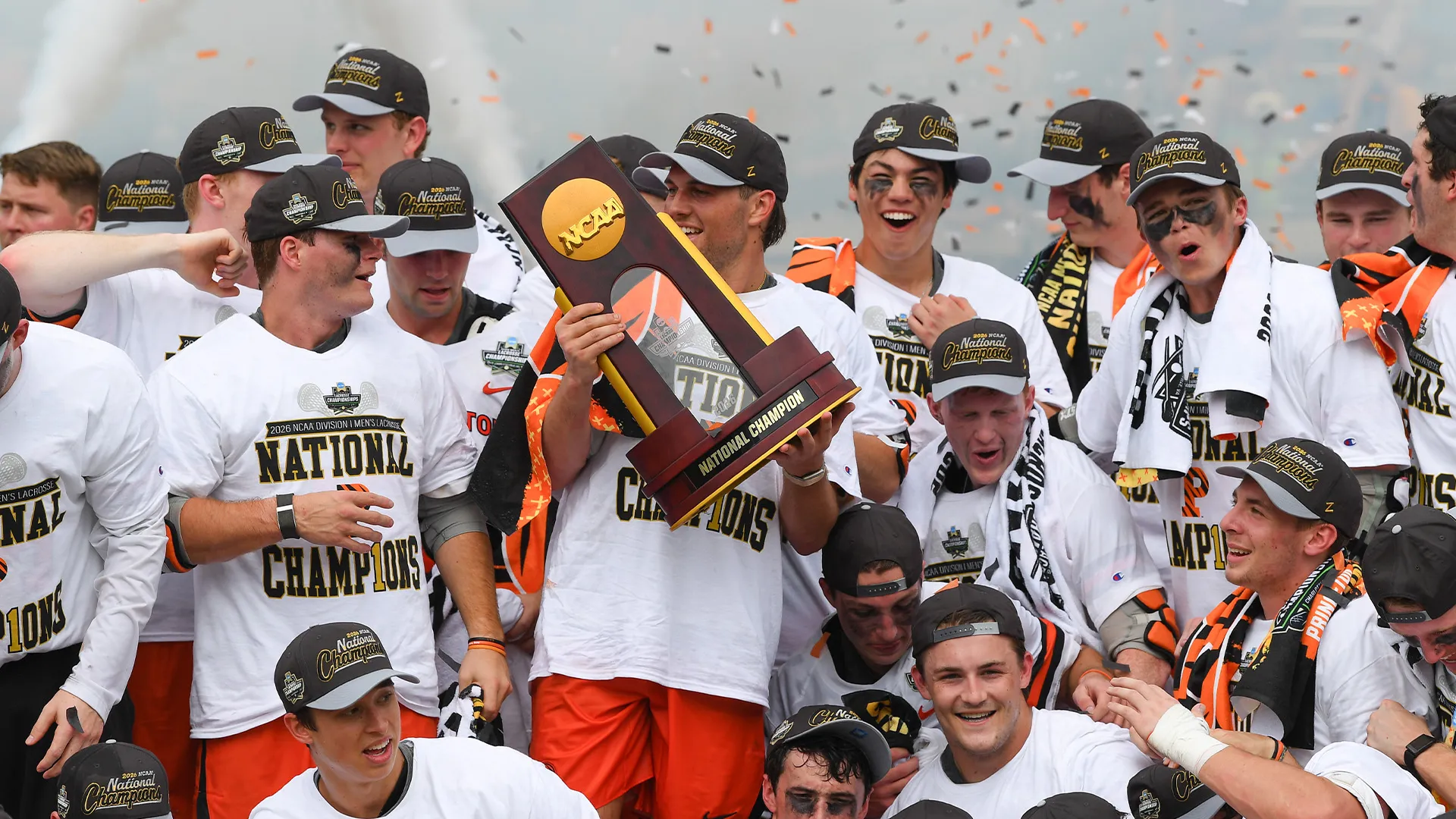
Princeton was already well on track to cementing a modern-day legacy. An hour later, Palumbo would exultantly hurl a ball into the Tigers’ cheering section at Charlottesville’s Scott Stadium as time expired in a 16-9 rout of Notre Dame. The program’s quarter-century title drought was over.
“On the bus home, thinking about it, ‘We actually did it,’” Palumbo said. “Waking up the next day and being like, ‘We really did it.’ Now, I can’t open my phone without seeing highlights and interviews. That game that I dreamed of for 23 years and that I watched on TV for 23 years and couldn’t even conceive of really actually doing was the game that we played. And was the game that we won.”
It was a victory for Princeton, certainly, as well as a coaching staff whose investment has helped the Tigers deliver five consecutive NCAA tournament appearances since returning to play from the pandemic.
Yet it was also a triumph of joyfulness and selflessness, of irrepressibility and unrelenting pressure, of whimsy coated with a touch of giddy ruthlessness.
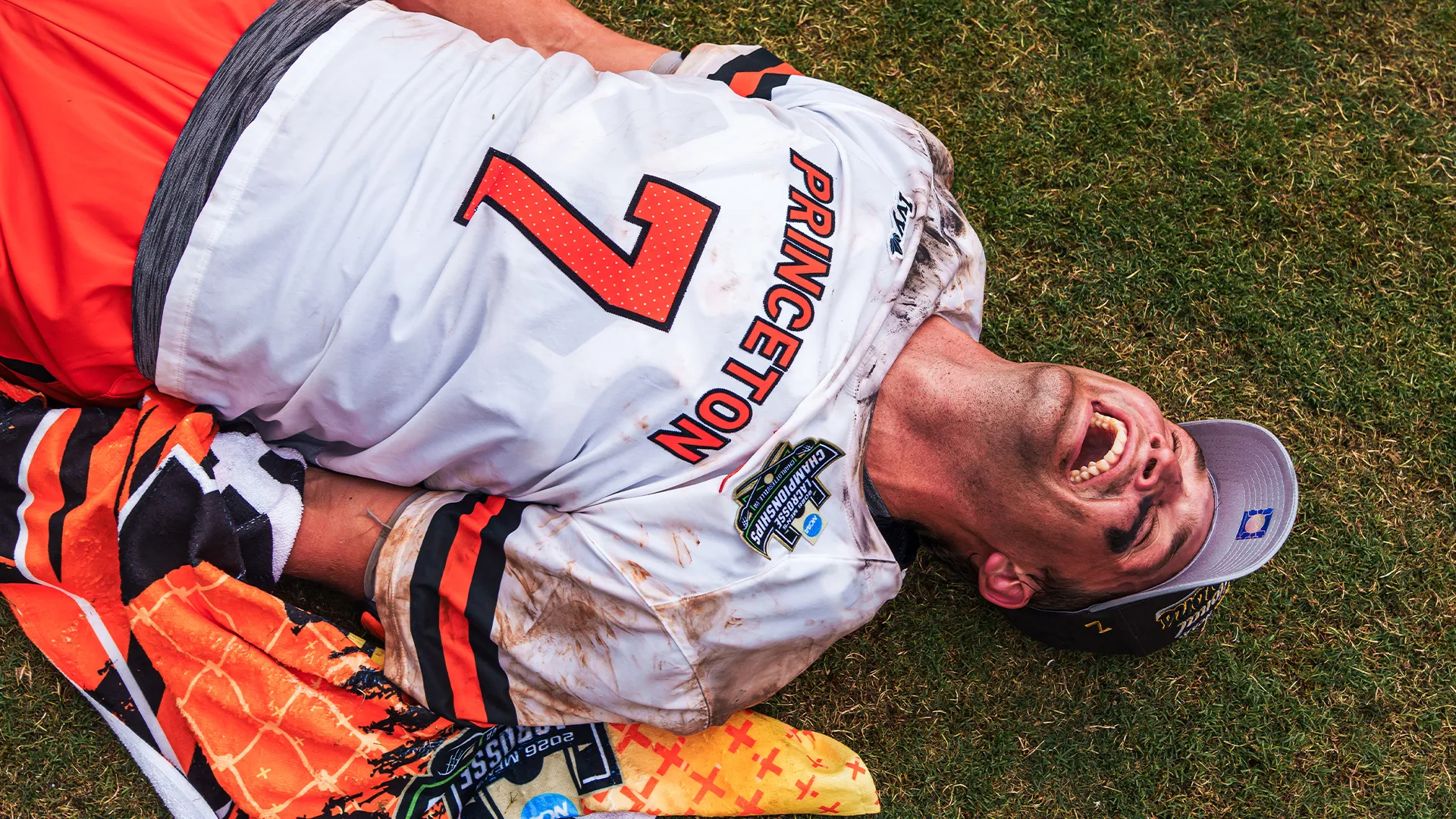
And maybe no one embodied that dynamic quite like Palumbo, who scored four goals in the title game and tied for the tournament lead in both goals (12) and points (19).
“Chad plays with this passion that can’t really be replicated,” said Cooper Kistler, his fellow captain.
Princeton senior David Smythe set up a trivia game for the night before Saturday home games, one that often had a couple categories devoted to the sport’s history. Palumbo usually crushed it.
Kistler sat down for a meal or two each week with Palumbo to catch up on the pulse of the team. Usually, Palumbo was devouring film downloaded from ScoreBreak, trying to find a new action to draw up and incorporate into the Tigers’ offense.
And junior Colin Burns, the team’s other captain, described a game he, Palumbo and Tewaaraton finalist Nate Kabiri would play. “Pick-A-Player” is a lightning round of 10 yes/no questions. Did he play in the ACC? No. Big Ten? No. How about the Ivy? Yes. Did his team wear red? No. How about orange? Yes. Is it Princeton? Yes. Was he a Tewaaraton finalist? Yes. Is it Coulter Mackesy? Yes.
“Chad is the centerpiece, the cover of the media guide when it comes to the lax rat culture that we have,” offensive coordinator Jim Mitchell said. “There are so many words I would use to describe him, but the creativity and his ability to be influential in that way, Chad’s very open and younger guys feel comfortable around him. He carries himself with a certain grace. He’s got great aura, as the kids would say.”
“
That game that I dreamed of for 23 years and that I watched on TV for 23 years and couldn’t even conceive of really actually doing was the game that we played. And was the game that we won.
One could say the same for the Tigers as a whole. They checked every box — goalie, faceoff man, multiple midfields, offensive balance — and wound up becoming the first national champion to score 14 goals in every tournament game of a title run since Virginia’s undefeated 2006 team.
It was a group invested in each other, as well as the sport.
“That was definitely a massive factor of the year,” Palumbo said. “If you walked in the locker room at any given time, there’s a bunch of different conversations going on about X’s and O’s and players that people love and players people don’t love and ways to play the game and everything like that.”
Kistler, a one-time Brown commit who first got to know Palumbo on the high school club circuit with the West Coast Starz, marvels at both Palumbo’s sense of calm and his devotion. For even some of the lacrosse-obsessed players on the roster, the greatest satisfaction comes from the competition, from facing the best players on the biggest possible stage.
Those are good reasons. Palumbo’s thirst for the sport might be even more basic. “He wants lacrosse to be his life for the next 10-15 years,” Burns said. “He wants to play in both pro leagues. He wants to either be a coach or a broadcaster and stay within the sport in some way. Coming from a school like Princeton, that’s not common. While we have a lot of pros, we have so many guys who just go work on Wall Street and don’t even think about it. He just loves the sport so much that he’s going to dedicate his whole life to it.”
Spurring Palumbo’s determination to do so is the reality he faced as a high school senior. Diagnosed with rhabdomyiosarcoma, a soft-tissue cancer that largely affects people younger than 18, Palumbo said any feeling of invincibility was shattered in what was the defining moment of his life to date.
“That realization, ‘No, everyone’s going to die one day’ is a big one,” Palumbo said. “It took me a while to digest it a little bit, but once I got settled in at Princeton, I found an appreciation for my relationships with my teammates and my coaches, how much they meant to me and how much lacrosse meant to me, my relationship with the sport. I ended up realizing that it wasn’t something I liked to do but something I love.”
It proved to be infectious once he got to Princeton. He may have had some of the best highlights Mitchell had ever seen, but Palumbo still needed time to adjust to the structure of the college game and only made one appearance as a freshman. But he soon emerged as a sophomore in the midfield, a position he slotted into with Mackesy established as a top-tier lefty attackman.
He turned in a 47-point junior year, finishing it with six goals in an NCAA quarterfinal loss to Syracuse despite suffering a partially torn PCL early in the game. He rehabbed throughout the offseason, the injury costing him the chance to play box lacrosse with Burns over the summer. (He still visited Ontario for some games as a show of support).
By the time the spring arrived, he was part of a complementary group of captains. Burns is the organizer on and off the field, full of energy, and said Kistler was the soul of the team. The senior long pole was the guy who kept everyone on task, perhaps as consistent as anyone on an ultra-consistent team.
Then there was Palumbo, the perpetually happy presence and the heart of the Tigers.
“He’s very spiritual and he’s very much into his faith, and I think that helps his positivity and his leadership style, his infectious love for lacrosse,” coach Matt Madalon said. “We want a locker room full of lax rats, guys who truly love this game. He embodied that. We’re so proud that he represented our program so well in his time and he will continue to represent our program so proudly in the pros.”
Palumbo was part of the most pivotal in-season tweak for the Tigers. In the season debut, Princeton looked like anything but a title contender, losing 13-7 to Penn State.
There was work done at both ends of the field, with the defense embracing a condensed, in-the-paint approach to pair with a zone rather than a stretch-and-press style. And offensively, Palumbo moved down to Mackesy’s old slot on attack, swapping spots with sophomore Peter Buonanno.
Mitchell contended that while it was a move done in response to the offense not being ready for the opener, it is overdramatic to suggest it “unlocked” the Tigers’ potency.
Perhaps, but it surely didn’t hurt; Palumbo would finish with a team-high 48 goals to go with 31 assists. Plus, it established a crisp troubleshooting ethos that lasted the season.
“Every week we were hammering all the holes that we saw in our team and then by the end of the year you saw a team that didn’t really have many holes,” Palumbo said. “When holes would pop up, they’d get closed pretty quickly.”
There was only one more hiccup, a mid-March loss to Cornell that Princeton avenged in the Ivy League final. Palumbo went viral after the Tigers’ semifinal win over Yale when during an ESPN interview he did not mince words describing how badly Princeton wanted to beat Cornell, which at the time had seven straight wins in the series dating back to 2019.
“There’s a lot of rage,” Palumbo said. “You’re going to see a ferocity that I don’t think we’ve seen all year.”
The Tigers blitzed the Big Red 19-9 to secure the Ivy League’s automatic qualifier and collected the No. 1 seed on Selection Sunday. The team had T-shirts made with “Rage, Ferocity” printed on them in orange. Princeton brushed aside Marist 17-8 to earn a rematch with Penn State.
It would prove Princeton’s toughest test of the postseason. The Tigers were tied at halftime and trailed early in the fourth quarter on the steamy Delaware Stadium turf. And yet true to their nature, they were elated even before scoring the final five goals in a 14-10 victory.
“I said to the guys at halftime of the Penn State game: ‘This is awesome.’” Kistler said. “This is what we worked out early in the morning and late at night for — to be able to stare our season in the face and say, ‘Are we really that team?’ After that Penn State game, it gave guys a ton of confidence that we really are that team. We got over that hump.”
Memorial Day weekend was anticlimactic in comparison, with Palumbo again functioning as an example of the offense’s selflessness. Duke committed to double poling the midfield and shorting Burns, which opened up the junior to thrive in the picking game. Recognizing the situation, Palumbo kept the ball moving and didn’t score in the 14-7 semifinal victory as Burns and Kabiri dissected the Blue Devils.
Two days later, Notre Dame took a more conventional approach, and Palumbo was more prominent as the Tigers ripped off the last 11 goals of the first half to wipe out an early three-goal deficit.
“We could do a lot of things at a really All-American level,” Palumbo said. “If you wanted to shut down any one of us, we weren’t going to press the issue because we have Tucker Wade bombing out of the box. We have Aidan McDonald running two-man games with Kabiri and Burns moving off ball. [John] Dunphey and [Parker] Reynolds initiating off short sticks a lot of the time. There was frankly too much in our offense to stop. It felt like if you pushed on one lever, another lever would just pop open.”
It was a lax rat’s second-biggest dream, and it led directly to the most important one. Madalon has long preached the idea that when a team loses its last game, it starts to dissipate when someone on the roster leaves campus.
And as the final seconds trickled away, it dawned on the Tigers they were in for a different experience, much like the one they were reminded of by their alums at halftime. Their season didn’t end with a numbing loss. It ended in a dogpile.
“Usually, you get to say it’s sad when you say goodbye to the seniors, and it really is,” Burns said. “But we didn’t even say goodbye, because we’re going to see them again in the fall. We’re going to see them again for the rest of our lives because this is a forever team.”
Is it possible for a man who is the personification of happiness to somehow become even more ecstatic? Palumbo didn’t necessarily consider it in quite that way, but here’s one way that might.
Could there be some lacrosse-obsessed kids out there captivated by the joy and reverence for the game Princeton played with in 2026? Who develop their own version of Pick-A-Player? Who might just name goalie Ryan Croddick or faceoff ace Andrew McMeekin? Perhaps Kistler or Kabiri or Burns? Maybe they’d pick the charismatic Palumbo?
It’s something to possibly look forward to as a champion. So, too, is something Palumbo and his teammates already have on their calendar: An exceptionally strong link in the Long Orange Line reuniting for the national title game in 2051.
“In 25 years, we’re all going to get back together and drink a bunch of booze and watch a team win another natty and we’ll say, ‘Yeah, we did this,’” Palumbo said. “There’s been a lot of blood, sweat and tears in this program in the last 25 years, and weren’t able to actually hoist that trophy. To be able to put in the work and do it feels really special. They guys realize they did something that’s going to live on forever.”