
“He’s got rope!”
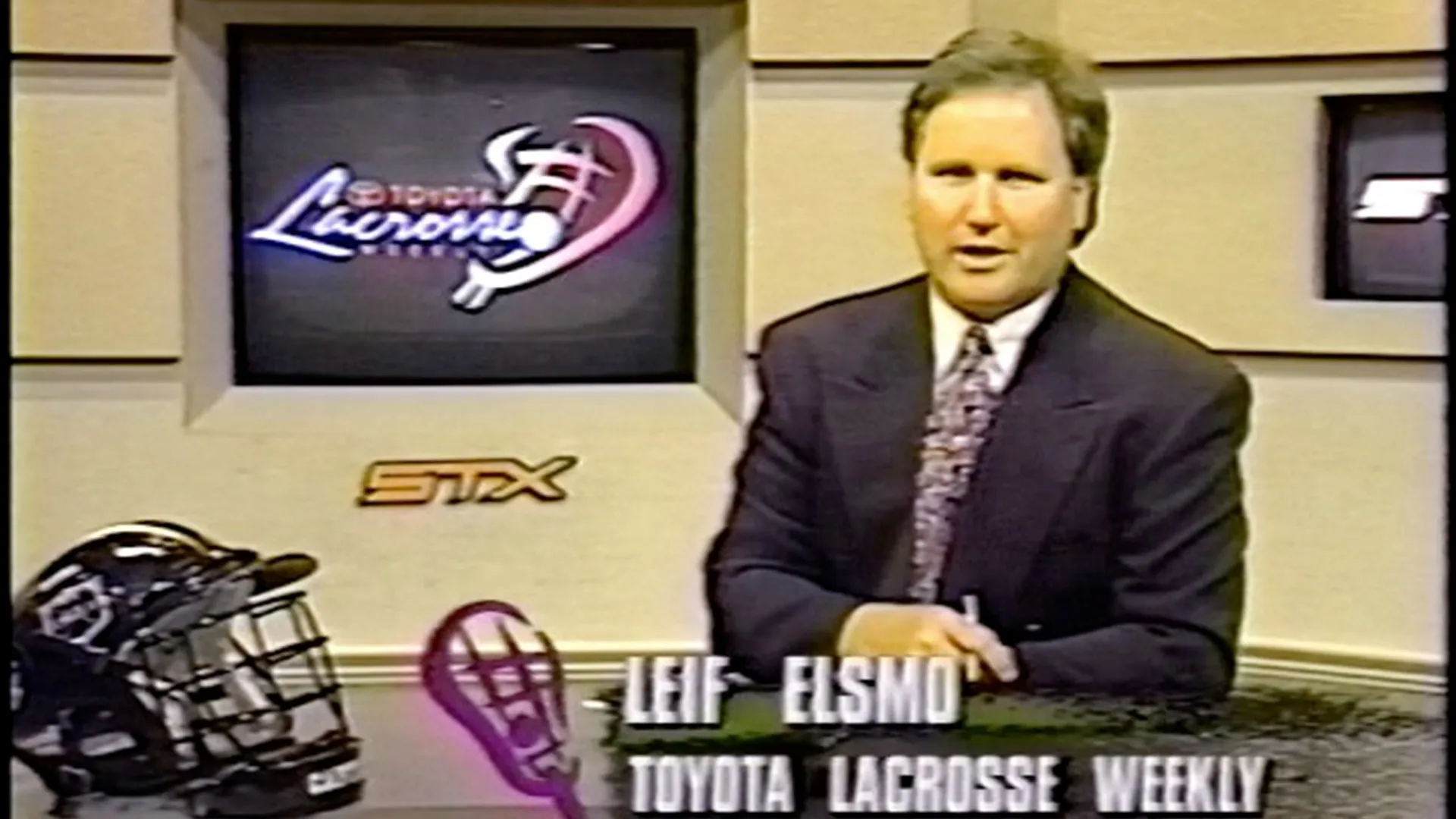
Leif Elsmo’s trademark call is familiar to so many that watched lacrosse in its early decades on television. He was the voice of lacrosse and broadcasted 24 straight NCAA Championships, along with countless college, Major Indoor Lacrosse League and National Lacrosse League game in his career. He also compiled and produced the only weekly national lacrosse highlight show for 20 years.
He will be inducted as a truly great contributor into the National Lacrosse Hall of Fame on January 10, one of eight members in the Class of 2025.
“I was surprised,” Elsmo said. “I was hopeful, but getting it validated, your work validated, it’s just so critical. You work hard, you try to be as good as you can. You hope you’re making something significant for people, and then when it’s validated, that’s good.”
His voice was mostly what lacrosse fans will recall, but Elsmo’s efforts went far beyond just calling the action.
“He’s listed as a broadcaster, but his impact was much, much deeper than that,” said Quint Kessenich, who worked with him for 10 of the NCAA title broadcasts. “Obviously, he was the name and the voice behind 20 or so championships and world championships, indoor games, but most importantly to me, he was really a content creator back in the ‘80s, ‘90s and early 2000s. Without Leif’s work, there’s a lot of lacrosse that would never have gotten in front of so many eyeballs.”
Elsmo had a broad skill set and he dipped into all parts of it to secure, research and promote coverage of lacrosse. He believes he just happened to come along at the right time.
“I wanted to show the best of lacrosse to as many people as possible,” Elsmo said. “I wanted to have more respect from the six o’clock news guys. I wanted basketball fans to wanna come see the game, not just mothers, brothers, sisters, uncles. So that was my driving, underlying ambition. And I was proud that I got to show as much great lacrosse with unbelievable stories to as many people as possible.”
Elsmo first showed a broad skill set as a player. He started playing lacrosse when he moved a few miles to Towson, Md., in seventh grade. His best friend was future Virginia captain Jay Connor, and they won the Baltimore County Championship together in 1968.
Elsmo went on to play at the Midwest oasis, Bowling Green, which supported Division I lacrosse for only 14 years. Elsmo was a key midfielder and faced off for the Falcons under legendary coach Mickey Cochrane. In 1970, they went 9-0, captured their first Midwest Lacrosse Association Championship and were ranked sixth nationally.
That team was inducted in the Bowling Green Hall of Fame in 2024.
“Bowling Green really made a mark in lacrosse for a program that was only there 14 years,” Elsmo said. “I loved playing, came back, played club a little bit, and then got into production.”
Elsmo was an advertising major at Bowling Green. He went into the Screen Actors Guild – American Federation of Television and Radio Artists after graduation and in 1980 co-wrote and produced a feature film, “The Adventure of the Action Hunters,” as well as doing some documentary work.
But he loved being in front of the camera, and when Bob Harlan advertised for an announcer for NCAA lacrosse, Elsmo applied.
“I had a great tape because I was doing professional work and I played lacrosse,” Elsmo said. “So, he grabbed me and boom, in two years I was doing the national finals and I just loved the production aspect and stayed with it. I was proud that I was in a lane that nobody else was in because of the circumstance of where the game was and the skill set I had. Serendipity, it just kind of happened. And I took the opportunity and made the best of it.”
He was the ideal hire. Being a former player was a plus for broadcasting knowledge, and his education and work background immediately paid off. He did a bit of everything and contributed to all aspects of production as he started a weekly highlight show while his broadcasting picked up.
He secured advertising from the likes of STX and Toyota to keep the show supported, he put together highlights himself and had a hand in the production and distribution. He used a studio in his own home to do editing. He was far ahead on analytics, compiling his own stats decades before it became commonplace.
“If I didn’t have the skill set – the advertising background, the sales background, the ability to produce, direct, syndicate, actually edit the show, and then distribute it by going to networks and selling it – if I didn’t have that skill set before they were looking for an announcer, it wouldn’t have worked,” Elsmo said.
Elsmo broadcasted The World Games 1982, then teamed the next two years with ESPN’s famed personality Bob Ley to call the NCAA Championship finals, the first of 24 straight. Along the way, he worked side-by-side with a number of different personalities, from Frank Gifford to James Brown to Mike Tirico, many of whom had no background in lacrosse and he’d try to share the nuances of the game.
He’d interviewed Kessenich in 1987 after he backstopped Hopkins’ NCAA title win, and they went on to call a decade of games together.
“He was at his best at the big moments,” Kessenich said. “I always thought Leif had a way of really being very cool and calm and reserved and coming to that crescendo when the game was on the line.”
As for Elsmo’s signature call? ESPN executive producer Paul Pistol told Elsmo to come up with a hook line as ESPN2 started broadcasting MLL games. Pistol suggested something with twine, and over the next weekend, Elsmo played with some of his own options.
“I knew whatever I came up with, it was gonna be with me for a long time,” Elsmo said. “So I had to like it, and I wrestled with it and I came back with, ‘He’s got rope.’”
Elsmo has been honored to hear the call repeated by everyone from kids playing pickup in parking lots and playgrounds to Paul Rabil in his Hall of Fame induction speech in 2024.
Kessenich admired the way that Elsmo took chances and made a personal investment in sharing his passion for the game.
“He really was very much an innovator,” Kessenich said. “I mean, when he started announcing those MILL games on ESPN2, at the launch of that network, they wanted to try new things. So they put him on the benches, they put him in the penalty box, he’d call games upstairs. It was really the first show that was done where he was the solo announcer.”
He and Steve Stenersen made a big push to get The World Games 1998 on television. Fans at home were treated to a 15-14 double overtime win by the United States.
“Without that final, that incredible final being on TV, I’m not sure that the PLL or the MLL would have been hatched,” Kessenich said. “So, in a lot of ways, him being aggressive and finding a way to get these things on television really benefited that next generation.”
Elsmo wanted to educate those that didn’t know the game. If you were tuning in for the first time, he explained who you were watching and why you were watching. He sold the game’s stars, the underdog angle and whatever else made the matchup of broad interest.
“He really understood the advertising side of it,” Kessenich said. “That was his background, and he just had his fingertips on the right pulse to make this game compelling.”
Kessenich calls Elsmo a catalyst to the game’s growth. He also said that Elsmo’s influence is underrated in helping the game get to where it is currently, with now hundreds of games on television every year.
Behind the scenes, Elsmo pushed for more exposure of the game he loved. And out in front of the camera, he displayed that passion for all to see.
“I loved the announcing, I really did, “Elsmo said. “I loved being the face of the game and I worked hard at that. But the fact that I got that network together and showed the best of the game to as many people as possible is probably my biggest joy.”