
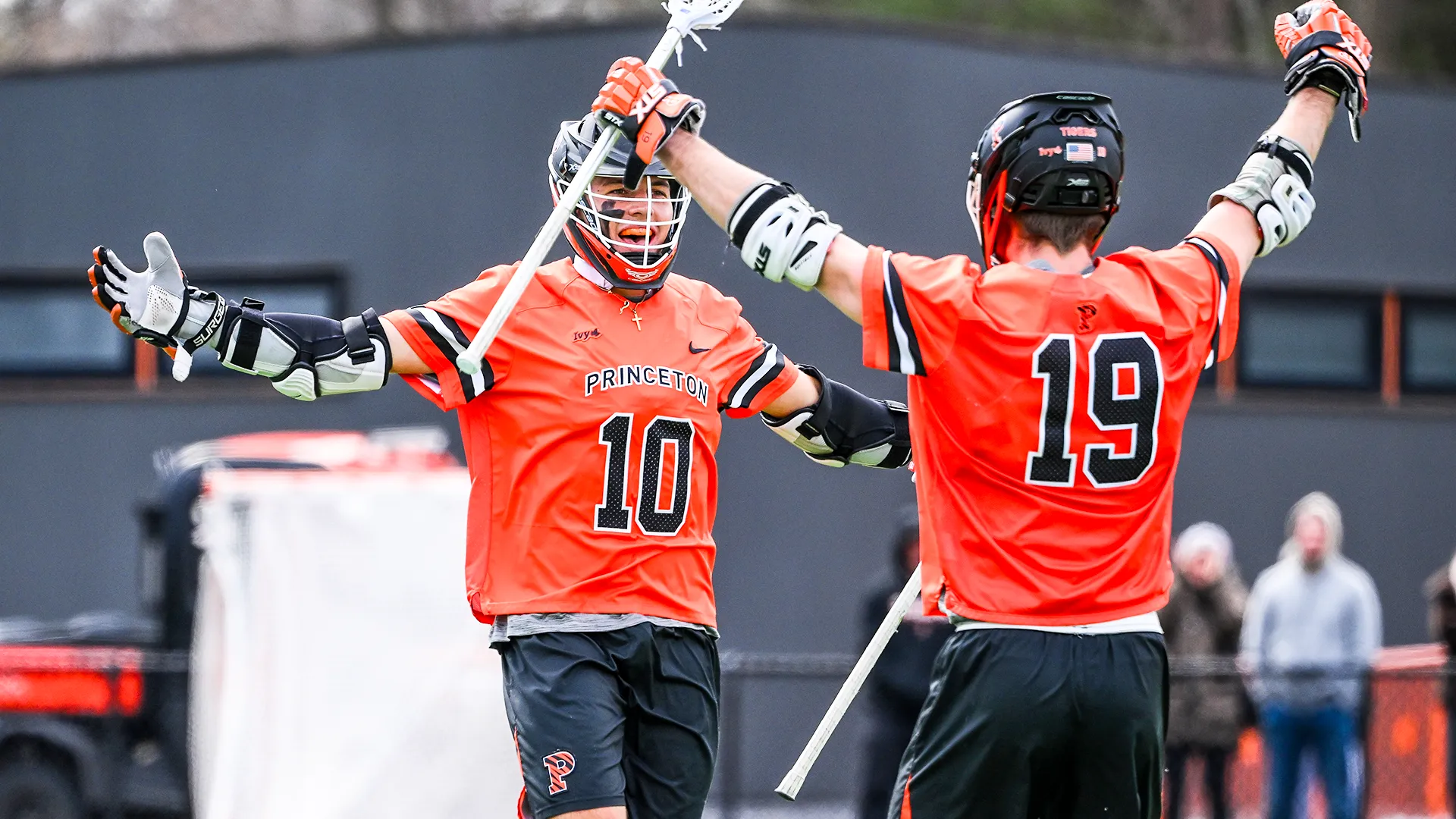
Selection Sunday is something akin to college lacrosse’s Christmas morning, when everyone gets to see the big present unveiled as the start of a three-weekend sprint to the crowning of a champion.
This year, it was like someone broke into the house and unwrapped all the gifts by the time everyone got downstairs.
Maybe that’s the best analogy for what happened Sunday, when the NCAA tournament bracket was revealed at least an hour or so before the selection show. “Leaked” isn’t the right word, because the identity of the No. 1 seed was not revealed. That offered the only suspense for the 9:30 p.m. ESPNU broadcast.
(The top two seeds — No. 1 Princeton and No. 2 Notre Dame — were not included in the unscheduled unveiling since they do not have an opponent yet; play-in games Wednesday will determine them).
At least the commentators had some fun with it, with ESPN’s Anish Shroff knowingly acknowledging, “We know you have the Internet,” in his remarks to open the show.
This was an unexpected development for everyone involved, including plenty of coaches who have been through their share of Selection Sundays.
“It was very different from a show,” said Yale’s Andy Shay, whose Bulldogs will make their 10th NCAA appearance since 2012. “I didn’t know when I was going to hear that we were in or out, because I’m just going to this website that may or may not have it on there. It was very unique relative to watching the show. You know when they unveil it.”
As for the NCAA, it’s probably safe to assume this will be one of the things reviewed when it evaluates how smoothly the championship is run over the summer.
“Unfortunately, a technical glitch is what occurred in the first-round matchups and times for Division I, II [and] III, both men’s and women’s, were revealed prior to the selection show,” committee chair Matthew Colagiovanni said Sunday night. “All six championship committees for each tournament look forward to providing a positive experience for all the students, coaches and fans participating in the postseason.”
For Duke and Yale especially, things are off to a good start. They were the last two teams into the field, edging out Maryland and Harvard for the chance to continue their respective seasons.
It didn’t come as much of a surprise for those who have dug into the numbers over the last week that those four programs were the final ones under consideration. Duke beat North Carolina in its regular-season finale, giving it a high-end victory despite missing the ACC tournament. Harvard, Maryland and Yale each lost in their respective conference semifinals.
“It was very tight,” said Colagiovanni, Rutgers’ deputy athletic director and the committee chair for the third year in a row. “We spent a ton of time looking at those four programs. It was the most of probably what we did in the room.”
One thing that seemed to stand out about Duke and Yale (which won at Cornell on March 28) is both had a road victory against a top-tier team, while Maryland and Harvard did not. And while those were noteworthy results, it does not appear they were determinative for the committee.
“I wouldn’t say it was a major part,” Colagiovanni said. “It’s just another factor as we’re going through when you’re looking at all the criteria we use — obviously, RPI, number of wins and all that — as we go through. It’s just one piece that we look at it. I always want to make sure I credit the coaches, the [regional advisory committee]. That’s just another data point for us.”
Here’s a trek through the 18-team tournament, which gets underway with a pair of play-in games Wednesday.
THE FAVORITES
Notre Dame and Princeton
Is there a favorite? This isn’t like three of the last four tournaments, when juggernauts led by Logan Wisnauskas (2022 Maryland), Pat Kavanagh (2024 Notre Dame) and CJ Kirst (2025 Cornell) capped exceptional seasons with four victories in May.
Even entering the 2023 tournament, it felt like one of three ACC powers (Duke, Virginia and eventual champ Notre Dame) would celebrate on Memorial Day.
That doesn’t mean this year is devoid of dangerous teams. Notre Dame has as reliable a defense as anyone and hadn’t given up more than 11 goals until Friday’s 15-10 loss to Virginia in the ACC semifinals. Princeton is a load at the other end, averaging 14.43 goals to rank fifth in the country.
Yet there are arguments to be made for a slick North Carolina bunch, Richmond’s deep, tested crew and even Virginia and Penn State outfits that clearly figured things out the last few weeks. And that doesn’t even touch on Syracuse, a senior-laden group that was built to win this year, or defending champ Cornell.
Maybe it turns out to be a bunch of usual suspects making their way to Charlottesville in three weekends, but the outcome feels a lot less certain than at any time this decade.
LAST TEAM IN
Yale
The Bulldogs are back in the postseason after a two-year hiatus in what might be the unlikeliest of Shay’s tournament teams.
Last year, Yale went 5-8 and took heavy graduation losses. They were 3-4 in mid-March after dropping games to Princeton and Penn to open Ivy League play.
And since then? The Bulldogs inched closer to the postseason, first by defeating Cornell and Harvard and then handling business in late April.
A six-game winning streak ended Thursday, but even that was a commendable showing in a 12-10 loss to eventual top seed Princeton.
“We didn’t anticipate it, given our talent exodus and experience exodus,” Shay said. “I’m just really proud of the guys. It’s been great. I don’t think I’ve had a younger team. I certainly haven’t had a less experienced team.”
By taking the final spot in the field thanks to a solid RPI (12) and strength of schedule (11), Yale now gets the experience so many of its teams have enjoyed over the last decade and a half: a trip to the NCAA tournament.
“Apart from the freshmen, there were guys that had never played,” Shay said. “It was like, ‘Well, it’s your turn. You’ve been waiting. Let’s go.’ And they’ve been great. It feels a lot like my teams from the early 2010s — maybe a little bit undervalued with the four stars and five stars and stuff like that, but a lot of grit and a lot of fun to coach.”
FIRST TEAM OUT
Maryland
The Terrapins’ run of 22 consecutive tournament appearances — the third-longest in the event’s history behind Johns Hopkins (41 from 1972-2012) and Syracuse (24 from 1983-2006) — is over. Maryland went 7-6 and was shut out of the postseason for the first time since 2002, which was the last year the field had only 12 teams.
“We just felt with Duke and with Yale, they had a little bit more full body of work and ended up putting them in,” Colagiovanni said. “But we did spend a lot of time looking at Maryland, which had a very challenging and difficult schedule. We looked at Harvard, which had a very good year as well. We just felt that with Duke and with Yale, they just edged them out by a little bit.”
TOUGHEST DRAW
Princeton
Yes, the Tigers are the No. 1 seed, and with respect to Marist and Stony Brook, they should be able to make it to the quarterfinals without too much of a hassle.
But once there, they could run into a Penn State team that drubbed them 13-7 in their season opener. Army wouldn’t exactly be a pushover if it can win in Happy Valley on Saturday. And it’s not as if any of fourth-seeded Richmond, fifth-seeded Virginia, Duke or Georgetown look like an easy out in a semifinal.
If Princeton makes it to Memorial Day for the first time since 2001, it will have earned it.
UPSET ALERT
Duke vs. Richmond
A year ago, geographical considerations led the selection committee to pair Notre Dame with fourth-seeded Ohio State. It wasn’t particularly fair to the Big Ten champion Buckeyes to begin with, and it seemed even worse in retrospect when the Irish rolled into Columbus and earned a 15-6 victory.
That was a byproduct of the fiscal concerns imposed on the committee. It is supposed to have no more than two teams flying to first-round destinations, with schools within a 400-mile radius permitted to bus to a site. Jacksonville is flying to its opening round game at Robert Morris, and Albany got shipped to North Carolina in a nod to bracket integrity.
Long story short, there were no non-ACC hosts for Duke to go to that did not require a flight except for Richmond. That’s a trickle-down consequence of Penn State earning the No. 8 seed over Johns Hopkins, and it makes for a tricky matchup for the Spiders, who will play host to an NCAA tournament game for the first time.
The Blue Devils are coming off their best performance of the season, and in a world where money wasn’t a concern, they’d be off to Cornell or Penn State. Instead, Richmond will have to beat an ACC team from the Research Triangle for the second consecutive year to make the quarterfinals.
THE BIG QUESTION
Did the committee get it right with the last two spots in the field?
Let’s start by reversing this question and as whether things went badly wrong. This isn’t like 2022, when at least one team (Notre Dame) and arguably another (Duke) capable of winning a national championship under the right circumstances got left out. Maryland’s offense this spring was spotty. A few notable injuries lowered Harvard’s ceiling over the last month.
Both might have won a game (or maybe two, in a nod to John Tillman’s sideline sorcery in the quarterfinals with the Terps). But neither looked poised to stitch together four victories in a row.
There were ultimately four teams with somewhat flawed profiles getting sized up. That’s typical. Yale owned a head-to-head defeat of Harvard, and with a similar overall resume, it would have been difficult to leave the Bulldogs out in favor of the Crimson. In any analysis, Yale was either in or really close.
The lingering question about Duke is tied to its early-season schedule. The Blue Devils played one eventual NCAA tournament team (Jacksonville) and one eventual top-20 team (Saint Joseph’s, which slipped in right at 20th) during their 8-0 start. Reasonable people could argue such a team might not warrant inclusion.
But there must be an alternative, since the committee wasn’t going to settle for picking 16 or 17 teams and calling it a day. Maryland could have made a case for itself by beating Penn State in the Big Ten semifinals; it lost 8-6. Harvard had a chance to impress in the Ivy League semifinals; it caught Cornell on the wrong night, didn’t play especially well itself and lost 17-8 to close the year on a four-game skid.
The Terps, in particular, were one win away. One of this season’s great what-ifs will be how things might have shaken out if Johns Hopkins midfielder Matt Collison was called for playing without a stick while scoring a fourth-quarter goal in a 9-8 defeat of Maryland on April 18. But it wasn’t, and the committee didn’t have the authority to award the Terps a provisional victory.
OTHER QUESTIONS
1. Did Penn State’s batch of questionable losses have any impact?
Not enough to cost the Nittany Lions a home game after their run to a Big Ten tournament title. That included a 16-8 pounding of Johns Hopkins, which was sent on the road to Cornell while Penn State earned a home game against Army.
“The RPIs were close. The strength of schedule was really close,” Colagiovanni said. “Penn State with their seven [top-20] wins was very impressive, and beating Princeton as well. When you looked at the overall, we felt like Penn State had the edge. We did spend a good percentage [of time] looking at that knowing that one of them was going to drop out of the top eight.”
2. How did Virginia jump to the No. 5 seed?
The Cavaliers were in a tight scrum with Cornell and fellow ACC member Syracuse, which had a head-to-head victory over Virginia. The Orange also owned seven top-20 wins, while Virginia wound up with a strength of schedule advantage after winning the ACC tournament.
“Winning two times against Notre Dame just put them a little bit ahead,” Colagiovanni said. “We went back and forth looking at those three teams. We just felt like this was it where it ended at the end.”
3. How close was the No. 1 seed?
It came down to Sunday, and there was the potential for a three-team race for the top spot entering the afternoon. Then North Carolina was trounced in the ACC final, leaving Princeton to slip ahead of Notre Dame on the last day of the season.
“Notre Dame was up there pretty much the whole year, but we spent some time looking at that. With [Princeton’s] win today and their full body of work with their RPI being 1 and their record and their eight wins in the top-20, they just had an impressive season,” Colagiovanni said. “It was a tight race until the end. We couldn’t make that decision until it was over.”
PAYBACK TIME
Marist vs. Stony Brook
The only regular-season rematch in the first weekend of the tournament is one of Wednesday’s play-in games. Stony Brook earned a 14-11 victory at home on April 4, and the Marist will get a return game with a trip to Princeton at stake.
Last year there were three rematches of regular-season games — Colgate-Penn State, Harvard-Syracuse and Notre Dame-Ohio State — in the first round.
“We were pretty excited it worked out that way,” Colagiovanni said of this year’s fresh pairings. “We talked about in the room after we laid it all out how it wasn’t the rematches.”
DON’T BE SURPRISED IF …
The quarterfinal round is the best of the tournament.
Just a chalky list of potential quarterfinals is fascinating. Princeton-Penn State. Virginia-Richmond. North Carolina-Syracuse (Round III). Notre Dame-Cornell. But even possibilities like Princeton-Army, Virginia-Duke, Richmond-Georgetown, North Carolina-Yale and Notre Dame-Johns Hopkins could be fun games in two weekends.
YOU’LL HEAR A LOT ABOUT …
The Cornell-Johns Hopkins reunion
It’s hard to believe these two schools haven’t played since 1987. Part of that is because of the rich history they share from the 1970s and 1980s, with the programs meeting in the postseason five times (including the 1977, 1978 and 1987 national title games). And partially it’s because with fewer than 100 Division I programs, it’s hard for such tradition-laden teams not to encounter each other eventually.
There’s also an obvious connection in Hopkins coach Peter Milliman, who left Ithaca in 2020 to take over the Blue Jays.
AND YOU’LL ALSO HEAR PLENTY ABOUT …
The possibility of a home team on Memorial Day weekend
As a result of FIFA World Cup hosting duties this summer, Foxborough, Mass., relinquished the rights to championship weekend. The NCAA eventually awarded it to Charlottesville, Va., the first time the title will be decided on campus since Rutgers was the host in 2002.
But the Scarlet Knights didn’t make it to the semifinals that year. The last time a team played on its campus on the season's final weekend was Maryland, which reached the final in 1997.
While Scott Stadium is not Virginia’s home field, the Cavaliers did have a dry run there in March against Utah. Virginia, which will open the tournament at Klöckner Stadium on Sunday against Georgetown, would have to win only one game away from its campus (a quarterfinal against Richmond or Duke in Newark, Del.) if it makes a title run.
COMPLETELY RANDOM STATS OF NOTE, PART I
The Sunshine State checks in.
Jacksonville’s Atlantic Sun title was not only a program first. It also meant Florida produced an NCAA tournament team for the first time, becoming the 19th state (plus D.C.) to do so. The last time there was a new state added to that list was 2023, when Utah made the first of its two postseason appearances to date.
COMPLETELY RANDOM STAT OF NOTE, PART II
There are a half-dozen teams from New York in this year’s field.
A year ago, there were five teams from New York in the NCAA tournament to match an all-time best for the Empire State. This year, Albany, Cornell and Syracuse are back in the field and joined by Army, Marist and Stony Brook.
That matches the record for any state. Back in 2007, Maryland had six teams (Johns Hopkins, Loyola, Navy, Maryland, Towson and UMBC) participate in the postseason.
COMPLETELY RANDOM STAT OF NOTE, PART III
It was a rough few months for prominent men’s teams at Maryland.
Not only did the Terps’ impressive tourney streak come to an end, but also it marked the first time since 1990 and just the second time since the NCAA began sponsoring a championship in 1971 that Maryland’s men’s basketball and men’s lacrosse teams both missed the tournament.
COMPLETELY RANDOM STAT OF NOTE, PART IV
Everywhere you look this weekend, there’s championship weekend experience on the sideline.
Ten of the 18 coaches in the tournament have led a team to the semifinals, and at least one of them will be in every first-round game. It’s the first time that’s happened since 2017 and just the second time since 2010.
GRADING THE COMMITTEE
B
There are plenty of decisions that could have unfolded a little differently, given the narrow margins. Should Virginia be the No. 5 seed? How about Penn State as the No. 8? And, of course, Maryland getting shut out.
A consistent thread in those is that high-end performance was rewarded. Virginia had a better top of its resume than Syracuse and Cornell. Penn State’s depth of victories overrode its odd losses. And the best days for Duke and Yale came on the road, while Maryland’s was a triple-overtime defeat of Virginia at home.
It didn’t seem as if Virginia wasn’t dinged for its early struggles. Taking the concept of a bad loss out of play, Penn State’s profile looked like a team that would get a No. 8 seed or be the first team on the road, and that’s how it shook out. The losses really didn’t appear to matter. Is that a good thing? (There’s a case for both.)
The flight restrictions aren’t the committee’s fault, but it’s far from an even 1-to-18 bracket as a result.
Overall, it’s a product that can be bickered about, but there’s nothing egregiously wrong with it, either. It’s sufficient work under the circumstances.