Opening day of the 2026 NCAA Division I men's lacrosse season is Jan. 31.
Throughout the month of January, we'll pose three burning questions for each team ranked in the USA Lacrosse Division I Men's Preseason Top 20, presented by CWENCH Hydration, starting with No. 20 Michigan and finishing with No. 1 Maryland.
Join the conversation on social media @USALMag (IG/X/FB). Wrong answers only.
The sun has set on the Kavanagh dynasty and the Faison brothers fantasy lasted less than a month. But the Notre Dame lacrosse pedigree stretches well beyond its famously fraternal ties.
“You don’t build a team on wishes and memories,” said Kevin Corrigan, entering his 38th season as Fighting Irish head coach. “You build it on the guys that are here every day doing the work.”
The longest-tenured head coach in NCAA Division I men’s lacrosse, Corrigan said he still relishes the process of stewarding a team toward its identity, creating new stars and enabling the culture that has consistently produced winners — including seven final four teams and two national champions.
Notre Dame graduated a Tewaaraton Award finalist (Chris Kavanagh), a human highlight reel (Jake Taylor), a three-time All-American defensive midfielder (Ben Ramsey) and a four-year starting faceoff specialist (Will Lynch) who was a clutch postseason performer.
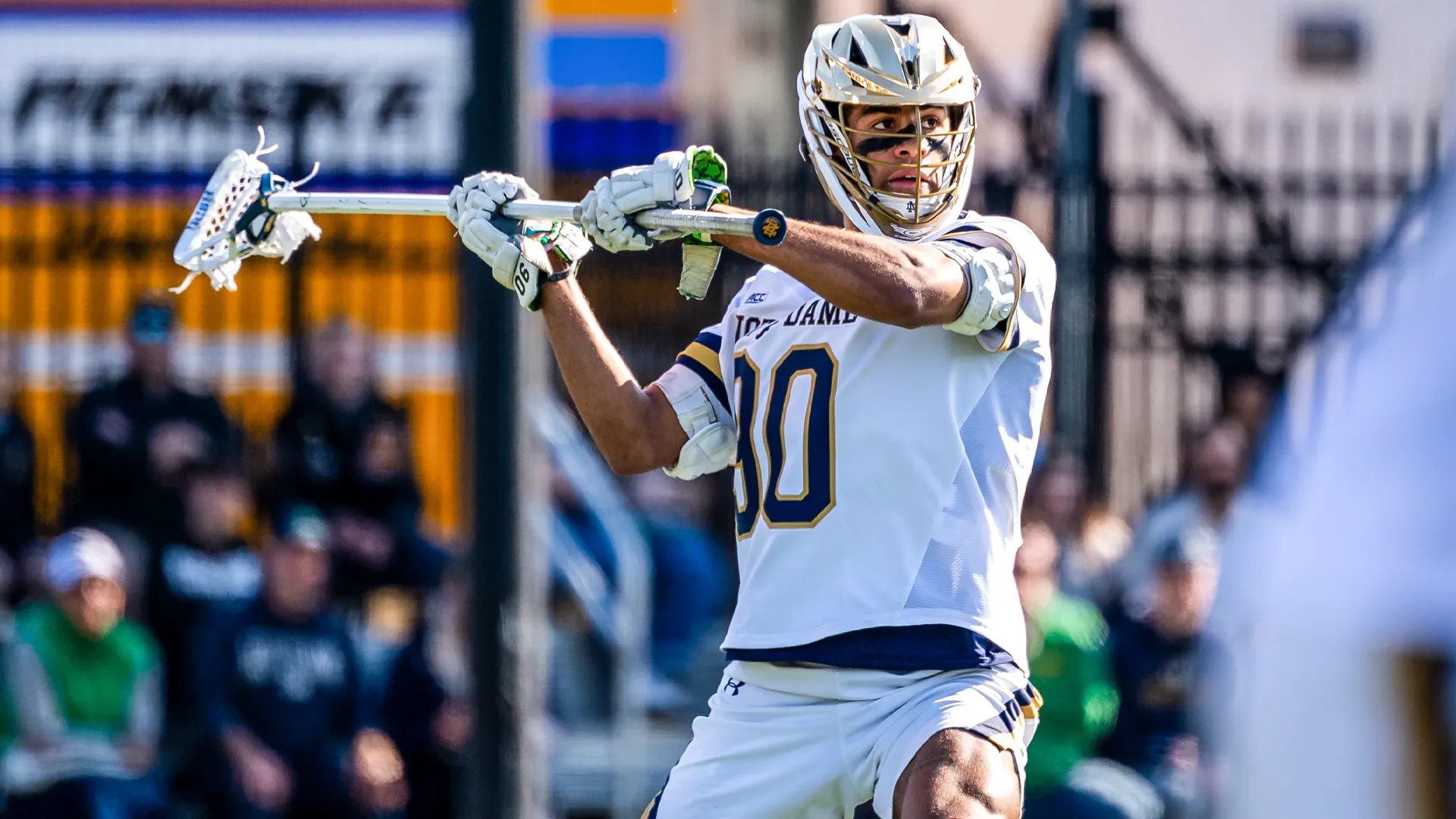
The optimism for 2026 centers on Schmeisser Award-winning defenseman Shawn Lyght, who is only a junior but has already cemented himself as the best at his position. Some say he could go pro today and immediately become one of the top defensemen in the Premier Lacrosse League.
“He is, at this point, as good of a defenseman as I’ve ever been around,” Corrigan said.
It’s lofty praise, considering the Fighting Irish have produced two previous Schemisser Award winners in Matt Landis and John Sexton, as well as other long-pole luminaries like Garrett Epple, Jack Kielty, Steve O’Hara, Kevin Randall and Kevin Ridgeway.
“I read an article on Roger Federer, and [he] was kind of taking offense at one of the things people said to him all the time, which was that he makes it look easy. He makes it look so effortless, right? And he’s like, ‘Well, you know, I’ve had to work my ass off for a long time to make it look this easy.’ It made me think of Shawn,” Corrigan said. “Because when you watch him, you think, ‘Gosh, he just seems to make it look easy.’ But he works his tail off. Yes, he’s got the ability, but he works very hard, diligently and intentionally getting better at the things he’s not good at and refining and being great at the things he’s good at. There’s no shortcut, no easy path to that.”
Which brings us to the first question, one Corrigan himself spent an offseason pondering.
Why wasn’t Shawn Lyght guarding Matt Traynor in the NCAA quarterfinal loss to Penn State?
Traynor memorably went ballistic in Annapolis, scoring six goals in the Nittany Lions’ 14-12 comeback win over the Fighting Irish and ending Notre Dame’s bid for a three-peat.
The game plan called for Lyght on Kyle Lehman while mixing in some zone to slow down Penn State’s explosive offense. It worked for a half. Then it didn’t.
“Shawn does everything well. There’s not a glaring weakness in his game. He handles the ball well. He gets if off the ground well. He can cover anybody. He can cover the speed guy. He can cover the big guy,” Corrigan said. “I’m disappointed in myself that we didn’t have him in a better matchup in the Penn State game at the end of the year. There were reasons for that and things we tried to do, but it might have just been overthinking on my part to anything other than match him up with their best player.”
Lyght’s even keel provides the perfect ballast for a Fighting Irish defense that returns almost entirely intact and presumably eager to put that performance in rear view.
Goalie Thomas Ricciardelli (56.5 percent) succeeded Liam Entenmann as well as anyone could step into the shoes of the two-time national goalie of the year, earning honorable mention All-American honors and posting a 20-save game against Ohio State.
Fourth-year starter Will Donovan is back as the best long-stick midfielder in the country. And while rope mate Ben Ramsey leaves a massive void at the short-stick defensive midfield position, Notre Dame has never had a problem tapping its depth at the position to unearth new gems.
“
You don’t build a team on wishes and memories. You build it on the guys that are here every day doing the work.
How does Jordan Faison’s decision to focus on football affect the midfield?
As Faison’s stock rose in football from walk-on wide receiver to NFL prospect, Corrigan prepared for the possibility that he would walk away from lacrosse.
“We don’t feel like the cupboard is bare,” he said.
Notre Dame has a pair of All-American caliber anchors in Will Angrick (15 goals, 12 assists) and Jalen Seymour (13 goals, five assists) as well as Fisher Finley — all graduate students and fifth-year members of the team. Senior Max Busenkell and ACC Freshman of the Year Matt Jeffery also give the Fighting Irish some much-needed midfield punch.
Corrigan is especially eager to see what Jeffery can do with a proper preseason under his belt. He’s another crossover talent who plays wide receiver for the football team.
Last year, Corrigan exercised patience with Faison, Jeffery and Tyler Buchner as Notre Dame advanced to the College Football Playoff national championship game. The lack of a true break between seasons wore especially on Faison, Corrigan said.
Controversially, the Fighting Irish were left out of the playoff field this year despite a season-long top-10 ranking. They declined a bowl game invitation, thus making Jeffery available earlier than expected.
“Having that time this year — none of us would have wished for it, but we’ll take the advantages that come with it,” Corrigan said.
Football giveth and football taketh away. While Faison foregoes lacrosse for the foreseeable future, his younger brother, Dylan Faison, has arrived early as the No. 1 recruit in the Class of 2026 and while also onboarding with spring football will be available as another weapon out of the midfield for Notre Dame.
Who comprises Notre Dame’s starting attack?
You’d have to go back to the pre-Kavanagh days circa 2012 to find the last time the Fighting Irish had this much uncertainty in its attack rotation.
Notre Dame got a gift in the form of Air Force transfer Josh Yago. The ASUN Offensive Player of the Year, Yago (37 goals, 35 assists) led the Falcons to the conference championship and an NCAA tournament opening-round win over Robert Morris as a senior.
“He’s not here because we recruited him here, but because he had an opportunity as one of the few Air Force grads able to use their first year of service to get a master’s degree on another college campus,” Corrigan said. “We’re fortunate that they’re allowing him to play lacrosse as well. Josh is our best attacker right now. He will be playing in a role where he’ll be all over the place and we’ll take advantage of all the things he can do. There are very few things he can’t do.”
Junior Brock Behrman, a USA Lacrosse National Team Development Program product, solidified a starting spot in the fall with notable growth, Corrigan said.
The last spot is up for grabs between Griffin Grant, Teddy Lally, Luke Miller and Brady Pokorny — the latter two being lefties and all being four- or five-star recruits upon arriving in South Bend. That is, unless another Kavanagh miraculously appears between now and the season opener Feb. 14 at Marquette.
Asked if he was going through Kavanagh withdrawal, Corrigan quipped, “Other than just thinking that they were selfish to quit at six kids, I think we understand where we are there.”