
The most thorough accounting of any lacrosse final four requires more than 26 paragraphs. It could include charts and graphs and a heavy dose of X’s and O’s, which come to think of it, would at least take care of two letters of the alphabet.
Alas, while the space of the internet is virtually unlimited, a reader’s (and a writer’s) time is not. So as Duke, Notre Dame, Princeton and Syracuse converge for only the sixth set of semifinals ever to feature four schools already in possession of multiple NCAA tournament titles (1989, 2000, 2002, 2003 and 2021 are the others), here’s the full A-to-Z rundown of what to look for in this year’s final four.
A is for Will Angrick. A two-year starter on Notre Dame’s deep, balanced midfield unit, Angrick has 13 goals and six assists. The graduate student is one of four Irish midfielders (along with Matt Jeffery, Will Maheras and Jalen Seymour) with between 12 and 17 goals. Also notable: He had a goal and an assist in Notre Dame’s 2024 national title game rout of Maryland.
B is for Henry Bard. The senior captain has started on defense for Duke for much of the last three seasons and shares the team lead in caused turnovers (17) with Charlie Johnson. Bard has forced at least one turnover on five of the Blue Devils’ last six games, and has helped Duke keep all but two opponents (Syracuse and Virginia) to 12 goals or less this season.
C is for Charlottesville. The vibrant college town will play host to the first on-campus championship weekend since 2002. It marks the third time the national title will be decided at Virginia’s Scott Stadium. Cornell (1977) and North Carolina (1982) both defeated Johns Hopkins to complete successful title defenses.
D is for Duke. The unseeded Blue Devils (11-4) are making their 15th appearance in the semifinals after rallying past fourth-seeded Richmond (14-12) and trouncing Georgetown (16-6) the last two weekends. Duke is making its first trip to the season’s final weekend since losing in the national title game to Notre Dame in 2023 and is vying for its fourth NCAA championship (2010, 2013 and 2014).
E is for enduring. Duke coach John Danowski is the all-time Division I men’s lacrosse victories leader with 495, more than 100 clear of everyone besides Bill Tierney (439), and he’s the only coach in Division I history to have 20-year tenures at multiple schools (21 at Hofstra, 20 with the Blue Devils). Earlier this month, he joined Tierney as the only coaches to win 40 NCAA tournament games. The guess here is Danowski would have another “E” word in mind — educator — and it surely fits, too. Nonetheless, his longevity is worth a nod as Duke makes its 13th semifinal appearance in his tenure.
F is for Riley Figueiras. The senior is coming off a stellar afternoon defending North Carolina sniper Dominic Pietramala, who was held without a goal until the final 10:21. Figueiras has a team-high 25 caused turnovers this season and ranks second on the roster behind faceoff man John Mullen with 59 ground balls.
G is for Jackson Green. The junior picked off a pass to ignite the unsettled situation that led to Princeton’s go-ahead goal by fellow short stick Quinn Krammer in the fourth quarter of Sunday’s NCAA quarterfinal against Penn State. Green is also a wideout for the Tigers’ football team, and he’s the first Princeton player since the class of 1982’s Mike Neary to have at least one goal in lacrosse and one touchdown in football for the school.
H is for Wyatt Hottle. Part of the Orange’s heavily utilized first midfield line along with Payton Anderson and Luke Rhoa, the junior has 20 goals and 12 assists while shooting 36.4 percent while often drawing a short stick matchup. Hottle has three goals and two assists and has not missed a shot in two NCAA tournament games.
I is for Christopher Iuliano. Notre Dame is never caught without plenty of capable defensemen, and the freshman figures to be a factor for the Irish for years to come. He’s played in every game so far this spring and provides a presence on faceoff wings. Iuliano recorded his first career point with an assist in a first-round defeat of Jacksonville, and he collected a season-high six of his 22 ground balls in the Irish’s first meeting with Syracuse on April 25.
J is for Benn Johnston. An effective midfielder in his first two seasons in Durham, Johnston shifted to attack and has scored a team-high 40 goals this season for Duke. He found the net three times in the Blue Devils’ quarterfinal drubbing of Georgetown, his first hat trick since March 28, and he has recorded multi-point games in all but one of his 15 outings this season.
K is for Nate Kabiri. The Princeton junior is one of three Tewaaraton nominees still playing this weekend, joining Trevor Tierney (2001), Ryan Boyle (2004), Tom Schrieber (2013 and 2014), Michael Sowers (2019) and Coulter Mackesy (2025) as the Tigers’ only Tewaaraton finalists. Kabiri enters the semifinals with 35 goals and 43 assists, and he and Sowers are the only Tigers with both 90 goals and 90 assists in their careers.
L is for Shawn Lyght. The Notre Dame junior, deft at smothering an opponent’s top attackman, is the first defenseman to be named a Tewaaraton finalist since the Irish’s Matt Landis got a nod in 2016 and could become the first defensive player ever to win the award.
M is for Aidan Maguire. One of the best short-stick defensive midfielders to grace the college game in recent memory, Maguire is exceptional at winning matchups and causing turnovers (15 this season, 66 for his career). But he’s also a transition force and has five goals and six assists this season, including a pair of empty-net darts in Duke’s first-round defeat of Richmond.
N is for Notre Dame. The second-seeded Fighting Irish (12-2) are making their eighth semifinal appearance — and seventh since 2010 — after claiming victories over Jacksonville (18-5) and Johns Hopkins (15-9). Notre Dame is seeking its third national title after also winning in 2023 and 2024. No team has won three titles in four years since Princeton took three in a row from 1996-98.
O is for Michael Ortlieb. The freshman has 24 goals and 17 assists while starting every game for Duke, and his 2-for-2 effort in the quarterfinals bumped him up to 47.1 percent shooting for the season. Over the last decade, the only Blue Devils to surpass that figure are Justin Guterding (2018) and Dyson Williams (2022 and 2024).
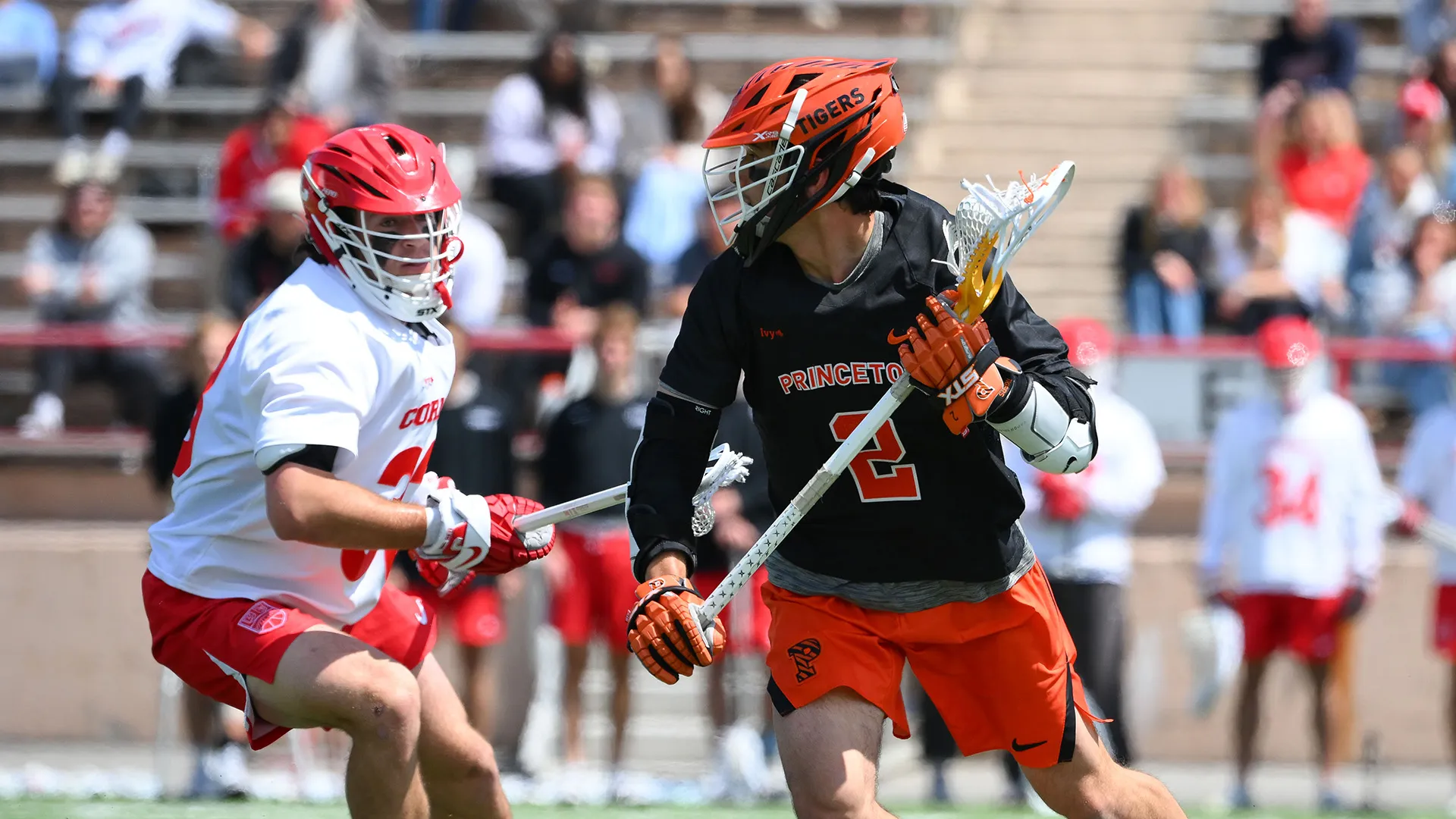
P is for Princeton. The top-seeded Tigers (15-2) return to Memorial Day weekend for the first time since 2022 after dispatching Marist (17-8) and then pulling away late from eighth-seeded Penn State (14-10) in their last two games. Princeton will play in the semifinals for the 12th time — eighth most all-time — and will look to add a seventh championship to trophies earned in 1992, 1994, 1996, 1997, 1998 and 2001.
Q is for Quint. What a blessing it is to this alphabetic adventure each year to have ESPN analyst Quint Kessenich as a backstop — could there be a better descriptor of a one-time All-America goalie? — for one of the trickiest letters. Kessenich, a mainstay on the sport’s highest-profile broadcasts since the 1990s, will be joined in the booth by play-by-play man Anish Shroff and fellow analyst Paul Carcaterra. Those three have worked the final four together in each tournament since 2017.
R is for Luke Rhoa. Syracuse’s all-ACC midfielder heads into the final weekend of his college career with 30 goals and 12 assists in his senior season, including seven goals and four assists in his last three outings. Rhoa’s rocket of a shot makes him one of the best field-stretching options in the country, and he’ll undoubtedly be especially incentivized after going 0-for-8 in the Orange’s loss at Notre Dame last month.
S is for Syracuse. The sixth-seeded Orange (13-5) are back in the semifinals for the second consecutive season after edging Yale (16-15) and scrapping past third-seeded North Carolina (13-11) in the tournament’s first two weekends. Syracuse is making its 29th semifinal appearance, tied with Johns Hopkins for the second most in the event’s history behind Maryland (30). The Orange are seeking their 12th national title and first in 17 years (1983, 1988, 1989, 1990, 1993, 1995, 2000, 2002, 2004, 2008 and 2009).
T is for twenty-two. Joey Spallina donned one of the sport’s most famous jerseys from his first day on campus, and he’ll leave Syracuse as its career leader in points (331) and assists (188), as well as its first Tewaaraton finalist since Kevin Rice in 2015. Spallina has 35 goals and 50 assists as a senior, and he needs two points to pass Jacksonville’s Jack Taylor for the national lead in points this season.
U is for unseeded. It was once an almost annual occurrence for an unseeded team to make the semifinal, happening seven times between 2010 and 2017. However, Duke is the first team sent on the road for the first round to make it this deep since then, and it will attempt to join 2016 North Carolina as the only unseeded teams to ever win a national title.
V is for Jake Vana. The most prolific scorer on Princeton’s productive second midfield line, Vana has 17 goals and has found the net at least once in nine of the Tigers’ last 12 games. Given the quick turnaround Monday and Princeton’s willingness to lean on an all-sophomore second line that also includes Porter Malkiel and Aiden McDonald, Vana could be a pivotal figure if the Tigers reach the title game.
W is for Tucker Wade. In an era when the old-school, overpowering midfielder is nearly extinct, Wade is a welcome exception. The junior is the only Princeton player to have scored in every game this season and is coming off a four-goal outing against Penn State in the semifinals. Wade has 35 goals, third-most by a Tiger midfielder in a single season behind Kip Orban (45 in 2015) and Josh Sims (36 in 2000).
X is, of course, for the X, even if it’s not an X anymore. All four of the faceoff men in the postseason who won at least 60 percent of their draws have been bounced from the tournament, but there are still some exceptional FOGOs left. Princeton’s Andrew McMeekin (59 percent), Notre Dame’s Tyler Spano (58.9 percent) and Duke’s Cal Girard (58.6 percent) all have similar numbers, while Syracuse’s John Mullen (53.5 percent) is coming off a two-goal day. Mullen has taken 486 draws this season, the sixth most in Division I history behind Duke’s Brendan Fowler (526 in 2013 and 510 in 2014), Yale’s TD Ierlan (519 in 2019), Duke’s Jake Naso (508 in 2023) and North Carolina’s Brady Wambach (491 in 2026).
Y is for Josh Yago. The graduate transfer from Air Force leads Notre Dame in assists (18) and points (47) and is coming off his most statistically potent outing with the Fighting Irish, a four-goal, three-assist effort against Johns Hopkins. With 108 goals and 95 assists, he is one of two players on a team still in the tournament with at least 200 career points; Syracuse’s Joey Spallina is the other.
Z is for Alex Zepf. Another Notre Dame graduate student, the backup to star goalie Thomas Ricciardelli logged only 23:36 of action over three games this season. But if he trots onto the field this weekend, it will likely mean things are going quite well for the Fighting Irish. Notre Dame is 21-0 over the last four seasons when Zepf appears in a game.