
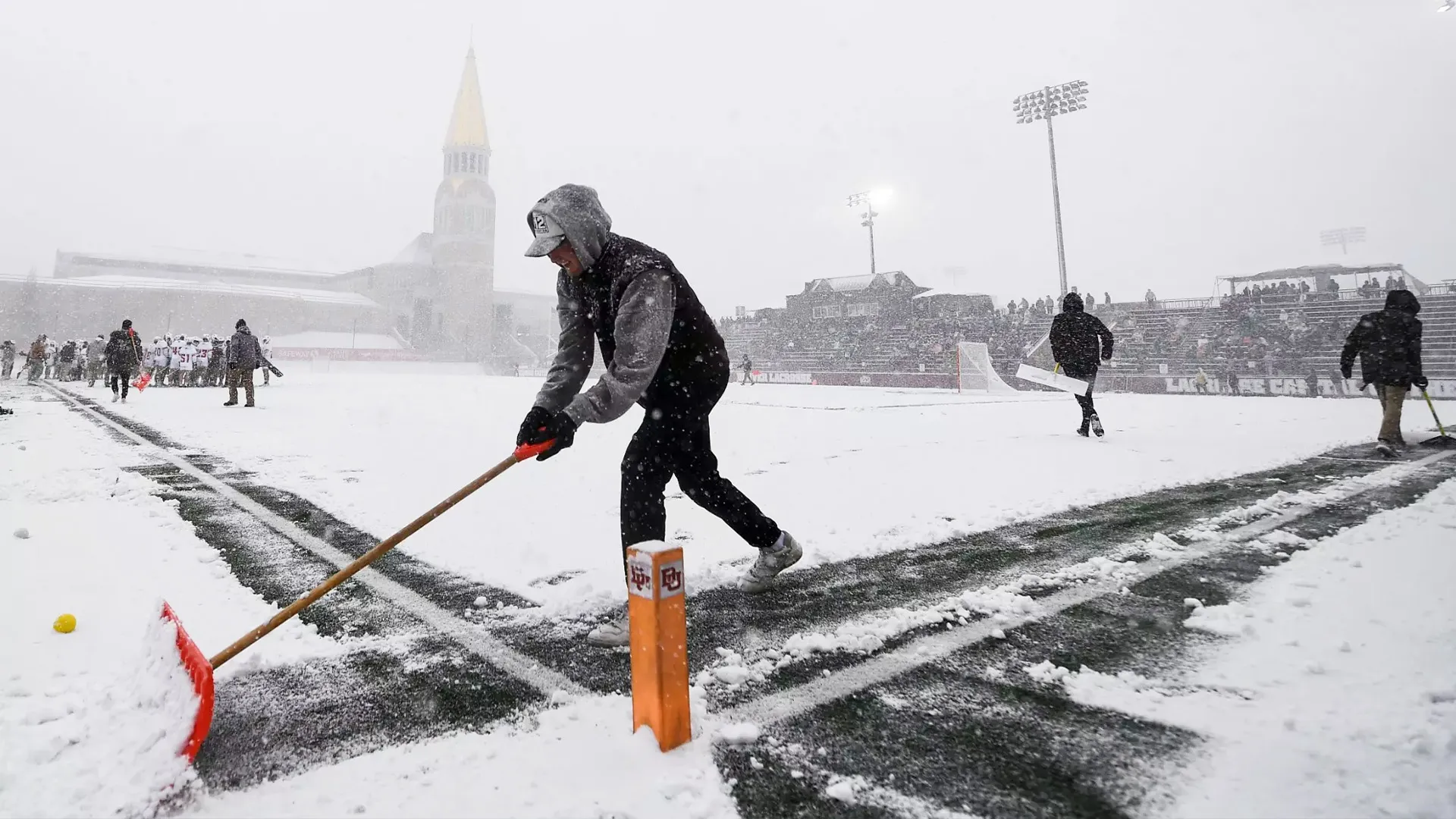
Mount St. Mary’s coach Chris Ryan’s team will belatedly play a season opener Friday afternoon. It’s merely the fourth different day it was supposed to happen thanks to an especially frigid winter that has snarled the start of this college lacrosse season.
The Mount was supposed to face Queens at home on Jan. 31, a game that was shifted to the following day at Queens to dodge the enduring low temperatures in the Mid-Atlantic. But a snowstorm hit North Carolina last weekend and postponed the game, leaving a trip to Long Island on Saturday as the new opener.
But with the cold not abating, that game — along with nine others in Division I — were moved up to Friday. Three other Saturday games were postponed. One of those — NJIT-St. John’s, which will now be played Sunday in Flanders, N.J. — was shifted indoors.
All of which begs two questions: Just why has the college lacrosse season encroached into late January? And is there any chance to start a bit later?
“I think there’s always been a recognition that this is a little bit of a tough situation,” Ryan said. “It just took a winter like we’re currently having to push it to the forefront. I was in the office the other day and we were talking about it and I said, ‘Man, it’s been a really tough beginning to the spring.’ And then I sat there for a second and said, ‘Too bad spring’s not going to be here for another month and a half.’”
The last few weeks have prompted some nostalgia for an era when the season started in March. Of course, those schedules often only included about 10 games. It’s easy to forget that some early games have been around for a while.
The last time there wasn’t at least one Division I game by Feb. 7 was in 2008. And since 2014, there have only been three years when the first day with at least 10 Division I games came after Feb. 8. Even those came with caveats. In 2016, there were nine games on Feb. 6 and a bunch of schedule changes the next weekend. The next year, there was an eight-game slate on Feb. 4.
And in 2021, a combination of the pandemic and winter weather helped delay the launch of many seasons.
The last few weeks, though, have prompted more chatter than at any point in recent memory about how early is too early for lacrosse.
“I don’t want to sound like I’m this old, experienced guy, but I’ve been around the sport for long enough to remember the days when we played two games in a week and the sunny days in April and mid-March when everybody loves to be outside,” Navy coach Joe Amplo said. “It’s just common sense. Ask any random person: ‘Hey, you want to go outside in shorts for three hours and play a game on a day like this?’ Come on.”
| Year | First Game | First Day w/ 10+ Games |
|---|---|---|
| 2003 | Feb. 14 | Feb. 22 |
| 2004 | Feb. 14 | Feb. 28 |
| 2005 | Feb. 12 | Feb. 26 |
| 2006 | Feb. 11 | Feb. 25 |
| 2007 | Feb. 10 | Feb. 24 |
| 2008 | Feb. 9 | Feb. 16 |
| 2009 | Feb. 7 | Feb. 14 |
| 2010 | Feb. 5 | Feb. 20 |
| 2011 | Feb. 5 | Feb. 19 |
| 2012 | Feb. 4 | Feb. 18 |
| 2013 | Feb. 2 | Feb. 16 |
| 2014 | Feb. 1 | Feb. 8 |
| 2015 | Feb. 1 | Feb. 7 |
| 2016 | Feb. 6 | Feb. 20 |
| 2017 | Feb. 2 | Feb. 11 |
| 2018 | Feb. 1 | Feb. 3 |
| 2019 | Feb. 1 | Feb. 2 |
| 2020 | Feb. 1 | Feb. 1 |
| 2021 | Jan. 30 | Feb. 20 |
| 2022 | Jan. 29 | Feb. 5 |
| 2023 | Feb. 4 | Feb. 4 |
| 2024 | Feb. 3 | Feb. 3 |
| 2025 | Feb. 1 | Feb. 1 |
| 2026 | Jan. 30 | Feb. 6 |
First Contest or Date of Competition.
(a) Men. An institution shall not engage in its first date of competition (game or scrimmage) with outside competition prior to:
(1) Nonchampionship Segment. September 7 or the institution's first day of classes, whichever is earlier. (2) Championship Segment. The Saturday that is 16 weeks before the Saturday immediately preceding the NCAA Division I Men's Lacrosse Championship game.
— 2025-26 NCAA Division I Manual, Rule 17.16.3
There are three avenues to tinkering with the college game’s calendar. The most difficult lift is shifting the end of the season to a later date, in part because it would require participation from others in the college sports ecosystem to make adjustments. One obvious one: The NCAA has already awarded championship weekends for 2027 (Philadelphia) and 2028 (Foxborough, Mass.).
Other issues are bandied about. Television windows for the final stages of the NCAA tournament might not be available with college baseball and softball postseasons contested in June. There is also the added cost of meals and housing, particularly for athletes who live on campus and might have to relocate when the spring semester ends.
(Maryland coach John Tillman said those expenses might be mitigated if a later start date to practice meant players didn’t return to campus until spring classes begin.)
But there’s also inertia stemming from 40 years of a format that has delivered the sport a reliable degree of attention.
“It’s been talked about,” Hofstra coach Seth Tierney said. “Sometimes it’s just an idea, sometimes it’s a really good idea and sometimes it just needs more push from behind. We have been possessive over Memorial Day weekend forever. Back when I played and earlier when I coached, that was the lacrosse holiday of what went on and you could get that Friday/Sunday, Saturday/Monday and take over that weekend.”
Put bluntly: A later start date is something coaches can’t unilaterally control and it is unlikely to change quickly — certainly not before the early days of next season.
So that effectively leaves two options for relief. Coaches could opt to open their season later and just play fewer games, or they could reverse the once-a-week trend and opt for more midweek games. Those have become increasingly rare, particularly on the final month of the regular season as programs preserve full weeks to prepare for games that will determine the fields of conference tournaments (and for those in one-bid leagues, whether a team’s NCAA hopes survive into May).
From March 23 to the start of conference tournaments, there are only 13 Division I games scheduled for a Monday-through-Thursday this spring. Eight of those are conference games in the nine-team Metro Atlantic as it attempts to squeeze in a round-robin without starting league play in February.
It’s a potential model for other conferences, including the nine-team Patriot League. Amplo suggested the possibility of travel partners, for example a team playing at Boston University and Holy Cross in a Friday/Sunday format. Perhaps every team would get a two-game week at home and another on the road each year in conference play to create an equitable schedule.
“Is it uncomfortable? Yes, it’s uncomfortable, absolutely,” Amplo said. “Does it make coaches more paranoid and is it less preparation? Yes. But it’s a player’s game. If you ask the kids, would you rather practice a week for 15 weeks in a row and play one game or would you have four or five weeks where you have two games in there. I would say 100 percent of the kids would say they want to play two games in a week. I’m not saying they’re always right, but they should have a little voice in this.”
“
I would say 100 percent of the kids would say they want to play two games in a week.
It would help to have some sort of mechanism requiring buy-in from programs throughout Division I.
Maryland hasn’t played a Monday-through-Thursday regular season game since 2020, and Tillman is among the most determined coaches to build a non-conference schedule with an eye on how it will impact selection and seeding in the NCAA tournament.
The Terps’ loaded schedule includes Richmond, Syracuse, Princeton, Notre Dame and Virginia plus the rest of the Big Ten, so it’s understandable why Tillman would want regular prep time for those games. He’s also had the Terrapins’ scheduled Jan. 31 opener at Richmond postponed, and Saturday’s home game against Loyola was relocated across the street to inside the school’s football practice facility.
Ultimately, Tillman said he would simply adapt to a rule that necessitated midweek games.
“It is a quick turnaround, but it’s not impossible,” Tillman said. “People do it. If it’s something that’s mandated, we’d just do it. I wouldn’t complain or argue. We’d just say, ‘If that’s what we’re doing, we’ll do it.’”
That sort of stipulation would be easier for some teams to meet than others. Take Robert Morris. The Pittsburgh-area school located within a 200-mile drive of just four other D-I programs: Ohio State, Penn State and fellow NEC members Cleveland State and Mercyhurst.
Little wonder the Colonials were content to play their opener at Johns Hopkins two days late rather than take their chances finding a replacement for later in the season.
“For us, we enjoy the opportunities to play really good programs like this,” coach Craig McDonald said after Monday’s 17-2 loss. “I think it helps us get better. Some of those are only options early in the year. For us, we have to jump on every one of them that we can. For us, getting midweek games is a little bit more of a challenge. We’re in a little bit different spot than a lot of schools, location-wise.”
There is still a matter of choice. The Ivy League’s opening start date isn’t until two weeks later. And other programs take a more deliberate approach to getting the season underway.
Of the 77 Division I programs, 33 weren’t scheduled to play last weekend and 15 didn’t plan to play this weekend.
“Heck, it worked for Cornell last year starting [practice] Feb. 1, and Notre Dame has a pretty good track record not playing early,” Amplo said. “The model’s out there.”

Navy was something of a trend-setter last week. Amplo was convinced it was unwise to play in the cold, and athletic director Michael Kelly and sport administrator Tim Ford were both supportive in his desire to cancel the Midshipmen’s opener against High Point.
That decision was made last Wednesday, and a cascade of similar announcements soon followed.
“They were like, ‘Look, let’s be a leader in this,’” Amplo said. “We’re here for the student-athletes at the end of the day. It’s not the right environment for student-athletes to be at their best, and from a safety perspective, it’s dangerous. Our medical team said there’s a very high risk of injury in these conditions. Our team had not prepared on a full field for quite some time. And you have the risk of frostbite for the guys who are standing on the sideline.”
The matter of training time is tied to this as well. Tillman marvels at how teams can put in a few months of work in the fall, then scatter for several weeks at the holidays before returning to campus. Within 11 days of the start of practice, the Terps scrimmaged Duke.
“We’re out, we’re running on hard turf. We’re carrying titanium metal shafts. And it’s cold,” Tillman said. “Are we doing what’s best for the athletes? Are we doing the best for the level of play? If you can’t feel your hands, are you going to play as well? Are you surviving those games? I think that’s all reasonable to discuss.”
So is an experience that isn’t remotely fan-friendly. Hopkins dug out several rows in three sections of the Homewood grandstand on the side opposite the benches and announced an attendance of 100 on for Monday’s chilly contest. It was the definition of a friends-and-family (and the pep band) crowd.
That’s probably to be expected for many of this week’s games, whether they’re played a day early or inside or even shifted to smaller outdoor venues as Duke did with its delayed opener against Bellarmine on Monday and Virginia plans to do Sunday against Colgate.
“I think there’s a lot of viable solutions that would make this a better experience for the kids, a better experience for the fans, a better product on the field,” Ryan said. “You go look at some of those early February games, it’s early. But who goes outside in those conditions?”
Amplo’s first game as a head coach was Feb. 23, 2013, while he was at Marquette. Tierney’s debut season at Hofstra began Feb. 24, 2007. The sport isn’t that far removed from teams routinely dodging much of the lousy weather February can deliver, and this particularly harsh winter has reinforced how befuddling the calendar can look.
At minimum, Tierney expects it to be a subject of discussion at the next IMLCA Convention. For this year, there’s little more to do than try to wait out an especially frosty winter.
“Mother Nature is undefeated,” Tierney said. “And it doesn’t look like she’s giving up the belt anytime soon.”