Ahead of championship weekend, coaches often discuss the importance of dotting their I’s and crossing their T’s. They want to have the basic X’s and O’s down pat.
But there are 22 other letters in the alphabet, and each of them has a tie to something (or someone) to watch this weekend as the top four teams in Division I women’s lacrosse battle it out to be the last ones standing.
With that in mind, it’s time for us to also go “back to basics,” as in one of the core lessons we learned in kindergarten: The ABCs. It was just as hard for us to come up with something for “X” as it likely was for this year’s kindergarten graduates to choose something to bring in for show-and-tell the week they learned that letter (pro tip: Get a xylophone).
But we — like the four teams still playing — rose to the occasion for you.
Below is the guide to the NCAA Division I women’s lacrosse final four, including the players and storylines to watch.
A is for Annabel Child. The Northwestern fifth-year transferred from Harvard, where she was first-team All-Ivy League in 2025. In Evanston, Child has played both defense and midfield and notably showed her offensive chops when she scored the game-winning goal in the Big Ten championship game against Maryland.
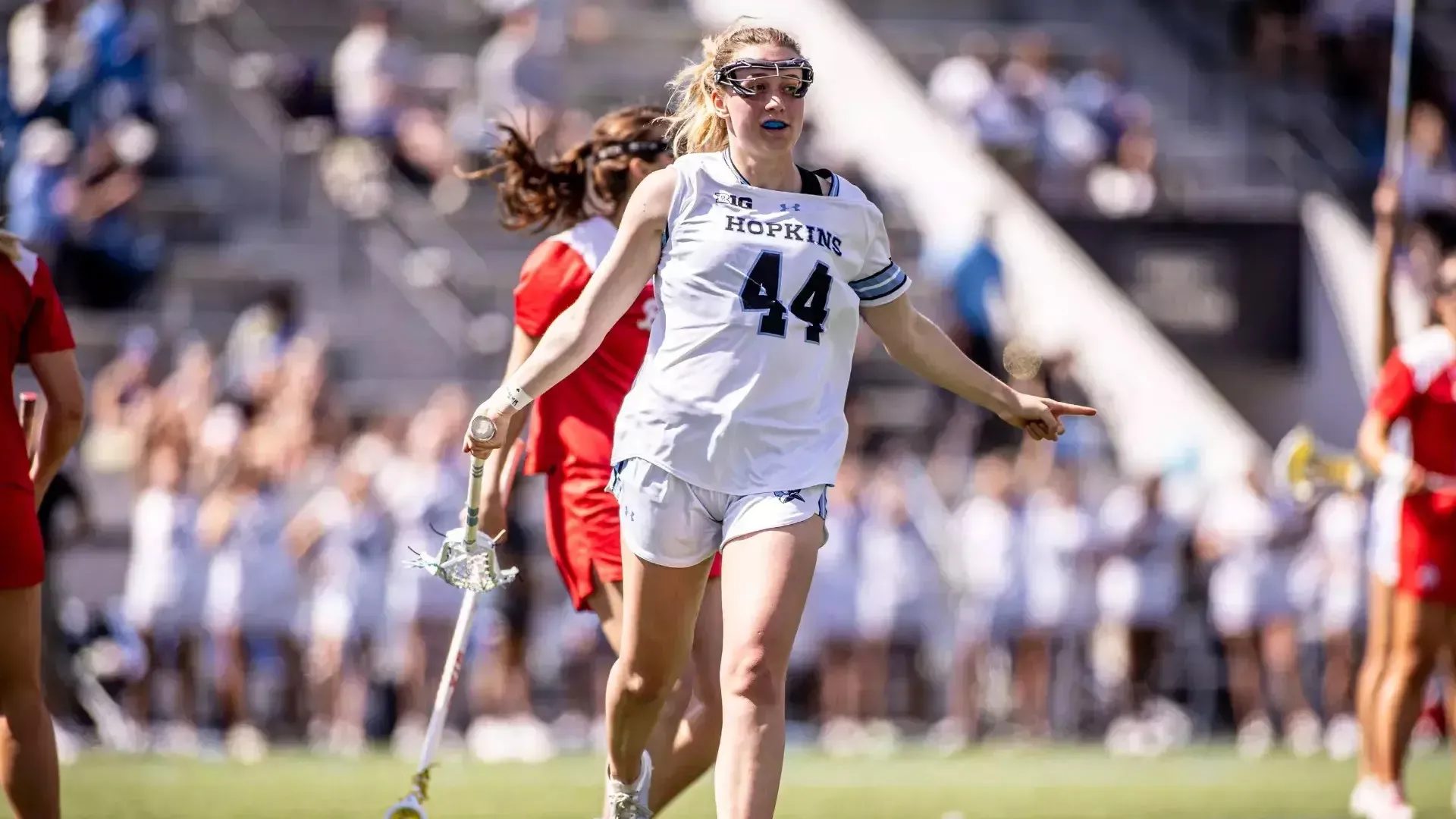
B is for Big Ten. Three of the four semifinalists hail from the Big Ten — Northwestern, Maryland and Johns Hopkins — cementing it as this year’s top power conference.
C is for Chalk, but not without Chaos. After a wild year of upsets, the NCAA tournament’s top four seeds advanced to championship weekend. But it wasn’t easy. Johns Hopkins scored two goals in the final 2:30, including Taylor Hoss’ buzzer-beater, to edge No. 5 Stony Brook. No. 1 Northwestern needed overtime to top No. 8 Colorado. And Maryland (14-10 over Navy) and UNC (14-11 over Stanford) faced tough quarterfinal tests.
D is for Lacey Downey. The Big Ten midfielder of the year is second on Johns Hopkins in points, but she told USA Lacrosse last week that, “There’s nothing more satisfying than taking a ball away from a player.” Downey had one caused turnover against Stony Brook, but it was her ground ball off a Reagan O’Brien takeaway with 13.7 seconds left that helped tee up Hoss’ eventual game-winner.
E is for Kori Edmonson. A true two-way midfielder, Edmonson has done a lot of a lot for the Terps as a senior, totaling 48 goals, 13 assists, 20 ground balls and 72 draw controls.
F is for Sam Forrest. The first-team All-American and USA Lacrosse Preseason Defender of the Year has delivered in her final season in Chapel Hill, leading the fifth-ranked UNC scoring defense with 39 ground balls to go along with 15 caused turnovers.
G is for Kayla Gilmore, who paces Maryland with 118 draw controls and will be integral in getting enough possessions for the Terps offense.
H is for Humphrey. We went with a chalk-chaos hybrid for C. But this list would be nothing without the generational talent and possib.y second-time Tewaaraton winner, who is somehow only a (redshirt) sophomore. She has 102 goals heading into the weekend, which is seven off the single-season record set last year by Madison Taylor (more on her shortly).
I is for Illinois, the host state for championship weekend.
J is for JJ Suriano and Jenika Cuocco. We’re cheating here, but both Big Ten goalies and All-Americans have been absolute fire this season.
K is for Kelly Amonte Hiller. Hiller engineered Northwestern’s second move from club to Division I status, built a dynasty and lacrosse scene in the Midwest, and now gets to sleep in her own bed as Northwestern plays first-time host for championship weekend.
L is for Levy. We’re talking about UNC head coach Jenny Levy and her daughter, Kate Levy. Mom has four national championships, including the one she led the Tar Heels to last season — Kate’s first as a student-athlete in Chapel Hill. Kate has produced an All-American sophomore campaign (26G, 14A, 27GB, 21CT).
M is for Madison Taylor. The No. 1 pick in the WLL draft has business to handle before she goes pro — namely, win a second national championship. Some think UNC and Northwestern are on a collision course to meet in the title game for the second year in a row. They already met in the regular season, and it was Taylor who netted the overtime winner to spoil UNC’s perfect season.
N is for Noel Cumberland, the heroine for Northwestern in its quarterfinal win against Colorado.
O is for Reagan O’Brien. The Tewaaraton finalist leads Johns Hopkins with 83 caused turnovers, none of which were bigger than the two she produced in the final minutes of Johns Hopkins’ instant-classic of a comeback win over Stony Brook.
P is for patience. The Johns Hopkins faithful have needed plenty of it. The Blue Jays are playing in their first final four since transitioning to Division I in 1997.
Q is for quarters. There are four of them. But as recent history tells us, sometimes, it’s the team that gets hot last that wins.
R is for review. Accuracy is important, especially in win-or-go-home situations. But commentators for both men’s and women’s lacrosse NCAA tournament games have repeatedly pointed out a desire to limit reviews to 60 seconds. It would arguably make games more appealing to TV viewers (and certainly shorter) while avoiding killing momentum.
S is for Kristen Shanahan. The one-time Notre Dame swore she was done at the end of the 2025 season. But Shanahan had one last ride in her, and she chose to take it at Maryland, where she paces the Terps in assists (34) to go along with 40 goals.
T is for Time Zone. For the first time in Division I lacrosse history, championship weekend will be played somewhere other than the East Coast.
U is for Upset. Despite Maryland’s illustrious history in lacrosse, any final game that doesn’t include North Carolina and Northwestern will have involved a semifinal upset.
V is for Views. Enjoy the ones of Lake Michigan, next to which Northwestern Medicine Field at Martin Stadium sits.
W is for Paige Willard, the freshman who tallied the equalizer for the Blue Jays against Stony Brook and has 40 goals and 12 assists in her first college campaign.
X is for XO. Northwestern beat Maryland and UNC in overtime earlier this year. Maryland downed Hopkins in overtime in a contentious Big Ten semifinal game. It’s unlikely any of these teams will be signing good luck cards “XO” (or sending them period). But the grudge-match undertones may make these games fun for all involved.
Y is for Yellow Card. Teams will want to be mindful of these (and green ones). Northwestern leads the field with 53 woman-up goals, followed by North Carolina (47), Johns Hopkins (43) and Maryland (41).
Z is for Lexi Zenk. The Tar Heels netminder has seen action in 10 games this season, including each one in the NCAA tournament, where she has split time with Betty Nelson, the starter. Zenk owns a 47.4-percent save rate and an 8.17 goals-against average.