
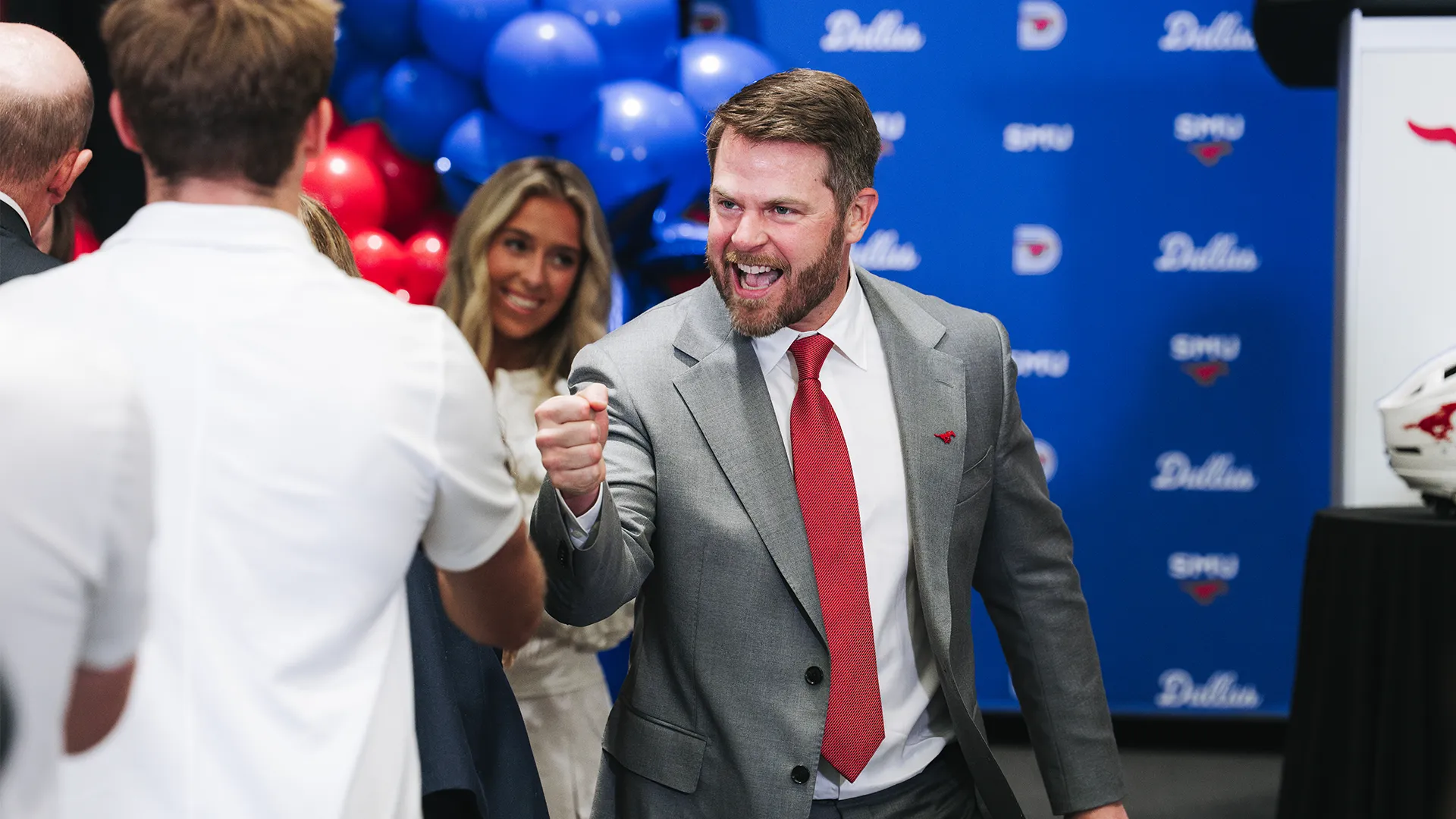
If you’ve ever had the chance to meet Jim Mitchell in person, your knuckles are probably still sore from his energetic fist bumps.
Mitchell likes to attack things, and that’s exactly what he’s been doing since being named the inaugural men’s lacrosse coach at SMU less than a month ago.
For much of the year, the worst kept secret in lacrosse circles was that a varsity lacrosse program was coming to the Texas-based ACC school. Reality finally hit when the official announcement was made Oct. 15.
Less than two weeks later, on Oct. 28, Mitchell, the offensive coordinator for Princeton’s 2026 NCAA championship team, was named the school’s first head coach. Much like Mitchell, SMU is attacking its entrance into the sport by making a splash. They flew his family down on a private jet for a press conference to announce his arrival.
Eight days later, the school announced the “First Class” — a group of 13 graduate transfers that will join the program after spending the 2027 season at their undergraduate colleges. The group is headlined by Ryan Goldstein, an All-American attackman who helped Cornell to the 2025 NCAA championship, and Tucker Wade, a first-team All-American midfielder who played under Mitchell while helping Princeton win its NCAA title.
SMU hasn’t officially announced any high school signings yet, but Inside Lacrosse has reported 10 flips from other programs this month and has the Mustangs ranked 16th nationally for the Class of 2027 — an amazing figure given the limited amount of time.
On Nov. 13, Mitchell hired his first staff member. Donal Mullane, a rising star in the coaching ranks, will serve as SMU’s offensive coordinator after helping Bowdoin to unprecedented success with three consecutive NCAA Division III final four trips while serving as the offensive coordinator at his alma mater.
The accelerated timeline has been necessary because of SMU’s 2028 start date for varsity play, a timeline that became possible because of the NCAA’s new “five-in-five” rule giving many players an extra year to play.
Mitchell and SMU are doing something unprecedented in recent times. Michigan announced the establishment of its varsity program in May 2011 with play beginning the following spring, but that move was essentially a transition of the existing club program, and head coach John Paul, to varsity status.
Utah announced its new program in June 2017 and began play as an independent program in 2019. SMU will be on a shorter timeline (by about four months) and will play in arguably the nation’s top league, the ACC.
It’s been a whirlwind, but an opportunity he couldn’t pass up. USA Lacrosse Magazine caught up with Mitchell to see how his first four weeks have gone.
When did you know coaching at SMU might be a possibility?
As soon as it got officially announced, my heart started racing because I knew it was maybe the greatest opportunity in my career. It’s the first ACC program that’s started since I’ve been coaching lacrosse, and it’s in a booming region of the country. I was hoping I’d have the opportunity, and not too long after, they put together a group of candidates and I was fortunate enough to be one of those. The whole process was pretty quick, certainly thorough conversations, but overall, a fast process.
You’re in uncharted territory. How do you even begin to prioritize everything that needs to be done?
I'm 20 years in the business. I've coached at all levels, Division III, Division I, small conference, big conference. I've been a defensive coordinator, offensive coordinator, head coach. I've done the grunt work. I've done the ops stuff as a young coach, which, you know, you're wearing a lot of hats.
I think the scale of it is a little bit bigger. And when everything is up to me in a lot of ways of starting the program, there's certainly a lot of responsibility and a lot to do. But again, a lot of it is things I have been doing my whole career, just on a little bit of a scale and a little bit of a crunched timeline.
Every day is really exciting. I mean, every day I wake up really energized, ready to go because everything is for the first time, and I want to get everything right the first time. And that might not be possible, but certainly that's what we're all working toward.
What’s your mindset on how you're going to build the roster to get going?
Well, everything about the roster building aspect of it is somewhat unprecedented. The five-in-five thing just happened. There were rumors about it, but all of a sudden, every single Ivy League student athlete, if they want to pursue that fifth year, has to leave the institution they're at. And it's been a good run for the Ivy League. You know, Yale's been a national champion in the past, and then Cornell and Princeton in the last two national championships.
Just the sheer volume of them that enter that fifth year and just being hypothetically available is definitely part of the ability to start this on the aggressive timeline that was determined. Knowing the ability to bring a few guys on hopefully relatively quickly to have a nice core group is something that was appealing about it.
But I think long term, my desire is to get it more toward what I guess would be the new norm. I think everyone's adapting to the five-in-five. The first couple years, we're gonna have to lean on the portal, the grad portal a little bit, just to realistically compete in the ACC at the level we want to. Once we get to year three or four, I would hope that our roster management looks more like most of our peers, where a bulk of the recruiting happens through the high school admissions process.
How was it getting things going largely by yourself.
The one-man band, playing the tuba and the bass drum and smashing the cymbals together for the first couple weeks has been fun, but definitely challenging.
I was able to bring on Donal Mullane as an offensive assistant. He's very well rounded as a coach. He was just named the Division III assistant coach of the year. So, it's nice to see his impact on Bowdoin recognized in that way.
We have some shared values and see the game a certain way. And I'm just excited what he's going to be able to bring to the table there. And then the defensive coordinator is certainly a big hire. Although I'm seen as an offensive guy, which I take pride in, the first half of my career was coaching the defense. I really came up in the business as a defensive coordinator, so I feel like I still have a strong command and ability to communicate things that are important to me defensively.
I do want an experienced defensive coordinator who's very capable and competent on that side to have their own system and schemes they want to bring, recruiting connections and vision for the program that we can share. That’s a really important hire. In some ways, if it were able to be done quickly, it gives a little bit more time to settle in. But to me, it's more of getting the best candidate possible as opposed to fitting a certain timeline. If I feel like the candidate pool is best at the end of spring, then that's when it will happen.
So, I'd say my effort, my job in this first year, yes, it's certainly recruiting and building a roster, but it's also a lot of logistics, figuring out scheduling, facilities, budget stuff, all that. The director of ops is an important time-sensitive hire for the staff.
What’s the support you’ve seen from SMU’s administration?
One of our sayings on the wall of our department is, “Be big, be bold.” And if you're going to start an ACC team in a different region of the country and expect to be competitive fairly quickly, you’ve got to have the support behind that.
So, I credit the whole department and the leadership of the department. They've done their homework, and they realize what it takes. I think going into it we're supported in a way that we should be able to be competitive relative to our peers quickly.
It doesn't mean we have every single thing you could ever imagine. Part of that is working toward that and having fundraising goals and presenting ideas for how we can be the best at what we do. But certainly from the first day, there's a tremendous amount of support with what we're trying to do.
As great as Princeton was the last few years, you always saw some of your top players finishing up their careers at other schools due to Ivy League regulations. What’s it like to be on the other end of the equation?
You know, a month ago, I was the offensive coordinator at Princeton. It was business as usual. You're onboarding the first years and you're trying to go to the next level with the other guys. And we had a number of guys at Princeton that were going to be four-year starters.
Then to have to flip the switch and then try to create that from the very beginning. From the first ember, the first spark, but then also making phone calls to the same guys I was coaching a month ago, and now I'm recruiting. So, it's just a really unique thing, but I also do think the opportunity to play at SMU — some of these guys that just feel so passionate about their teammates and the experience they have. This is really the only place where a number of them can come together and maybe relive or try to recreate some of the things that they felt were so valuable from a cultural standpoint, from a work ethic, from tactics, whatever it may be. SMU is just a once-in-a-lifetime opportunity to do that.
I think being the first, being a founder, being able to write the chapter, be the first alum, the first of everything. Someone will score the first goal for SMU, be the first alums of SMU, create the culture, help pass that down. I think all those things are so unique and so special.
Will there be an opportunity for the current club players to be part of the varsity program?
One thing that's nice about SMU, there has been lacrosse for a long time. The club team is a proud program. They have a lot of alums that are very passionate about lacrosse, very involved in the community. So, I will celebrate the history of SMU lacrosse, including the club team's accomplishments and their alums. I've spoken with a number of guys on the team, and they are excited about a potential opportunity.
For me, it's head-down and focusing on the current priorities I have with roster building, but I fully anticipate there being tryout opportunities. We are held to 48 [players], so that's a new thing in sports. We used to have a little bit of a bigger roster, so we do have a certain limitation there, but I fully intend on having tryouts and letting everyone have a chance to put their best foot forward and try to be a part of year one with the SMU Mustangs.
What are you doing when you’re in Texas?
Before signing day, before the dead period started, I was able host a couple recruits on campus, onboard our new assistant coach and then get to know all the compliance people and meet with the business office and all those things. So, I went out there with the hopes that I'd like drive around and check out some neighborhoods and meet up with some friends that are out there. But now it's all business. It's all business right now.
Everything's exciting and everything is stuff I've one way or another been doing most of my career. But it's everything all at once, all day with no end in sight either because there's still so much.
A lot of times you get a new job and you're sort of told, here's how things work here and you can change them. But here the lay of the land is where I get to create that. I'm trying to think it through. I mean, decisions have to be made, but I do want to make sure that I'm taking the appropriate amount of time to think through all angles because there's so many interesting logistics of the job, its location, where we want to be strategic about year one, chapter one, and how we do this.
What’s been the biggest surprise as you’ve taken this job?
Just the passion for the forward-facing support. So many people want to help. It's very inspiring. Not that that doesn't exist other places, but I think the genuine enthusiasm for what we're trying to build is unique.