
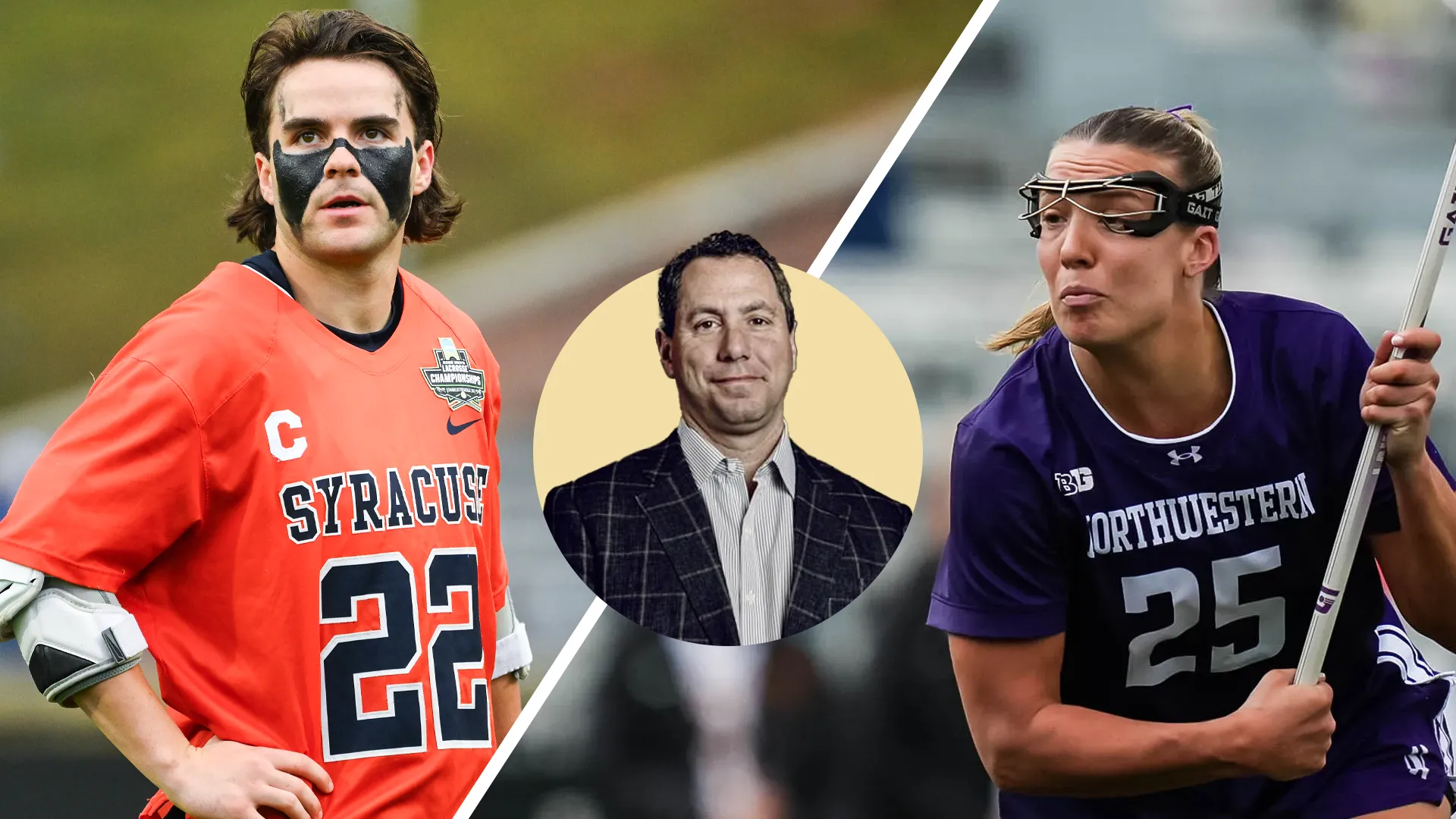
Long before Peter Schaffer became one of the foremost agents in professional sports, he was a lacrosse player at Franklin & Marshall.
The attorney and agent has since represented thousands of athletes across the National Football League, Major League Baseball, the National Hockey League, the PGA Tour and the Premier Lacrosse League. His past NFL clients include Pro Football Hall of Famers Barry Sanders, Jerome Bettis and Joe Thomas. His current PLL clients include Trevor Baptiste, Connor Shellenberger, Michael Sowers and the Kavanagh brothers.
Schaffer still cares deeply about lacrosse, and that affinity has drawn him into one of the sport’s biggest off-field questions this year: whether athletes from the high school class of 2022 will get a fifth year of eligibility under the NCAA’s new 5-in-5 rule.
“It’s my desire to grow the sport,” Schaffer said. “And I truly believe in this case that if these 2022s get what they should deserve, it helps the sport by keeping great players playing college lacrosse another year.”
Schaffer was the named attorney for a lawsuit filed in a Colorado court in July against the NCAA seeking an additional year of eligibility for Syracuse men’s lacrosse players Joey Spallina, Billy Dwan, Luke Rhoa, Michael Leo and Finn Thomson, as well as a few athletes from other college sports.
The filing argued that the players, all high school class of 2022 graduates, were being unfairly excluded from 5-in-5. The rule allows all college student-athletes from the high school class of 2023 and beyond to compete for five years beginning in 2026-27.
A Colorado judge ruled that the players’ games in Colorado were not enough for Colorado courts to have jurisdiction over the lacrosse players. They are among a number of 2022s now in limbo as the clock ticks toward the spring semester and the start of lacrosse season.
The landscape across all sports has been in flux through the fall season. In another big Colorado case, the 10th U.S. Circuit Court of Appeals sided with the NCAA in a class-action suit filed in July by Northern Colorado basketball player Brock Wisne on behalf of athletes who first enrolled in 2022
“Two weeks ago, there were three or four cases that came down on the side of the NCAA and everybody’s like, oh, the NCAA’s winning,” Schaffer said last month. “Well, in the last two weeks about 10 cases have come down for players. So the pendulum is switching back. This is not an area that has 20, 30 years of law. It’s changing every day.”
Schaffer stands ready to help college athletes, particularly lacrosse players, from the class of 2022 gain a fifth year. Each case carries layers of complicating factors: eligibility, timing, roster limits and players coming from a wide range of situations, whether trying to play a fifth year at their school or negotiating a late transfer after the portal has closed.
Having seen the athlete experience from both sides — as a college player and as an agent at the highest levels of pro sports — Schaffer understands how each of those pieces fits together.
“We have a bunch of different competing issues going on,” he said. “But the point is that we’re trying to go forward, and we’ll try to get as many different players the opportunity they can to play.”
The exact number of players who would like to play a fifth year is unknown, but Schaffer said he has been contacted by players, parents and college coaches through the summer and into this fall.
“I try to counsel and advise them all as to what the best way going forward is and what are the likelihood of success, what’s the timing of it, and try to give them as much information as I can in a sort of area that’s changing every day,” he said.
The return of the 2022s could greatly impact the 2027 college lacrosse season. Madison Taylor, the 2026 Tewaaraton Award winner, is the most prominent name on the women’s side. She’s been spotted on social media at defending national champion Northwestern’s practices and is taking graduate classes.
On the men’s side, the biggest name is Spallina. Along with Dwan, who is now coaching at Fairfield, he pulled out of the lawsuit days after it was filed. More recently, on Oct. 7 on the radio show Orange Nation with Steve Infanti and Paulie Scibilia, Spallina said this about the possibility of returning: “If there is a path, I’d love nothing more than to go back and play. Once a path is presented to me, I will explore that option. But I haven’t really been presented anything just yet.”
Roster limits play a big part in any player’s return. There must be a spot for them without exceeding the 48-man or 36-woman roster limits set by the NCAA House Settlement.
“What’s very important in my cases, if I’m going to represent a player, is that we are making direct representations to the court that if successful, that our players will not displace any student-athletes,” Schaffer said. “So therefore, you need the cooperation of the coaches.”
College coaches contacted by USA Lacrosse Magazine declined comment on the possibility of fifth-year 2022s returning. Those with full rosters likely could not consider it.
“That was the big argument for the exclusion of the 2022 cohort to begin with, was that if we let all these 2022s in and all these 2026s, the freshman class would be displaced. We don’t want to solve one problem and get sued by another group of people,” Schaffer said. “We’ve made it very clear that in order for us to file a lawsuit on behalf of any student-athlete trying to get a fifth year, we have to get an affirmation from a school saying that no player will be displaced.”
Timing is also important, and sorting it out has become strategic. It takes about three weeks to get a temporary restraining order that would allow a student-athlete to play, Schaffer said. Spring-sport athletes are targeting rulings around the first week of January, in time to enroll for the second semester if they haven’t already and to join a team’s preseason practices. Holiday breaks could further delay rulings.
Even a favorable ruling may not last, with the NCAA appealing decisions that go against it.
“You don’t want to get the temporary restraining order only then to lose a preliminary injunction,” Schaffer said. “If we get a temporary restraining order in January, and then they have a hearing in March, the player plays the first six weeks of season and they can’t play after that.”
That risk is difficult to protect against. Wait too long and the player may not be able to enroll, and team chemistry could suffer as well. Schaffer has been watching how cases are trending, hoping to see student-athletes win basketball and other winter-sport cases to set a precedent.
“Once we have a bunch of those, then I think it’s right then to start moving from winter sports to spring sports,” Schaffer said.
Where student-athletes file is also part of the strategy. They must find a court that will preside over their case; Colorado would not for the Syracuse players. And some judges are more inclined to rule for one side or another, particularly with certain types of filings.
“The cases that are winning are the breach of contract cases,” Schaffer said. “And that’s what we’ve been winning in a multitude of cases the last three months, certainly in the last two weeks, where there’s a breach of contract. The breach of contract is that if every other player gets five years, why doesn’t the class of 2022 get five years? That’s really the argument: It’s a violation of the obligation to act in good faith and fair dealings to all your constituents. Why do you single out the 2022 class?”
NCAA president Charlie Baker has countered lawsuits with a position he reiterated in response to Ohio governor Mike DeWine’s Oct. 13 executive order allowing 2022s to play.
Baker’s statement supporting the NCAA’s federal lawsuit against DeWine, filed Oct. 16, read in part: “Allowing them to return for an unexpected fifth season of competition would give them a benefit they never reasonably could have expected, to the detriment of thousands of eligible student-athletes who have been waiting for their opportunity to compete.”
Schaffer doesn’t think that argument is consistent.
“But then, neither could ’23s, ’24s, ’25s and ’26s,” he said. “The idea of fair dealing and good faith means you treat everybody the same. You don’t arbitrarily kick out one class or one group of people — what they’re doing — which is the 2022s.”
With some 2022 athletes ruled eligible and others not, week by week, the playing field is not currently level, Schaffer said.
“How long is the NCAA going to allow there to be this disparity, where they’re not really ruling, but separate courts are ruling so there are some teams that have fifth years or 2022s and some teams that don’t?” Schaffer said. “How is that fair?”
The answer for the NCAA could be the Protect College Sports Act, legislation that would federally regulate the eligibility model and bring every state and sport into alignment. It passed the Senate on Sept. 28 but still needs House approval. If the House doesn’t act before the new Congress is seated in January, the process starts over.
In the meantime, some 2022s are playing and others cannot. Schaffer hopes any high school class of 2022 lacrosse player who wants a fifth season can find a program where they will not displace anyone.
If players who graduated from college last spring see others being granted eligibility, they may want to return as well, even if they’ve already moved into the workforce. Ivy League players cannot return to their schools. And it’s possible that a school simply may not want a player back.
“We would ask in that case for a special disposition to reopen the portal for them only because their old school doesn’t want them back,” Schaffer said.
Another complication: players who have played professionally, as Spallina has. The Power Four conferences have adopted rules barring student-athletes who signed professional contracts, but not always for every sport.
Lacrosse was not mentioned by name in the Big Ten’s statement, only: “The conference continues to evaluate potential rules restricting professional athletes in other sports from conference competition.”
Similarly, the ACC mentioned only football and basketball in its Aug. 27 ban of professional athletes. Each player’s background and case is a little different, but all share one thing.
They want a fifth season.
“There’s an avenue for every kid, no matter what,” Schaffer said. “There’s a path forward. What the courts will say, we don’t know. But there’s a path forward. And I do not believe for a second that these efforts are bad for the sport, bad for colleges and bad for kids. I think it’s the opposite. I think it’s great for the sport, great for these student-athletes to get a master’s degree and get further education.”