
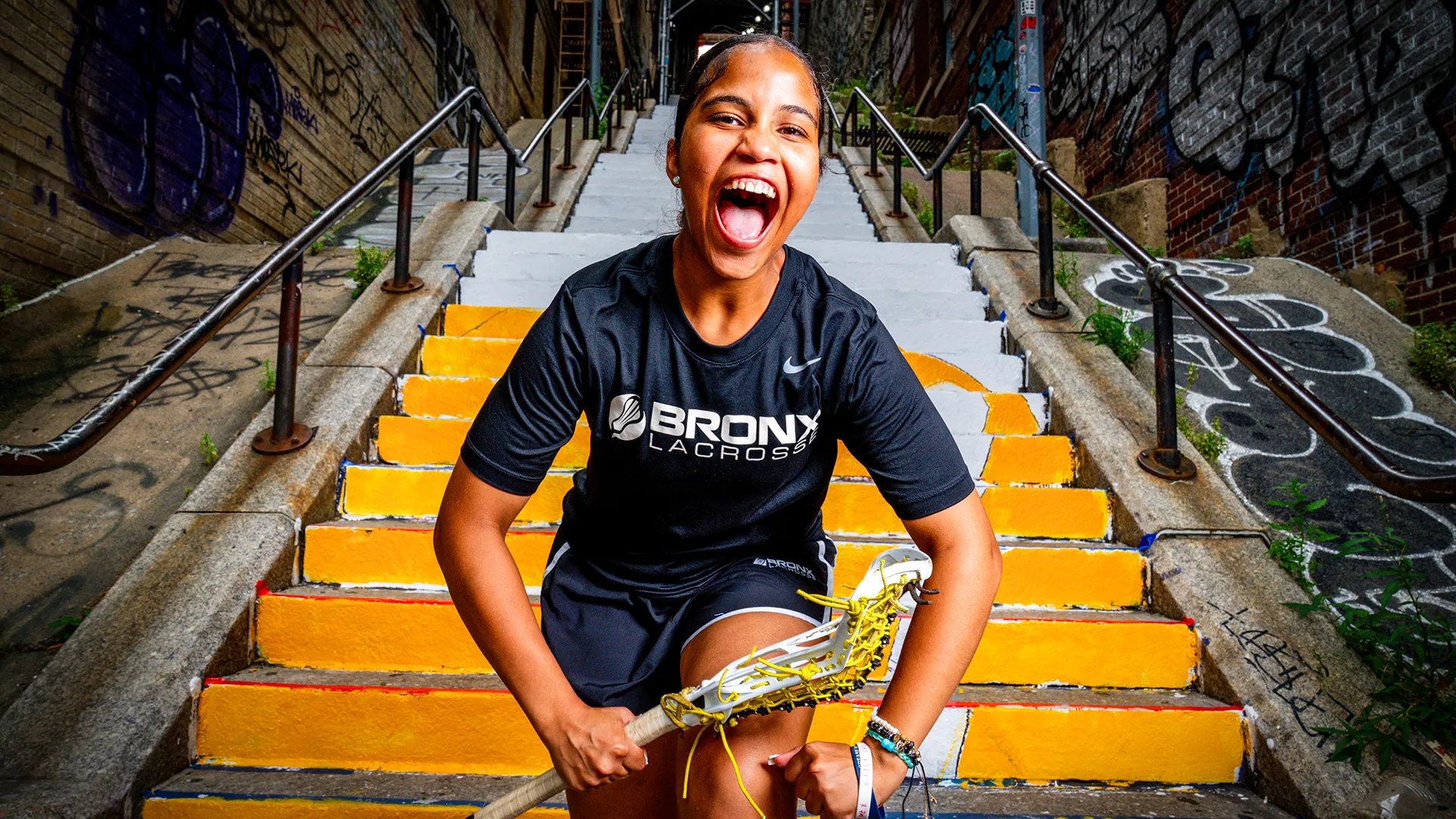
One hundred thirty-two concrete stairs separate Shakespeare and Anderson Avenues at West 167th Street in the Highbridge neighborhood of the Bronx.
Dan Leventhal looks at them almost wistfully as the 4 train rumbles into the station overhead.
Leventhal, 33, is 6-foot-4 and still built like a college athlete. A toothy, frothy smile betrays his chiseled jaw. Meeting him in person makes you appreciate the physical caliber of the players produced by the Tufts lacrosse dynasty. They are Division III in name only. Leventhal played there toward the beginning of the Jumbos’ ascent, scoring 13 goals as a starting midfielder for their 2014 NCAA championship team.
After graduating that year, he joined Teach For America and was sent to the nation’s poorest congressional district — a majority Latino community scarred by white flight yet ripe for reinvestment. Parents here raised $2 million to help fund the construction of the Highbridge Green School, an eco-friendly middle school with sustainable operations, an environmental curriculum and rooftop garden.
“I walked these every day,” he says, nodding toward the top of the steep stairwell and in the direction of the school some 85 feet above and five blocks yonder where he taught seventh-grade math.
Locals called these the Shakespeare Steps before the 2019 film “Joker” turned them into a tourist attraction. Now they’re known as the Joker Stairs, or Guasón Stairs, depending on your GPS language settings. Film buffs attempt to recreate Joaquin Phoenix’s clown-suited gyrations set to the “Rock and Roll” anthem of 1990s Chicago Bulls and Jock Jams lore.
Da-da-da-da-DAH — HEY! — da-da-da-DAH-DAH
Someone’s playing it on a Bluetooth speaker as we speak, syncing the music to their friend’s dance moves for their next TikTok. A cracked fire hydrant spits water onto the street as cars and kids slosh through the puddles on a hot and sunny midsummer afternoon. A passerby sees the cameras and logos and asks if we’re shooting for a pro sports team.
“No,” we say. “This is Bronx Lacrosse.”
Painted parts yellow and white by impressionist muralists, the Joker Stairs dissect graffitied apartment buildings where Whitney Antigua throws fake BTBs like Chloe Humphrey and Gabriela De Pena Vargas flexes like Charlotte North. They’re classmates now as freshmen at Cardinal Spellman High School, a diverse Catholic school in the Bronx with a 100% graduation rate and nearly as high a college attendance and acceptance rate.
Antigua used to struggle to show up on time for school. She was marked late 58 times, she says, in two years before Asa Goldstock, the former Syracuse goalie and USC coach, started calling her every morning before New York City Marathon training runs. The managing director of programs at Bronx Lacrosse and brawn behind its burgeoning women’s program, Goldstock nagged Antigua to the extent that Antigua eventually started preempting her coach by texting videos of her doing wall ball before opening bell.
“When you play lacrosse, it takes all your problems away,” she says.
De Pena Vargas oozes ambition. Born in the Dominican Republic, she moved to the Bronx when she was 5 with her grandmother, mother, uncle, brother and sister. Last year she finished with a 98% average, made valedictorian and earned a scholarship to Cardinal Spellman.
“I feel inspired. I feel supported. I feel like there’s people who want to see me succeed,” she says. “We don’t get that anywhere else.”
Along with eighth-grader Marcelle Djabigou, they are the manifestation of the Bronx Lacrosse mission to improve educational opportunities and life outcomes for underserved middle school and high school students in the Bronx.
And strictly the Bronx, the forgotten borough in the shadows of Yankee Stadium. Where Leventhal, Goldstock and the rest of Bronx Lacrosse’s 18-person staff hope to see lacrosse become as ubiquitous as baseball.
What started with 30 players recruited by Leventhal to start a Highbridge Green boys’ lacrosse team has grown to 300 players from multiple secondary schools. Today you’ll find them studying algebra in the new College Access Center at 818 River Avenue, the centerpiece of a $5 million campaign.
A whiteboard beckons with the quote of the day written in fluorescent green marker. They’re the words of late tennis legend Arthur Ashe, a pioneer of racial equity, global human rights and athletic activism.
Start where you are. Use what you have. Do what you can.
Leventhal started at Highbridge Green School. He had lacrosse. He did what he could.
The son of a financial tech CEO and teacher from Chappaqua, New York — an affluent Westchester County hamlet where the Clintons live — he followed his mother’s footsteps into education and needed an icebreaker.
“I was just looking for a way to connect with my students,” he says. “There were limited opportunities to do so.”
They didn’t have much in common. Leventhal was a Jewish lacrosse player from one of the richest towns in America. The median annual household income in Chappaqua is $241,432, according to U.S. Census Bureau data. In the Highbridge/Concourse district, it’s $44,103. Not exactly fertile ground for an expensive sport like lacrosse. But their eyes lit up when he showed them YouTube highlights from Tufts’ 12-9 win over Salisbury in the NCAA championship game.
Leventhal, who played and coached for Israel’s national team after graduating from college, scrounged together enough used sticks and equipment to start an informal after-school lacrosse club. He outfitted 30 seventh-graders with helmets from CityLax, sticks from Tufts and additional equipment from NESCAC rival Wesleyan. The only prerequisite was they had to attend school daily, arrive on time and participate actively in his class.
“We got real results early on,” he says. “That’s how I knew we could use this game to keep students on the right track to reach their full potential.”
The impetus for Bronx Lacrosse was a spring 2016 trip to Leventhal’s hometown. He wanted the students to play an authentic lacrosse game, on grass rather than blacktop. They attended a clinic put on by the Horace Greeley High School varsity team and competed against seventh- and eighth-graders from Chappaqua’s two middle schools. For many, it was their first time venturing beyond the Bronx. One player told Leventhal he thought he needed to go to Alaska to see that many white people.
Leventhal doesn’t remember the result of the game. Only that he knew at that moment his own Bronx tale would center on a sport that had no business taking root there. He left teaching after two years. With equipment grants from USA Lacrosse in 2017 and 2018, he founded Bronx Lacrosse.
“I was able to get up and running quickly with a team in a local league because of USA Lacrosse,” Leventhal says. “Since then, the partnership remains close. All our coaches go through the USA Lacrosse certification process. And USA Lacrosse has really helped us eliminate financial barriers with equipment grants and transportation stipends. It’s such an important part of this program. USA Lacrosse has helped bridge the gap and make these opportunities possible for our young people.”
The onset of the COVID-19 pandemic in 2020 halted that momentum but also presented an opportunity for Leventhal to double down on his commitment to the community. Bronx Lacrosse launched a food security initiative, raising more than $50,000 and purchasing gift cards from local supermarkets for 120 families to ensure their cabinets were full and refrigerators stocked.
“Everything is trust,” he says. “Every day we build trust and relationships in the community. We’re not going anywhere. We’re sticking to this community.”
Bronx Lacrosse does require a commitment in return. It’s not for the faint of heart. Spots are awarded by application only. There’s a waitlist. Start missing school or twice-weekly algebra readiness tutoring, and you risk getting dropped. That’s not to mention daily practices after school and early Saturday wakeups to travel to games and tournaments.
To get to the Randall’s Island athletic fields — a central hub of New York City scholastic lacrosse located under the Triborough Bridge in the East River — Antigua rides the 4 train to 125th Street and the 6 train to 103rd Street, then walks east to the footbridge. She crosses the bridge on foot and keeps walking once she reaches the island. Depending on the field, the trip can take close to two hours before she ever unsheathes her stick.
Still, it takes far less coaxing than it did to get her to school on time. If she’s not on the subway to a lacrosse game, then she’s doing stick tricks at Mullaly Park or bouncing a ball off the limestone walls of Yankee Stadium. Today she’s training with Goldstock during a field session across the street at Macombs Dam Park, on the clumpy grass between baseball diamonds where the original House That Ruth Built stood until 2009.
Goldstock sees herself in Antigua. A child of divorce, she bounced between homes upstate but found a second family in lacrosse. Literally. She lived with Kayla Treanor and her older sister, Alyssa, in Niskayuna, N.Y. They coached her in rec league. When Goldstock transferred to a private boarding school in New Hampshire, she spent holidays with the Treanors.
“Sixth through eighth grade, those years are so important for kids’ development, how they view the world, how they interact with people and see themselves. That’s a big reason why I can connect with my kids so deeply,” Goldstock says. “We serve Black and brown kids in the Bronx. I cannot connect with them on that level. But I’ve always been able to connect with them on what it’s like to be lost at 12 years old and in need of guidance. Lacrosse gave that to me. My family gave that to me. The Treanors gave that to me. Every moment in my life, lacrosse has driven it.”
Antigua sees herself in Goldstock too. She wants to play lacrosse at Syracuse, where Goldstock started 99 career games and led the Orange to the 2021 final four. Last year, every Bronx Lacrosse senior graduated high school on time and enrolled in higher education within six months of graduation.
While much of Bronx Lacrosse’s public acclaim has centered on men’s lacrosse, including four-star Delaware commit Jordany Rosario, privately they’re building a women’s lacrosse powerhouse. They have just as many girls as boys playing the sport. Highbridge Green teams swept the Middle School Athletic League championships in the spring. And their women’s staff could rival that of most colleges.
Managing director of operations Julie Krupnick was a starting goalie at Northwestern and still plays for Team Israel, which won a historic bronze medal at the 2026 World Lacrosse Women’s Championship in Japan. Program directors Jordyn Harrison (Michigan), Courtney Maclay (Stony Brook/Syracuse) and Abbey Ngai (Boston College) also have serious Division I pedigree.
“We were on a bus ride to a tournament the other day and they were looking me up on social media. They saw I had a post on there from when I played with the U.S. U20 team,” Harrison says. “They were like, ‘This is sick.’ Being able to talk about those experiences with them has been fun.”
A New Jersey native, Harrison fell in love with the Bronx as a stadium operations intern with the Yankees. She admired the families she met during food and toy drives and school supply giveaways.
“There’s a real sense of taking care of each other, looking out for one another,” she says, noting how players linger after practice and tote their lacrosse equipment to get a bag of chips at the bodega. “You don’t get that in every community.”
Women leading women, Krupnick says, matters in places where opportunity gaps exist. She notes the 2015 Ernst & Young/espnW survey finding that 94% of C-suite women played sports, including 52% who competed at the university level.
“It’s crucial for our girls to see that women belong in leadership positions,” says Krupnick, who graduated from Northwestern with a bachelor’s degree in social policy and a master’s degree in management studies and this year earned her second master’s degree from NYU Wagner Graduate School of Public Service. “It’s cool to show our kids where sports can take them.”
Lacrosse has already taken Djabigou viral. She frequently posts wall ball videos modeled after Humphrey’s routine on social media and got the chance to meet her idol when Humphrey visited Bronx Lacrosse over the summer. They played catch, exchanging behind-the-back grabs as onlookers whistled. “Finally got to see the magic in person,” Humphrey commented on Instagram.
Goldstock and Krupnick both say Djabigou could be the best player to come out of Bronx Lacrosse since its inception. She also plays for Predators Lacrosse and was one of the youngest players to earn all-star recognition at the Trilogy Lacrosse Future Icons Tri-State event two summers ago.
“There’s no shortage of academic or athletic talent in the South Bronx,” Leventhal says. “Our kids just too often lack the opportunities afforded to their more affluent peers.”
Djabigou even sounds like Humphrey when she talks about the unseen fails that precede her pristine wall-ball videos — the errant bounce-backs that hit her in her head or back —and how setbacks only embolden her to practice more.
“I love the fact that nobody around here knows about it,” Djabigou says.
Unsurprisingly, she says she wants to play at North Carolina and perhaps professionally. No Bronx Lacrosse girl has played high-level college lacrosse. Not yet.
“It’s coming in the next few years,” Leventhal says.
Djabigou has Chapel Hill in her sights. Antigua envisions Syracuse. After meeting Army coach Michelle Tumolo, De Pena Vargas could see herself attending West Point.
Back on the Joker Stairs, De Pena Vargas plants her feet on the painted concrete, grips her stick and roars at the camera. She has a name for the defender she’s becoming: the Reaper. She also has names for the Bronx Lacrosse staff members helping to secure her future in the sport.
“They build these connections with us players that make us feel like they’re our second family,” De Pena Vargas says. “It’s just like Aunt Asa or Grandpa Dan.”
The coaches laugh at the characterization, especially of Leventhal. De Pena Vargas speaks with childlike wonder but also striking confidence. Her younger sister, Daniela, recently joined Bronx Lacrosse and plays goalie. She’s grateful to have a wall ball partner at home.
Ask her what she’d tell the next girl from Highbridge who has never held a stick, and she doesn’t hesitate.
“There’s nothing wrong with trying,” she says. “Come, we’re waiting for you. Come play.”