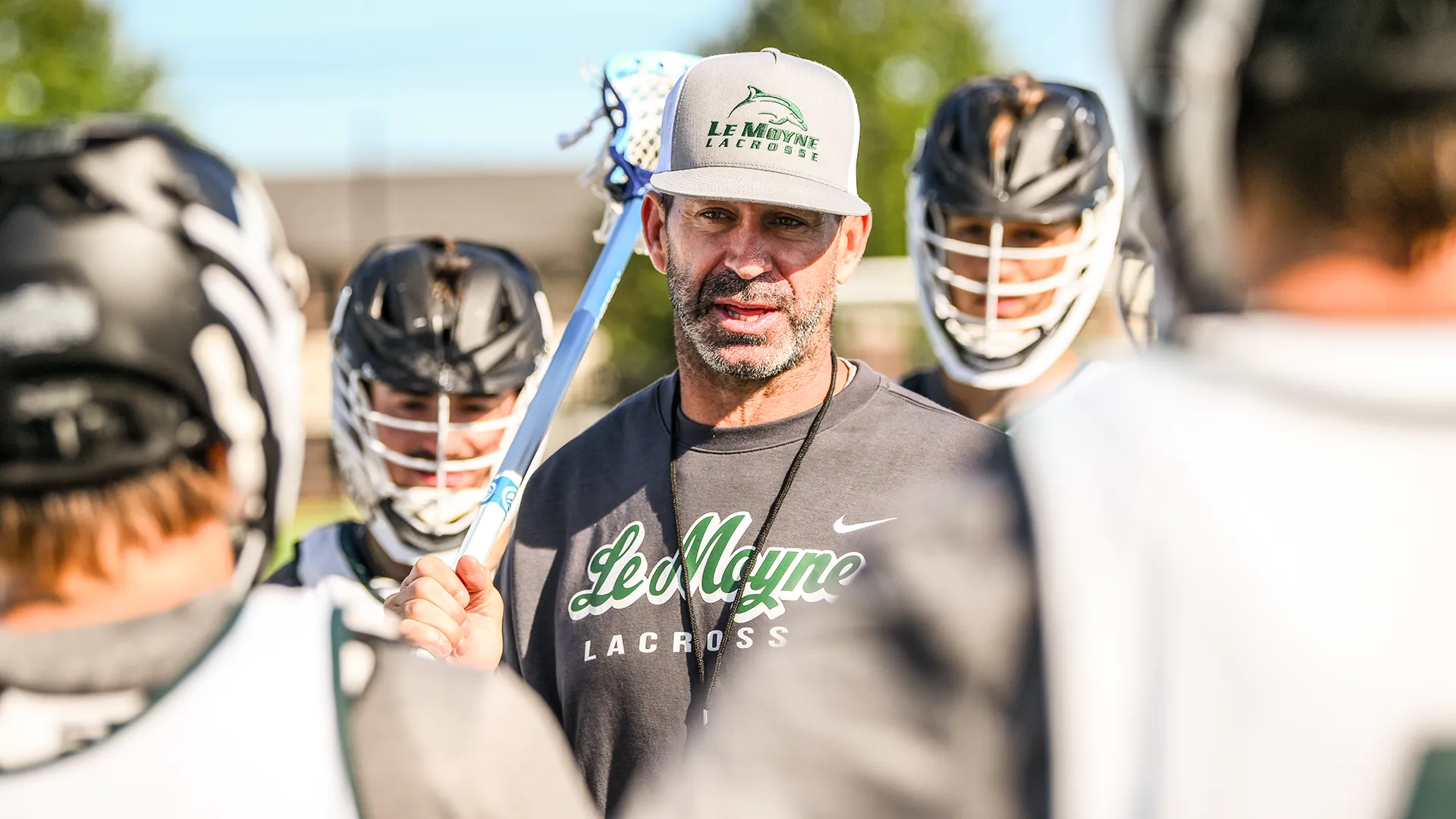
SYRACUSE, N.Y. — Le Moyne’s newest head coach sits in his black office chair, surrounded by trophies he didn’t win at a program he didn’t build.
He crosses his arms before he tries to answer the question.
“Well, you know, I'm involved with box lacrosse,” Casey Powell says. “I'm involved with sixes. I started a version of the game, a 3-on-3 version called Speed Lacrosse. I've played internationally. I've played for 13 different coaching staffs professionally, and these are the best coaches in the world. I got to play for Coach (Roy) Simmons Jr.”
When it comes to playing lacrosse, few people in the world hold a candle to Powell. There’s all the stuff he just mentioned, of course. But there’s also the fact that, as a freshman, he was the leading scorer on Syracuse’s 1995 NCAA championship winning team. Or, even better, the fact that he was forced into midfield as a sophomore out of necessity and ended up casually winning the Lt. Donald G. McLaughlin Award that season, a prize reserved for the nation’s best collegiate midfielder. A four-time All-American, two-time pro lacrosse MVP and twice a member of the U.S. Men’s National Team, Powell was inducted into the National Lacrosse Hall of Fame in 2017.
But the question wasn’t about playing; it was about coaching, where Powell’s CV is relatively barren. It includes a brief stint as an assistant at Cortland, a 2016 season engineering Jacksonville’s attack as its offensive coordinator and a 2020 season where he was a volunteer assistant for Northwestern’s women’s lacrosse program. Powell’s been out of the collegiate ranks for six years since.
He knows how this looks. He knows that, in the lacrosse world, coaches must earn the right to sit in this chair. John Desko did it. Gary Gait did it, too. So did Andy Shay, Matt Madalon, Kevin Warne and most any other Division I head coach you could name, really. He knows that, somewhere, there might be people who think he doesn’t really deserve to be in this chair.
“One thing I know about lacrosse is, you got to pay your dues,” Powell says. “And I wouldn't say that I have, in the coaching ranks.”
But Powell lives in a world where nothing he can dream is impossible. He dreamed about wearing the No. 22 jersey at Syracuse until it happened. He dreamed about winning a national championship at Syracuse until it happened. He dreamed about captaining Team USA until it happened.
“He’s Casey Powell,” said Ric Beardsley, who played alongside Powell at SU. “Everything he's done typically works out.”
Coaching only became a dream of Powell’s about three months ago. Once it did, he threw himself into it with the same intensity that he’s approached every other dream he’s ever had. Phil Brown, Le Moyne’s athletic director, led a national search after longtime head coach Dan Sheehan stepped down this June.
“We had a ton of interest,” he says, but it all led him to Powell, sitting in this office, surrounded by trophies he didn’t win at a program he didn’t build.
Practice is about to begin. Before it does, Powell points at the prize sitting on his windowsill.
“That’s the one that means the most to us,” he says, looking at the 2025 Northeast Conference regular season championship.
A man named Bobby Dick sits at a desk in Powell’s office.
He works on a silver Macbook he’s hooked up to the TV above him. He pulls up a highlight reel of a three-star recruit. Periodically, he’ll switch tabs and add a name to a Google Sheet for Powell to look at.
Nothing ever slows down here. Powell’s getting almost two dozen emails a day from prospects, and all of them would die to play for his program. The other day, Le Moyne hosted a prospect camp. Too many kids signed up, more than 60 of them. They had to prematurely close registration. He offered scholarships to a couple of them, too.
This is the Casey Powell effect.
“People are going to talk about him,” said ESPN analyst Paul Carcaterra, one of Powell’s former Syracuse teammates. “They're going to want to know what he's doing.”
He's still trying to figure out what he’s doing. Powell took the job about seven weeks prior to this visit from USA Lacrosse Magazine. When Justin Schneidman — the Dolphins’ defensive coordinator — left for Syracuse, Powell offered the job to his old SU teammate, Beardsley. But the timing didn’t work for Beardsley, so Powell landed on A.J. Mercurio, a hulking 24-year-old from Denver. The only holdover from Sheehan’s regime is Ray Ryan, a volunteer assistant who’s helped Powell run camps for years.
It’s time to meet the team. Powell throws on a pine green Le Moyne sweater — light protection from the rain — and makes his short walk to the field. He arrives to the tune of house music blaring from a black JBL speaker. The DJ is a freshman long pole named Henry Dvorak. All his teammates tell him how much fun they’re having every day, playing lacrosse for Powell.
For the next 90 minutes, it’s drill after drill: clearing drills, three-on-three quarters drills, six-on-six and a full-field scrimmage. Powell never lets his foot off the gas.
Someone scoops the ball with one hand. “Pay attention to detail!” Powell yells out.
Someone gets dodged past for a goal. “Are we going to play some defense?” Powell shouts.
“If you think being nice and making it easy is the way,” he later tells his team, “it’s not.”
He pulls aside attackman Will Hardy, a UAlbany transfer, and uses him as a test dummy to demonstrate a pick play. When he notices lackadaisical effort from his attack, he jumps in the air with a stick in his hand to show his players they should never catch the ball flat-footed.
After Sheehan left, Lucas Winger says, he considered transferring. But as he entered his senior year, Le Moyne’s starting goalie decided it didn’t make sense. Instead, Winger served on the school’s search committee and helped the Dolphins decide they needed to know what it’s like to play for Casey Powell.
“It’s awesome,” midfielder Carter Kempney says.
Before ending practice with a full field scrimmage, Powell brings his team together around the midfield circle. He wants to get his faceoff guys some work, so he’s doing it in the only way he knows how. In his camps, he’s tried for years to impart his training principles on the kids who come. He wants to get them to dream. He knows the world is within their reach.
Two sticks meet in the middle. Powell’s voice sets the stage.
“For the Northeast Conference championship.”
The boy wanted to dream at a time when nobody in Carthage knew how.
His name was Casey. Carthage sits next to the Black River, which runs at a velocity conducive for papermaking, so the boy’s grandfather worked in the paper mills. His father did, too, and he thinks he would’ve followed in their footsteps if Kirk Ventiquattro had not shown him how to dream in fifth grade.
Ventiquattro learned about lacrosse while studying at Cortland, and the gym teacher brought his lessons back to Carthage. One day, during a class, he taught the boy about it. The boy wouldn’t stop talking about lacrosse, so his father sold one of his shotguns to buy him and his brothers three sticks. They were the first kids in town to have them.
The boy channeled his hopes into his stick and began to dream in a backyard that’s spoken about in Carthage with the reverence of a holy land. He’d mow the lawn after school, place flour down to mark the crease, tighten the net strings and run out the back door like he was being introduced to thousands in the Carrier Dome.
Each night, another national championship. Everything the boy dreamed here came true. He became the nation’s best high school player, found himself at Syracuse and received the No. 22 jersey he’d always pictured himself in.
By 1995, the boy was no longer a boy. He was a man now, in Washington, D.C., standing on a field before his first collegiate game. He’d listen to any number of national anthems in the years that followed, on stages much grander than this, and almost all of them are lost to the sands of time. But he still remembers the first one.
He still remembers how it made him cry like a boy.
Le Moyne is a job for dreamers.
It’s a job for Mercurio, who dropped everything to come here because Casey Powell is someone you drop everything to work for. It’s a job for Dick, who worked his way into this office by cold emailing Powell and waiting weeks for a reply. It’s a job for Dave Falge, the former longtime Cazenovia head coach who — just one year before retirement — decided to leave the Lakers to be Powell’s assistant.
It’s a job for Brown, who grew up in South Louisiana, moved to Houston and came to Syracuse to push Le Moyne from Division II to Division I. When he became the AD, he did so hoping to make Le Moyne a national brand. He envisions a world where people turn on ESPN, see “Le Moyne” on the score ticker and think to themselves: “Oh, it’s that school in Syracuse.”
“That's what my vision was,” Brown said. “We're a great school for Central New York. Our alumni stick around. But how do we go further?”
The answer, in Brown’s eyes, was Powell. He didn’t know who Powell was until he saw his resume, but he quickly learned Powell was a national brand. It didn’t take much longer for Brown to learn what Syracuse meant to him. His fiancée is from Syracuse, and his daughter goes to school here. Fifteen years ago, his parents moved here from Carthage. The school that made him a star is in his backyard.
There is a lot working against Powell here. He must compete with that juggernaut up the road, at a fledgling program that has a history of success in Division II — a tier in which Dolphins won six national championships between 2004 and 2021 — not much in Division I. Next is the fact that the program’s annual budget is scrawled on a massive whiteboard hanging in his office, and the number isn’t particularly large.
Does any part of it scare him?
“We don't have a huge budget. We're not a huge school,” Powell says. “But I like that. We're underdog mentality. It reminds me of how I grew up, with limited resources, where I earned everything that I got.”
Well, but what about Brown? Does any part of this scare him? Le Moyne hasn’t had to replace a lacrosse coach in decades. When they did, they had no shortage of options, so they certainly could’ve found someone with any level of coaching experience to replace him.
Is there really no apprehension to the idea that he hired someone with none of it?
“I know what you're asking,” Brown says. “And yes, I would be lying if I said [I didn’t think], ‘Hey what does he not bring to the table?’ And that was, you know, years and decades of coaching experience, which some of the other candidates had.”
But the way he puts it, he can teach a coach to do the administrative stuff. He can teach them how to schedule a game, book a bus, arrange hotels, follow NCAA compliance rules, whatever.
He can’t teach someone how to teach the sport of lacrosse the way Powell can. It’s only been seven weeks, but Powell already thinks he’s figuring it out. Today was a good practice, Mercurio says. He can tell when the guys don’t have it and today wasn’t one of those days.
Back in his office, Powell looks outside his window. He’s trying to remember when this job finally felt like his. A few days ago, he says, he was at an alumni golf tournament. Sheehan spoke to the crowd.
Sheehan began by saying that, when your kid gets a permit, you’re always nervous they’re going to fail their test or — even worse — crash the car. But they get their license, and those nerves start easing up little by little until, one day, they’re gone. The kid went to the grocery store alone, and you never even thought to drive them.
Feels Like Home
"We don't have a huge budget. We're not a huge school. But I like that. It reminds me of how I grew up."
Casey Powell on Le Moyne
“
We don't have a huge budget. We're not a huge school. But I like that. It reminds me of how I grew up.
Casey Powell
Head Coach, Le Moyne College