
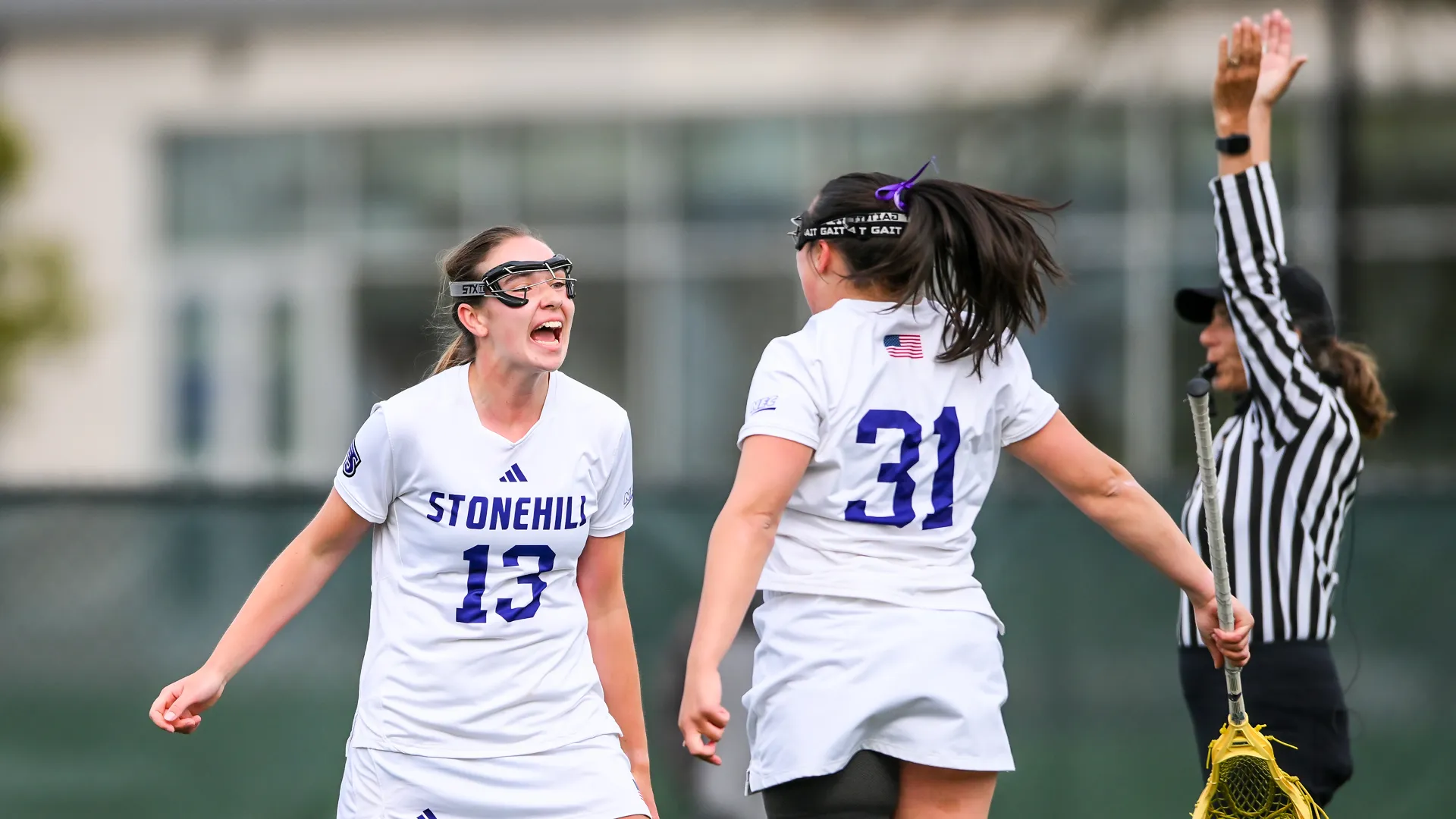
Members of the two NCAA women’s lacrosse rules committees have proposed modifications to refine the penalty rules in the sport, effective for the 2026-27 academic year. The changes also are designed to avoid unintended consequences.
The Division I Women’s Lacrosse Rules Subcommittee and the Division II and III Women’s Lacrosse Rules Committee made the recommendations.
All rules proposals must be approved before becoming official. The Division I Women’s Lacrosse Oversight Committee is scheduled to discuss the proposals later this month, and the Division II and Division III Playing Rules Oversight Panel is scheduled to discuss the recommendations Aug. 11.
In keeping with the committee’s ongoing focus on safety and recent emphasis on simplifying penalty administration, both committees proposed changes designed to further refine the penalty structure.
Those changes include:
- Making all yellow cards two-minute, nonreleasable penalties.
- Naming illegal checks and illegal contact as fouls in a way that defines and simplifies impermissible actions with one’s stick or body. An illegal check would be called when a player initiates contact using an uncontrolled or swinging (chopping or hacking) motion of the stick to strike an opponent’s stick, hand or body, regardless of whether the opponent is in possession of the ball. Illegal contact would be defined as using one’s stick or body against an opponent’s body in a manner that is unsafe or reckless or that pins, restrains or detains an opponent’s movement, including using the webbed area of the stick to hook.
- Classifying flopping as a flagrant foul, resulting in a yellow card and two-minute nonreleasable penalty.
- Adding targeting as a new flagrant foul. A player who commits targeting would be assessed a red card. The following definition was proposed: any action in which a player initiates forcible contact with an opponent without making a legitimate attempt to play the ball and where the primary purpose of the contact is to strike, hit or otherwise make significant physical contact with a high potential for injury rather than to contest possession.
Video review
In addition to the existing use of video review, officials also would be able to use video review to identify or confirm the correct offender when a card is administered.
A video review request must be made before:
- The defensive team advances the ball from the goal circle beyond the defensive 30-yard line following a no-goal ruling or undetected goal.
- The draw clock expires following a goal.
- There is a change of possession.
- The ball goes out of bounds and play is restarted.
- A restart is administered.
During a timeout, any video review request must be made within the first 30 seconds of the timeout.
Other rules proposals
- Teams on a power play at the expiration of a quarter, overtime half or overtime period would retain possession to begin the subsequent quarter, overtime half or overtime period.
- Officials would be required to conduct at least one stick check per quarter on players who take the draws. The stick check would be conducted immediately prior to a draw.
- Players receiving red cards still would be ejected from the game, but the automatic suspension for the next game would be eliminated.
Experimental rules
During the fall, teams could experiment with the possession clock.
Following possession gained from a draw or possession awarded in lieu of a draw, the possession clock would be set to 60 seconds instead of 90 seconds.
Also, teams could experiment with reducing the total number of players on the field from 12 to 11 and reducing the number of players required below the restraining line from seven to six.
If an attacking team fails to keep possession below the restraining line, except for a deflected shot, the opposing team would be awarded possession at the spot of the ball.