John Fee knew a guy.
It’s the opening line in so many legendary bar stories. But in this case, it’s about how a piece of steel from the World Trade Center ended up 200 miles away at USA Lacrosse headquarters in Sparks, Md.
The connection Fee had to obtain that piece of history also helped form a connective, healing tissue for the lacrosse community from New York to Maryland and beyond following the September 11 terrorist attacks.
“That request for a piece of steel turned into something much larger than a piece of steel,” Fee said. “It turned into a healing process.”
Fee spent 25 years in the New York City Fire Department and was an original member of the FDNY lacrosse team. His close friend, Ronnie Kloepfer, was the founder of the NYPD lacrosse team.
At around 10 p.m. on Sept. 10, 2001, Fee and Kloepher were on the phone discussing an upcoming trip to Chicago for a lacrosse tournament.
It was the last time they spoke.
Kloepfer was one of 23 members of the NYPD to die in the line of duty the next day. For the next 72 hours, Fee thought his brother, Frank, who was with FDNY’s Rescue One, was among the 343 firefighters who also perished on Sept. 11.
“We were on the phone, and my brother goes, ‘I’m going into the building,’” Fee recalled. “He hangs up, and I watched the building come down. I called him, no answer. It took me three days to find out that my brother was alive.”
When USA Lacrosse was set to move into its new headquarters in Sparks in 2016, former USA Lacrosse CEO Steve Stenersen said it was decided early on to include a Memorial Garden honoring Sept. 11 victims.
Kris Snider, a member of the USA Lacrosse board of trustees and a landscape architect by trade, designed the memorial, which includes a central heart stone surrounded by six spirit sticks pointing skyward.
“It’s not just honoring those who perished,” Stenersen said. “It’s also honoring those who were moved to serve others through the military and as first responders.”
As part of the grand opening of the headquarters and the dedication of the memorial, the FDNY and NYPD teams played at William G. Tierney Field.
Kira Muller, the USA Lacrosse alumni relations specialist at the time, reached out to invite Fee and his team.
“Everyone who plays lacrosse or who’s been involved in it says that lacrosse is the medicine game and it heals, and there’s some truth in that,” Muller said. “I think the two teams playing at the new headquarters, I thought that was healing for them, seeing the garden.”
It was more than that for Fee.
“I was blown away by the memorial garden,” Fee said.
In turn, Fee offered up a possible addition to the museum — a piece of steel from the World Trade Center. Muller was stunned by the unexpected suggestion.
“To get that piece of steel and then have this connection with the FDNY and the NYPD, which I didn’t have before, that was super meaningful,” Muller said. “Those guys had a great time on the field. It was like a moment of healing, and then, yeah, for him to say, ‘Oh, I think we can get some steel, I was like, wait, what?”
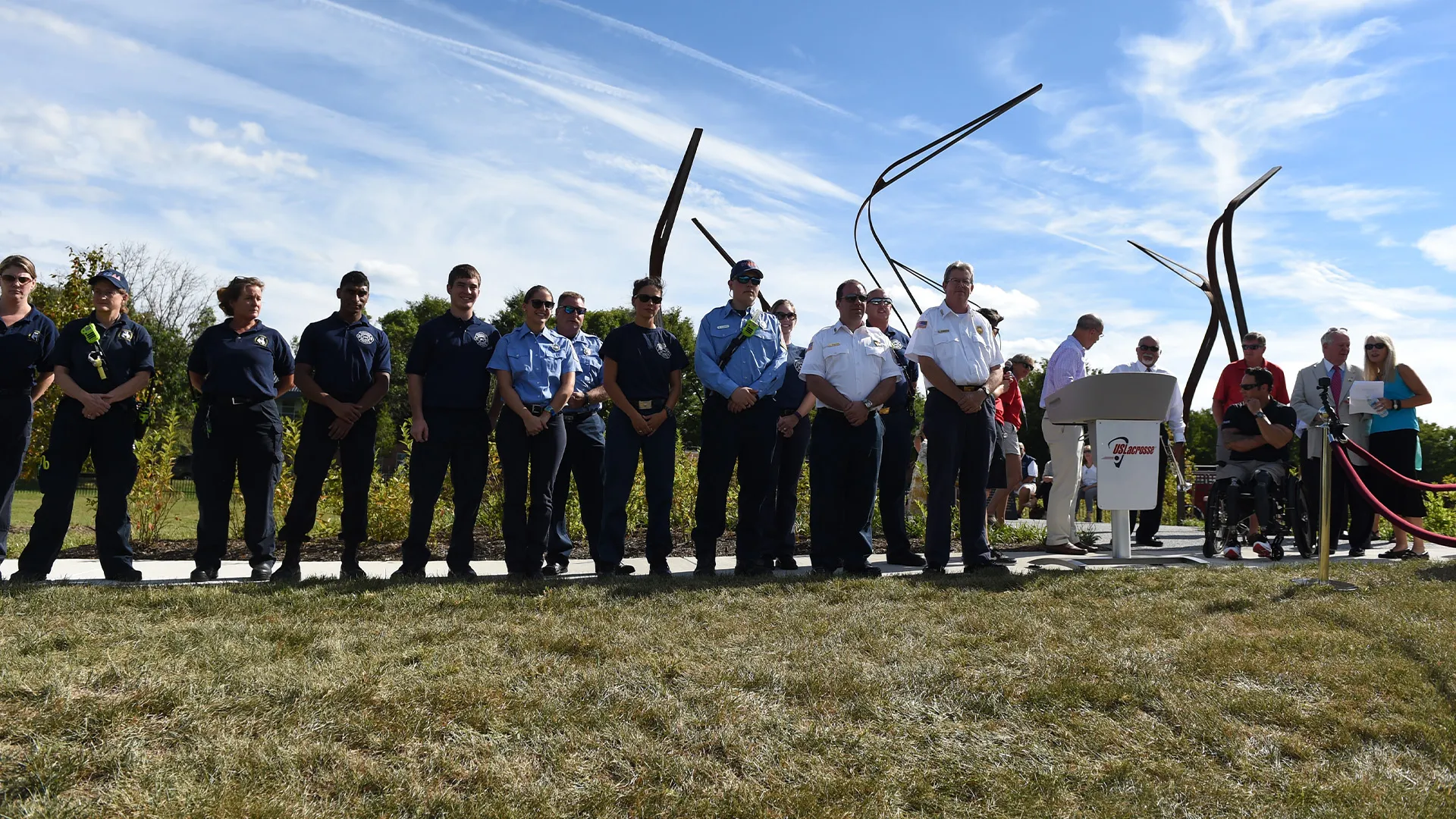
9-11 Memorial Garden
USA Lacrosse's 9-11 Memorial Garden was dedicated on Sept. 11, 2016. It led to a piece of steel finding its permanent home in the National Lacrosse Hall of Fame and Museum at USA Lacrosse headquarters on Veteran's Day a few months later.
In 25 years on the job, Fee made plenty of connections. That includes Robert Turner, who rose to the rank of First Deputy Commissioner of the FDNY, second in command of the department.
Turner told Fee his was among 2,000 applications for the 20 remaining pieces of steel. That was the bad news.
The good news?
“He goes, ‘You know me. See me at 2 o’clock, I’ll have you a piece of steel,’” Fee said.
The handoff from Fee to Stenersen took place on Veterans Day 2016 in a private ceremony on the 9/11 Memorial and Museum plaza. Joining the FDNY, NYPD and Port Authority of New York were the families of Ronnie Kloepfer and Welles Crowther, known as “the man in the red bandana,” who saved as many as 18 people before dying in the collapse of the South Tower.
“It was a really nice, quaint ceremony — meaningful,” Muller said. “It brought tears to my eyes. It still brings tears to my eyes.”
Stenersen and Muller transported the heavy piece of history in a suitcase and boarded a train back to Maryland.
“John said we can make it even nicer and more poignant and meaningful, and he did, and God bless him, man,” Stenersen said. “We never imagined that was a possibility. It was incredibly humbling to know that a piece of that day is forever remembered in the museum at USA Lacrosse headquarters.”
Muller also authored a Facebook page titled “Lacrosse Remembers,” where she wrote obituaries on the 75 people with known connections to lacrosse as players, coaches, and supporters of the community who died on 9/11.
“It was one of the most important projects I ever worked on at USA Lacrosse,” Muller said.
Fee was moved to start a first responders’ tournament on Long Island, which featured the FDNY, NYPD, Suffolk County police, a team from Maryland, and a team from the Iroquois Nation made up of Canadian police officers.
All told, eight teams competed and raised $11,000. Fee donated $8,000 to the Tunnel to Towers Foundation and another $3,000 to underprivileged college students from Freeport, Uniondale, and Hempstead in Nassau County.
It also spurred Fee to start a non-profit organization called Never Forget Lacrosse Foundation, which is still active today.
“That piece of steel has so much more meaning than a piece of steel. I played with Dennis Buckley, and I played with all these guys who weren’t even firemen or cops,” Fee said. “It meant a lot for me to be able to get it and to make it something that is more than a piece of steel in a museum. That tournament with all these different teams playing each other was an undertaking, but it was just God’s work, and I did it for [Ronnie Kloepfer].”