
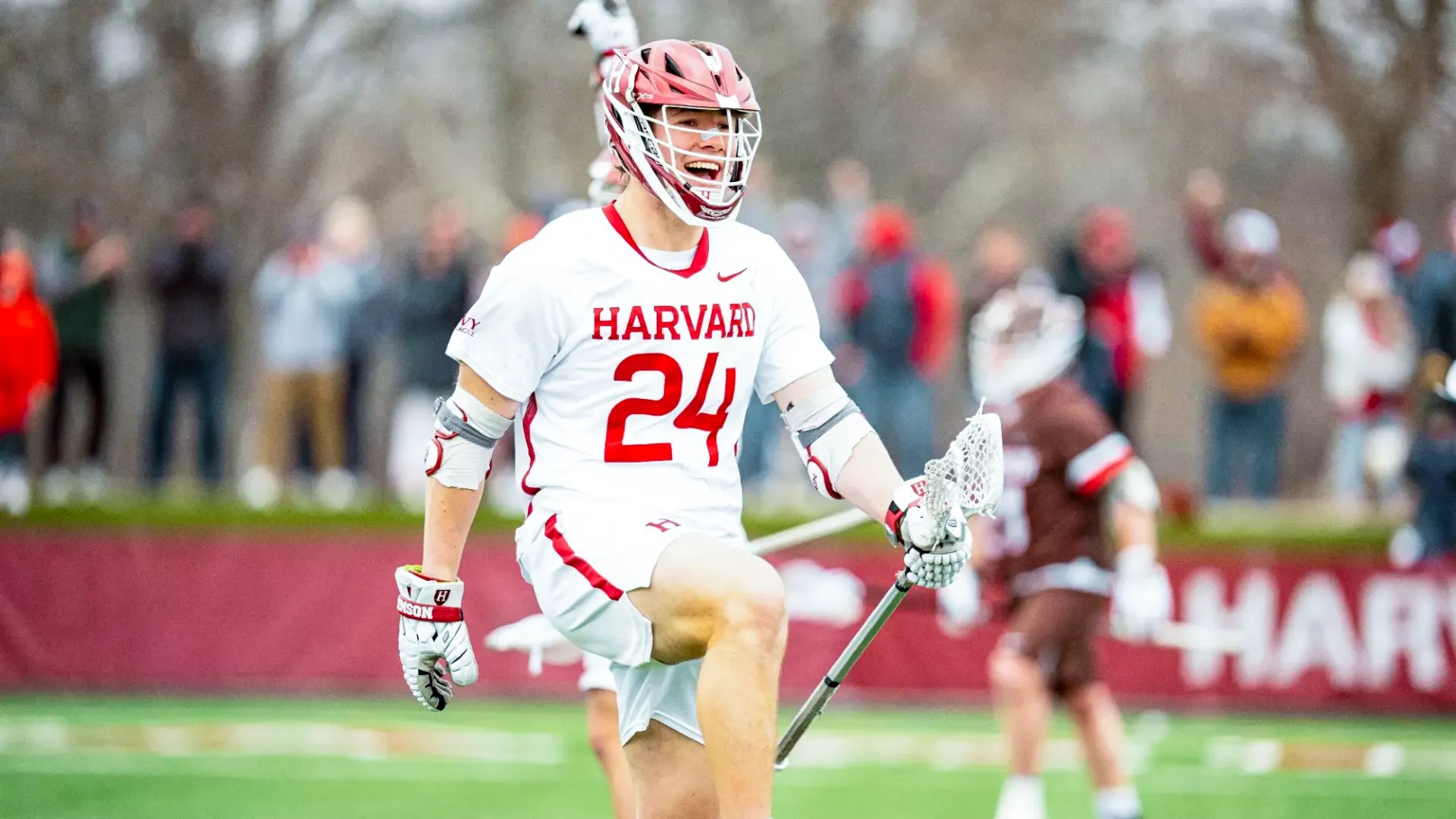
Gerry Byrne has his pitch down pat.
There are no smoke and mirrors, no bait and switch, no used car salesmanship. The head coach calls a couple dozen recruits each September, trying to get them to commit to his college men’s lacrosse program in Cambridge, Massachusetts.
And each one hears the exact same thing from him.
“Your NIL and scholarship money is your starting salary after you graduate from Harvard.”
Evidently, it’s an appealing message. It’s a primary reason why, despite offering zero athletic scholarships (a policy that dates back to 1954) or sharing revenue with their athletes, Ivy League schools like Harvard can build high-level recruiting pipelines in the high school ranks.
The last two NCAA Division I champions — Cornell in 2025 and Princeton in 2026 — hail from the Ivy and both squads relied exclusively on players they recruited out of high school.
Meanwhile, six out of the Ivy’s seven schools have 2027 recruiting hauls ranked within the Inside Lacrosse top 20, while all seven Ivies fall within IL’s top 20 hauls in the class of 2028.
In a post-House settlement era in which collegiate athletics are as volatile as ever, Ivy League programs are building powerhouses by refusing to adapt.
“You have to embrace the true student-athlete ideal in the Ivy League and at Harvard,” Byrne said.
Harvard boasts IL’s seventh-best 2027 class and its 14th-best 2028 class. Fresh off its championship, Princeton leads the Ivy League with IL’s second- and third-best classes in 2027 and 2028, respectively. Penn isn’t far behind with top-10 classes in both years as well.
It’s fair to point out that the influence of name, image and likeness money — whether it comes from third parties or the school itself — in college lacrosse is a far cry from what it is in revenue-producing sports like football and basketball.
Ty Xanders, a Prep Lacrosse recruiting analyst, says NIL money isn’t in play for many high school lacrosse players. He finds that it’s more of a factor for transfers.
Jono Zissi, the club director at West Coast Starz, says he doesn’t know if more than “a small handful” of high school recruits are truly getting paid.
But NIL money is real — Xanders knows of a Big Ten school that offered a recruit a car on top of revenue-sharing money — and the influence of scholarships is even more so. Xanders says that North Carolina, for example, can offer every out-of-state athlete in-state tuition discounts.
Ivy League schools counter with what Byrne calls “aggressive need-based aid.” And it can be substantial.
Some Ivies already offer free tuition or a full ride covering tuition, housing and food to students whose families earn below certain incomes. At Harvard, for example, those thresholds are $200,000 and $100,000, respectively. Ivy League schools also extend generous financial aid packages to athletes.
Even so, recruits still leave money on the table when they pledge to those programs.
“I definitely turned down some good proposals from schools,” said Princeton commit Riley Woods, IL’s No. 3 recruit in the class of 2027. “It was very, very hard to turn down some offers.”
Yet he did so anyway, forgoing monetary offers to commit to Princeton on Sept. 9, 2025. The Tigers were still months away from beginning their championship-winning 2026 campaign, so that win wasn’t a factor in his decision.
What did matter was an Ivy League rule that bars graduate students from competing, which means no graduate transfers.
“That was one of the biggest deciding factors for me,” Woods said. “Like, I’m not gonna work for three years, and then an All-American is just gonna transfer in and take my spot.”
Woods doesn’t even know exactly what he wants life after lacrosse to look like yet. He says financial consulting seems interesting before cracking a joke about the lacrosse-finance stereotype. But he’s also intrigued by political science.
Regardless of what path he chooses to pursue, he believes Princeton will help him get there.
“I just feel like there's a different level of like preparedness that a Princeton degree gives you for moving on to the job [market],” Woods said.
It’s a common sentiment across the Ivy League.
According to Aaron Ika, the father of five-star 2028 recruit O.J. Ika, the Wharton School was a strong selling point in his son’s decision to commit to Penn.
Princeton commit John Lynch, IL’s No. 10 recruit in the class of 2027, mentioned how excited he was about “everything the school had to offer academically.”
Grey Wildman, a four-star 2028 recruit, said he felt Princeton’s robust alumni network would set him up for career growth after lacrosse.
Similarly, Reid McCurdy, the No. 67 recruit in the class of 2028, grew up with a father who always emphasized using athletics as a vessel to find academic opportunities he wouldn’t get without it. McCurdy’s brother, Luke, used football to get into West Point.
With his commitment Sept. 18, McCurdy used lacrosse to get into Harvard.
“Harvard being one of the best schools in the world, that definitely was kind of the biggest appeal to me,” he said.
That appeal goes hand in hand with Byrne’s pitch to recruits. He estimates that fewer than 30 players a year get to hear it. In November of prospects’ sophomore year, he says, his coaching staff begins putting together a database of potential names to look at.
From there, they start making phone calls — hundreds, he says — to evaluate prospects’ character and looking at transcripts to evaluate their academic performance, seeing if they would fit Harvard’s rigorous program.
The summer before prospects’ junior year, Byrne and his staff hit the road, watching recruits play live and trying to finalize the list of names they’ll reach out to Sept. 9.
“I think at some point, they all wanted this aspiration to go to a place like Harvard,” Byrne said. “But when it was all said and done, the lacrosse ability to play, having the affordability, the [admission qualifications] and the desire and the hunger, it's less than 30 guys.”
For those who end up committing to Harvard, Byrne’s words aren’t just lip service. He follows through on his promises to set them up for life beyond lacrosse, estimating he spends about 20% of his time developing his players’ career goals.
“They tend to do well when they study exactly what they want,” Byrne said. “It makes it really easy for me to help place them at the bank, or the law firm, or in the medical school that they're trying to get to.”
This marriage of lacrosse and education is what Byrne calls “the undefeated experience.”
In October, for example, he took his Harvard team to Washington, D.C., to play in a fall scrimmage against Navy. But they also attended a career mentorship breakfast with Harvard alums who work in D.C., took a private tour of the Supreme Court led by Justice Brett Kavanaugh and volunteered at the Washington Jesuit Academy, a school serving low-income and underserved communities.
“That's the undefeated experience,” Byrne said. “We played another top-20 team. We performed community service. We engaged with our community. We did career development. We embraced and immersed ourselves in the city of D.C.”
Recruits still want that experience, competing in a conference that’s home to the last two national champions while setting themselves up for success in a life beyond lacrosse.
The model does have one built-in limit, and Byrne is the first to name it.
“We don’t have scholarships, and we don’t have 5-for-5,” he said.
He’s referring to the NCAA’s new age-based eligibility rule, which passed in June. It allows college athletes to compete for up to five seasons in a sport over a five-year window. That window starts when they enroll or at the beginning of the academic year after their 19th birthday, whichever comes first.
The same Ivy rule that keeps graduate transfers off Woods’ roster also means Ivy players can’t use that fifth season at home. They can, however, take it somewhere else.
Several current Ivy seniors are already lined up to do just that in 2028. Princeton’s Tucker Wade and Cornell’s Ryan Goldstein are headed to SMU, Cornell’s Willem Firth to Johns Hopkins and Penn’s Anthony McMullen to Notre Dame.
They’re having their cake and eating it too: four years and a degree from an Ivy, then one more season at a program with the resources to pay its players.
For recruits, that could change the math. The choice between an Ivy education and a payday is no longer an either-or proposition. It can be one, then the other.
Schools like Harvard don’t feel the need to change, even in a landscape of collegiate athletics where it seems everyone else is hellbent on doing so.
They don’t have to. The rules around them have changed, and for once, the changes are working in their favor.
Said Xanders: “The attractiveness of an Ivy League program has only gone up in recent years.”