
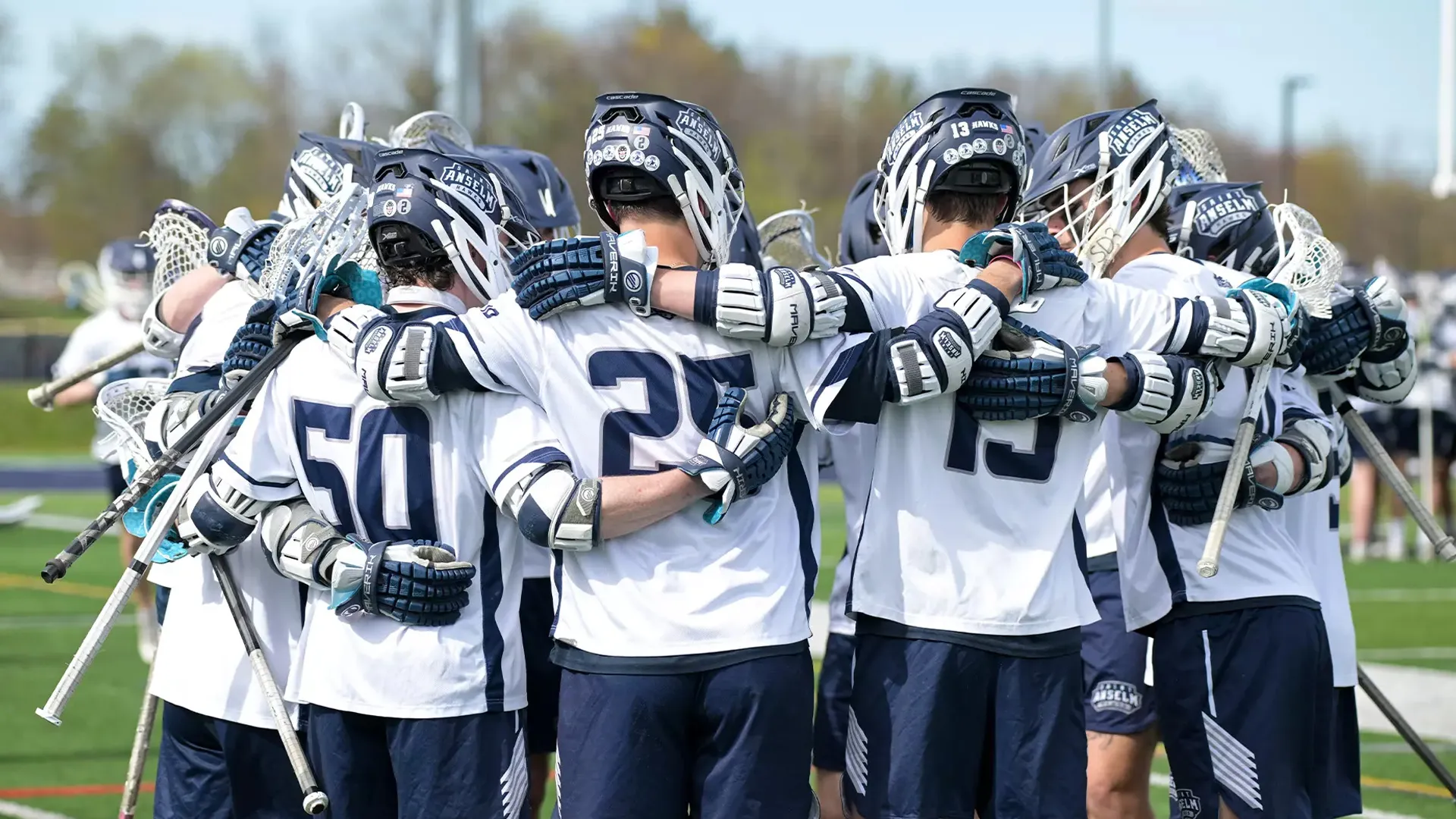
“The Last Ride” has been a phrase used and reused many times in the past few years across the sports landscape.
Whether it’s a legendary athlete’s final season as a pro or a high school senior with hopes of a state title chasing that last bit of glory before they go to college.
It was also appropriate when Saint Anselm head coach Drew Bourdeau said it to his team shortly after the school announced last spring it planned to move down to Division III and join the New England Women's and Men's Athletic Conference (NEWMAC).
“I found out about it about 45 minutes before the rest of the world,” Bourdeau said. “We are still in Division II this year, so we are still eligible for the D-II tournament. 2028 is our first year in Division III, ‘29 is a probationary year, and in 2030, we are a full member and eligible for the NCAA tournament. So, this is the last dance [in D-II].”
In a statement made by the school last April, there were many reasons given for the change.
“We are confident this strategic decision is in the best interest of the Saint Anselm student experience and the long-term future of the College,” Saint Anselm President Joseph A. Favazza said. “The NCAA landscape is changing rapidly, driven by Name, Image, and Likeness (NIL) financial opportunities, a transfer portal that leads to team instability, and growing uncertainty among conferences. After careful consideration, we have chosen a proactive path that aligns with our mission and allows the College to maintain control of its athletic future.”
It’s not much of a stretch to say that, at least in certain areas of the country, the entire concept of Division II lacrosse has been under siege since 2020. Notre Dame De Namur, Saint Rose and Alderson Broaddus no longer have teams.
Even former NCAA Division II champions like Limestone and New York Tech were not above the concentrated attrition of the second division of college athletics. It paints a fairly bleak picture, and that’s without the closure of other institutions in previously college-heavy areas like New England, so it is understandable that some schools are looking to make changes.
It doesn’t remove the shock to see a team like Saint Anselm, which has been to multiple final fours in the past 10 years, elect to move into a more crowded field, at least geographically. The campus sits on the outskirts of Manchester, N.H., the state’s largest city with a population of just under 117,000.
Over 2,250 students attend Saint A’s every year, a number that hasn’t fallen nearly as dramatically as some other colleges in the region, but is still not large enough to justify pushing athletics into Division I — unlike other former NE-10 schools like Merrimack and Le Moyne, which now have a competitive slate of Division I programs. Joining the NEWMAC was a logical choice given the history of Saint Anselm and the other schools in that conference.
The NEWMAC is home to men’s lacrosse programs of varying levels and longevity. It is home to Springfield College, one of the cornerstones of New England lacrosse and a former Division II school itself. Recent additions to the conference include Emerson, a film- and arts-focused college famous for producing talents like Henry Winkler, Bill Burr, and Dennis Leary, which joined in 2013. Salve Regina, a Catholic school that borders the coastline of Newport, R.I., joined in 2023.
The Coast Guard Academy also competes in the NEWMAC, as well as the world-renowned Massachusetts Institute of Technology. But the bogeyman of the NEWMAC in recent years is most certainly Babson.
“Babson is going to be a lot like Bentley has been for us in the past,” Bourdeau said. “In terms of recruiting, if it was between us and Bentley, we will lose some kids to Bentley because of the business program. It’s going to be the same thing with Babson. Where we fit in with the NEWMAC is almost exactly where we fit in with the NE-10.”
Still, joining an already stacked Division III landscape with a down ramp of a few seasons during which the team is ineligible for the NCAA tournament is a blow to any program.
How is Bourdeau handling that? It comes down to a promise and a goal.
“I promise you when the time comes, I will take care of you,” Bourdeau said. “But that day isn't here yet. There is no reason for anyone to leave. The same goal we have chased the last three years is right there in front of us. Let’s put everything we have into it and know that when the time comes, I will take care of you.”