
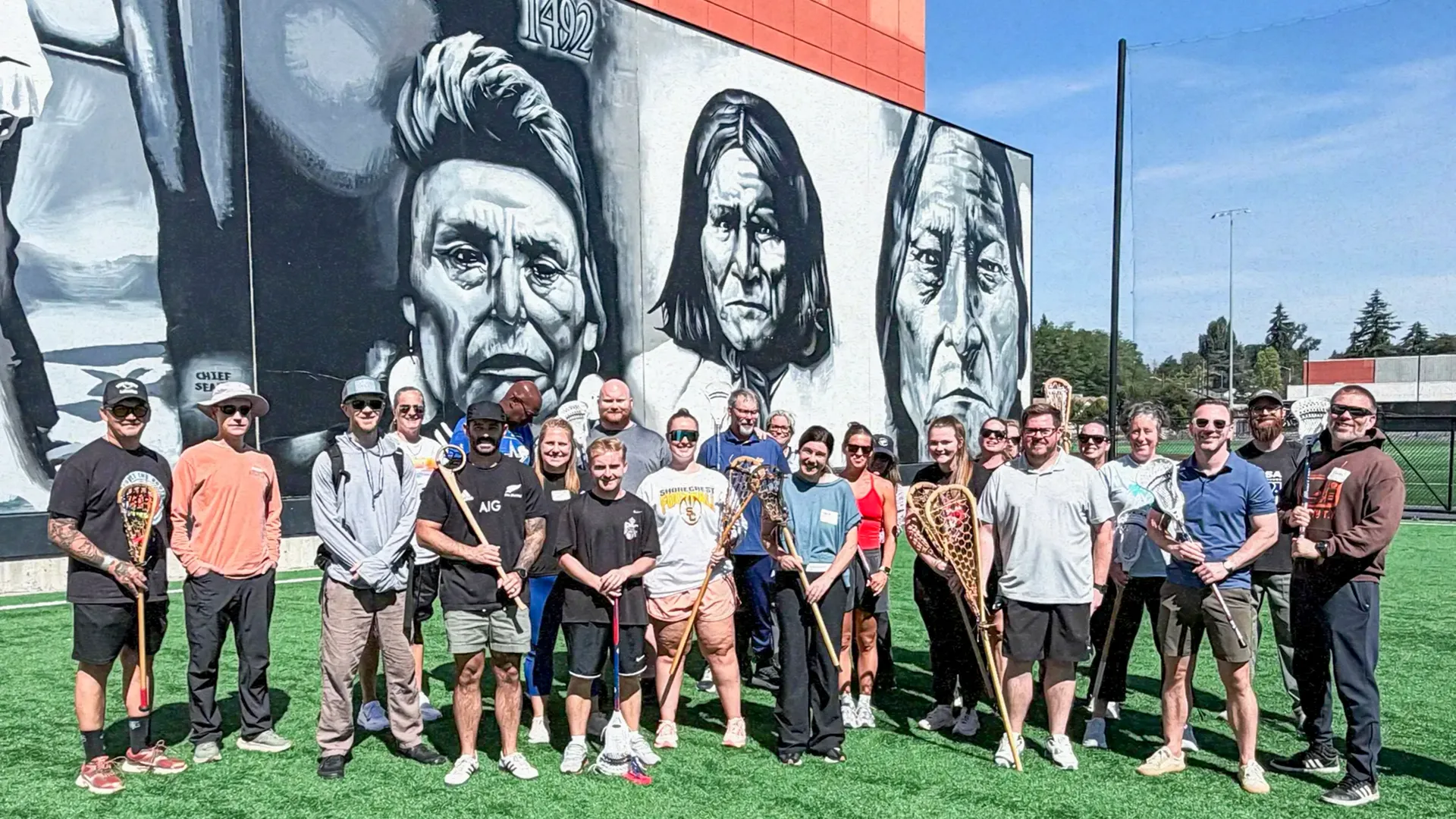
On the turf at Robert Eagle Staff Middle School, beneath a mural of Native leaders, a group of Seattle physical education teachers held two kinds of lacrosse sticks.
One was traditional wood, a link to a game played on this continent for centuries before anyone wrote down its rules. The other was built for a third grader.
By the time the Aug. 26 session ended, they wanted the game in their gyms. By the end of the month, 30 teachers from 28 schools had requested lacrosse kits. Twenty of those schools were new to the program. That’s four more than the district planned to add this fall.
Lacrosse is coming to Seattle Public Schools (SPS). The district piloted a lacrosse unit in eight elementary schools last spring. Sixteen more are rolling it out this fall, and the goal is all 73 SPS elementary schools by spring 2028. It’s part of a USA Lacrosse physical education (PE) pilot program that introduces the game, and its Indigenous roots, to elementary-aged students. Schools in California, Colorado, Ohio and New York also launched the program in 2025-26.
“We have a very robust rowing program, tennis program,” said Lori Dunn, the pre-K through 12th grade physical education and health literacy program manager for SPS. “It’s because we start early and teach fundamentals. And the students, we kind of hook them and then introduce them to that community connection. That’s our hope with lacrosse.”
USA Lacrosse sees this as potentially its most impactful model for growing the sport’s youth participation base. By seeding lacrosse in elementary schools with a turnkey curriculum and equipment, and connecting students with local lacrosse programs, the national governing body sees a pathway to high school sanctioning in states like Washington. Six local member clubs have rallied behind the Seattle pilot, part of the 128 USA Lacrosse member programs across the metro area. They’ve worked for the last five years to regain the momentum halted by the pandemic.
“This is the most promising development, because it puts a stick in every kid’s hand in the public school system,” said Michael Sas, president of Doublecrosse Seattle. “We’re talking thousands of kids who will have the opportunity to touch a stick.”
Both of Sas’ daughters play lacrosse. He offered to teach the game to physical educators at their school. But they were hesitant, he said, due to unfamiliarity with the sport and how to teach it safely. Serendipitously, he appealed to Dunn, who already had designs on adding the USA Lacrosse curriculum to all 73 elementary schools in the district by 2028.
“Getting that required from top down is huge,” said Lyn Porterfield, USA Lacrosse regional director for the Pacific. “The other piece that’s huge is having the existing youth programs already in that footprint, so that all of those kids at those 73 elementary schools have a place to play outside of school.”
SPS is a 2026 USA Lacrosse Physical Education grant recipient. It was one of nine Washington awardees in a pool of more than 600 applicants from 48 states. The district partnered with local clubs and USA Lacrosse to make sure every teacher was trained to teach lacrosse safely and thoroughly. Doublecrosse hosted the first clinic May 6 at Magnuson Park. Seventeen teachers attended, and eight schools left with kits.
“We had a rep from each of the clubs in Seattle, boys and girls, come to the field, introduce themselves and show them that Seattle clubs are behind this,” Sas said.
After the May session, Dunn committed to a full curriculum launch in grades 3 through 5. SPS built the program to last. The district owns the equipment, partner schools share kits, and deliveries come straight from the SPS warehouse, where reserve sticks arrived in June.
More than 30 teachers attended the second training in August, held during the district’s Welcome Back to School PE Workshop. That professional development set the stage for this fall’s rollout. Teachers used the equipment and learned the game from Shawn Maloney, the former Colorado College player and coach who is USA Lacrosse’s manager of adaptive lacrosse and sport growth. Doublecrosse helped lead the session.
“I could say, I want you to teach this and send you the equipment, but I don’t really know if they’re going to do that unless they’ve really gone through and had that hands-on experience,” Dunn said. “That’s why I require them to come to the training.”
That includes absorbing the history and cultural significance of the oldest sport in North America. At both trainings, JD Elquist (Sugpiaq/Alutiiq) shared lacrosse’s origin story and traditional styles of play so teachers could pass them along when teaching the medicine game.
“It’s important to us to make sure as we’re empowering educators here in the Northwest and the Seattle area to bring the game to their schools, that we start with the origins of the game,” said Elquist, the founder and executive director of the nonprofit Pacific Northwest Native Lacrosse. “Because it’s really important for me and for, I think, all the game that as the game continues to grow, that the roots are a part of the fundamentals.”
The lessons build on work SPS teachers already do. The district’s PE curriculum includes an Indigenous unit, and Dunn has asked to connect Elquist with the SPS Native Education Manager. November is Native American Heritage Month. What better time for a lacrosse unit? Elquist hopes teachers share just how powerful the game is.
“It’s healed me, it’s offered me community, all these different things that come because of the medicine of the game. And that comes from the Indigenous communities,” Elquist said. “I hope as that part gets taught and emphasized in schools, kids who need that medicine can find it through the game.”
The 28 schools that requested kits put SPS ahead of pace toward its goal of 37 shared kits within three years. That number matters. At 37 kits, lacrosse can become a districtwide program. It can be part of the required PE curriculum, and PE teachers can share club flyers with families. Kits contain unified sticks developed in partnership with Franklin Sports, goals, balls, cones, a curriculum guide and access to USA Lacrosse educational resources. Teachers have praised the sticks as a big step up from the flimsy plastic beginner sticks many of them remember. When lacrosse reaches all 73 SPS elementary schools, it will be within reach of more than 23,000 students who can keep playing outside school.
“I anticipate we’re going to see a fairly decent impact in terms of participation,” Porterfield said. “All these member programs are going to be able to leverage the fact that all of these kids have had exposure to the sport and really be able to recruit new kids through that. It’s a long game, but I’m super excited.”
USA Lacrosse has invested nearly $400 million in the sport’s growth and development since its founding in 1998, including more than $1 million annually in equipment grants alone. School programs stretch those dollars furthest. In 2025, USA Lacrosse PE and school programs reached 48,427 students at 97 sites, at $1.44 per participant. Supporting emerging teams matters. But putting lacrosse in schools puts sticks in far more hands, and that best positions the sport to build on its momentum heading into the LA28 Olympic Games.
In Seattle, that work is already underway. Doublecrosse helped organize, distribute and connect teachers with kits for the first eight schools last spring, and 16 more are rolling out lacrosse units this fall. Dunn is already looking past elementary school, toward a middle school after-school league that would give students a next step before high school.
“We’re bringing lacrosse in as an activity because it can be played for a lifetime, just like tennis and golf,” Dunn said. “It was a no-brainer. It was a great fit.”
Eight schools last spring. Sixteen this fall. All 73 by 2028. And in every one of those gyms, the lesson begins where it began for the teachers in August: beneath the mural, with the wooden stick.