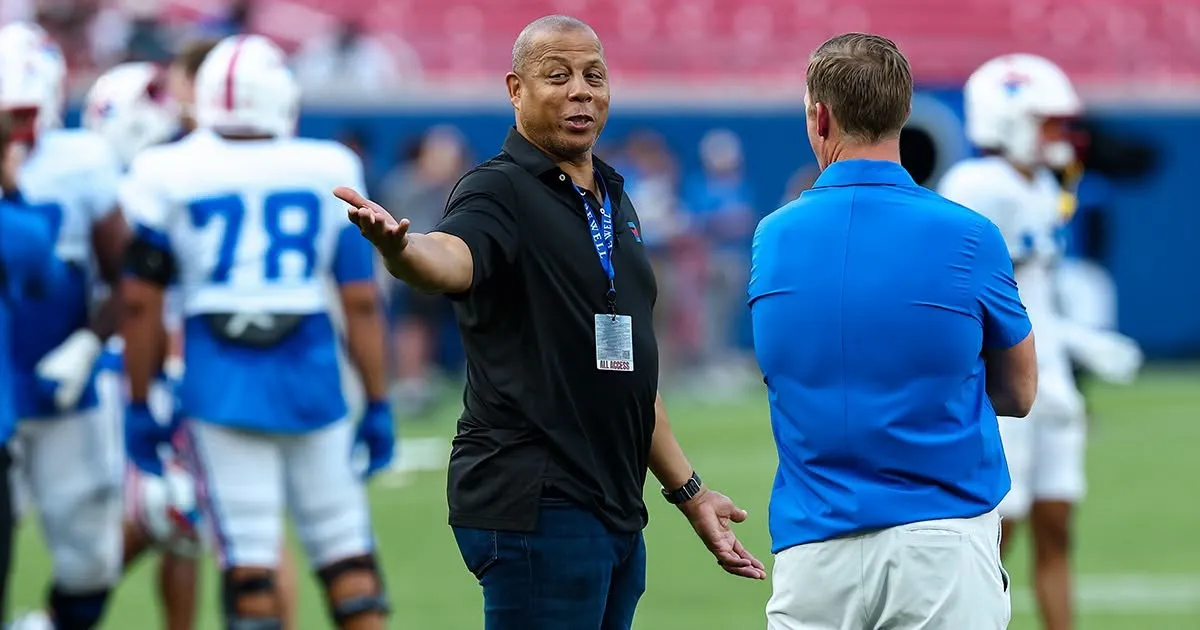
Damon Evans left Maryland to become SMU’s athletic director on March 31, 2025, after previously serving at Georgia.
Men’s lacrosse was already on the radar, but the timeline accelerated, and on Oct. 15 he announced it will become SMU’s 17th varsity sport. The Mustangs will begin play in spring 2028, a fast turnaround, as the 78th NCAA Division I men’s program and sixth in the ACC.
Evans answers questions about adding the program and how it can meet competitive expectations. The Q&A is edited for clarity and brevity.
There are other sports that you could have added. Why lacrosse?
Lacrosse is something that’s always been contemplated here at SMU prior to me getting here. Obviously, the Crums have been so generous and we have the Crum lacrosse facility, so we’ve got club lacrosse here. This is a community in which lacrosse is significant. Across the state of Texas and in the high schools and clubs, lacrosse is growing. There’s some great talent coming out of this area. We’re moving at an accelerated pace but it’s been fun and I think we’re going to build something here that people will be extremely proud of.
What enabled this timeline to move up and launch so quickly?
One is donor support. We fundraised a significant amount of money to get this started, and I think we’ll only continue to fundraise more. But just being very, very candid here, when you look at trying to take advantage of this new five years of eligibility, I think there’s a unique opportunity here to take advantage of that portal. But at the same time, I don’t want people to think that we’re just building a program for the short term. This is about trying to take advantage of what’s available now, but really the goal is to build a highly competitive program for the long term and that’s sustainable at a high level. We’re moving at a fast pace and there are going to be some bumps along the way, make no mistake about it, but I’ve put my mind into the implementation mode now. Let’s get things up and running and we’ll make some mistakes, we’ll learn from those, but I feel like we’re in a good spot to do something in 2028.
We hear a lot about the hurdles to adding a men’s program. What are some of the factors that made it possible for SMU?
We took a look at our numbers across the board. You’ve got to take a look at your participation numbers and everything from that perspective. I think the hurdles right now for us is just, you can use the word build, but we’re a startup. We’re starting up from ground zero. It’s challenging when you’re trying to find a coach during the actual season. Typically, you look for coaches at the completion of their seasons, that would have probably been better timing. But make no mistake about it, there will be challenges with this as we move forward. But we realize that and we decided to move in this direction even though those challenges are there because we think the opportunities far outweigh the challenges for us.
What are some of the unique things about operating a donor-supported program?
The uniqueness for us is, we can say a donor supported program, but I want to say a donor and institutionally supported program. We’re going to support this program from an institutional perspective. We wanted to raise money to help us get this program kicked off so we’re not taking away from other programs. [W]hat makes SMU special is that SMU is willing to take calculated, I’m going to say risks, that other people might not take. Other people might say, let’s go the conservative route, let’s wait a year and give more time to get things going. We at SMU like to think big and we like to be bold and this is an example of thinking big and being bold with this move.
Is there a level of scholarship and name, image and likeness (NIL) support you expect to provide annually, and is a full 48-man roster the expectation?
Yes, the best way I’ll describe that is SMU will compete at the top end from a resource level. We’re not going in at this halfway. We’re not starting this just to dip our toe in the water. We believe here and I believe here that resources have got to match expectations. The expectations here are high so the resources are going to be there for the coach and the staff and the student-athletes to go out and compete at the highest level.
Will this be a totally new program or is there a relationship with the existing club program?
First, I appreciate our club program. I’m going to say this will be a totally new program. This is a new build. That doesn’t mean we won’t lean on the club team some. There might be guys on the club team that want to try out for the varsity team. So I’m going to let the coach handle that.
Do you expect that your geography will help, or is the travel for East Coast players and families a concern?
Will there be some challenges associated with the travel? Yes. When I was at Maryland, I mean, we could almost drive everywhere. So there’s going to be much more travel involved for us, but also here’s the unique opportunities. You think about the sport of baseball and the timing of when baseball starts, and those teams that are in cold weather areas they all go down to Florida/Texas to play early on in the season. We might try to set up a schedule where we get more teams early on in the season to come to SMU because of the weather. I know there’s Utah and Denver out this way. And hopefully this will be the beginning of others out in this region maybe looking to add lacrosse as well.
What are the most urgent next steps for starting the program?
The most urgent thing is identifying a head coach and getting that individual in here sooner rather than later. The other piece is once that person gets here, you’re gonna have to really hit the recruiting trail from taking a look at fifth years, from taking a look at are there any kids that you can get in the ’27 class, and then start building on the ’28 class. We’ve got to do scheduling. The ACC, of course, will do the ACC schedule but we got to put together a non-conference schedule. [T]alent acquisition is key and we’ve got to acquire the talent and we got to build the things that the talent needs to be successful.
What insights can you share about interest in the head coaching position?
It’s been tremendous. I’ve been, I want to say, pleasantly surprised. I said to someone one time, I said, ‘It’s amazing. Why are so many people interested in this job?’ And the person I asked that question, they said, ‘Well, why were you interested in the job, Damon?’ And I paused, I was like, ‘Oh yeah, you’re right.’ And what I saw was that something special was happening here when I met with people. So I take me coming here or someone like [SMU president] Jay Hartzell coming here from some pretty established Power Four programs, and I feel there are people out there that are just very intrigued by what we’re doing, and see this as a great opportunity. I think everybody across the country, the coaches know that SMU is here to compete and as I’ve said, ‘Here we come.’
How does being a new program factor into finding a head coach?
I’m looking for someone who’s eager, who’s excited, who’s willing to roll up his sleeves and say, let’s go get it because unlike any normal program right now you’re not just going to be going out on the field and coaching. You’re starting a whole new organization. It’s like starting a new business per se and when you’re starting a new business, you’re building it from ground up. I’m looking for energy, enthusiasm, coaching chops, ability to recruit, and really someone who can come in and embrace this community, build relationships within this community, because I believe that everything falls back on the relationships that you have and someone who can build a tremendous culture because at the end of the day, culture leads to your outcomes and your outcomes are wins or losses. Your outcomes are how the experience is for the student-athletes.
How does this compare to heading up such established lacrosse programs at Maryland?
Very different. John Tillman had that thing rolling, and he still does. So I got a front row seat to witness excellence, both on the men’s side, and the women’s side with Cathy Reese. [M]y philosophy has always been you give coaches the resources and then you get the heck out of the way and let them do their job. And I was able to do that at Maryland because you didn’t have to worry about Tillman in that program. You just needed to support him and let him do what he does, and all he does is win. Here, it’s going to be a little bit different because [we] don’t have anything established. We don’t have an established culture. We don’t have an established identity. I can’t point to history and tradition of lacrosse here. I have none of that to sell to a recruit. But what I can do is I can sell the future. [O]ne day when you look back and you’ve got your kids and you’re saying, you know, I was a part of that first class at SMU and look at where SMU is now. So we are selling a strong vision of a great opportunity to have success here, incredible experience, be a first mover to say and do something that might shock the world.
How are you showing the priority to compete quickly for ACC and national championships?
Anytime you’re trying to win a championship, it’s gonna be tough, and I don’t take that for granted. I think there’s an opportunity to take advantage of fifth years out there, especially a lot of, I hear, great players coming out of the Ivies as well as other programs across the country. But also I think you have to be mindful of you’ve got to start building your culture too. And that means you’re going to need to try to get some other transfers in here that might be in their second, third year, and try to get some freshmen to come in and slowly build this thing from a steady perspective. I’m not looking to just be trying to take advantage of a fifth-year class and be a one-hit wonder. That’s not what we’re trying to do here.
What is a reasonable timeline for expectations?
I remember when I first got into this business and even five or six years ago before you had the portal, in all sports, [y]ou had to sit out if you transferred. I’d always tell people it’s going to take four or five years to build a program because you hire a new coach, you want to allow that coach to get his class of players in, build, stack three or four classes on top of each other. That was the older model. But I’m also realistic that because of the portal, the portal allows you to flip teams fast. Look no further than Indiana football. I mean, they flipped that quick. I’m not saying that SMU is going to come in in one or two years, flip things and win a national championship. I’m not saying that. But I’m sitting here saying, let’s build this thing the right way and that takes a little bit of time, and I’m going to give the new coach the proper time and exercise patience because there may be some very, very high moments initially, and then there might be some moments where we’re looking at like, oh, boy, this is tough. We want to win. We’re going to do everything we can to win and provide an incredible experience, but we’re also going to exercise patience.
Most of the top high school players in the class of 2028 have already committed. How do you address that challenge
We’re going to be playing a lot of catch up. We’re going to have to sell something new where other people can say, ‘We’re established, look at our team, look at what we’ve done, we’re ranked preseason number one, or we finished last year going to the Final Four, or we made the NCAA.’ We can’t say any of that stuff. And that’s OK. I mean, you don’t run from that type of stuff. But I will say what we have to do is, in this commitment world, you’ve got to try to flip kids. Yeah, a lot of the ’27s are already committed. A lot of the ’28s are already committed. That class that’s probably the most wide open for us right now is the ’29 class. And I don’t look at things and complain about them. OK, here are the circumstances that we’ve been dealt that we’ve decided to embrace. OK, and now let’s figure out how we best position ourselves within [those] circumstances.
What changes or additional infrastructure will be made to your existing lacrosse venue?
We do have a dedicated venue called the Crum Lacrosse Complex. There’s some, we’re calling in the initial years, a bridge facility to where we’ve gotta go in there and do some things, put down new turf, put up a video board, bringing seats, all that type of stuff, locker rooms and all that to get us going. But the long-term goal is at that facility build a stadium that will be one of the better ones in the country and give us an advantage because that plays in recruiting. [I]f need be at certain times depending on who we’re playing if we feel like we’re going to have a huge, huge crowd, we do have Ford Stadium here.
There’s also talk of a women’s program. What can you say about that timeline?
I never rule anything out. You know, women’s lacrosse is significant in this country, and as I told you earlier, I had an opportunity to witness greatness with Cathy Reese at Maryland. What I would sit here and say is we’re going to focus right now on the men’s program, making sure that we can get this going. That’s a huge enough task as it is, and we’ll cross that bridge with women’s lacrosse if and when we get there.