
What is StickLab, and is it the next great lacrosse company?
A chance meeting at a Chili's north of Dallas is where lacrosse’s latest company was conceived. Two students at North Texas University, Ben Baker and Wesley Sanders, got reacquainted with one another over fajitas and queso, and it led to the creation of an innovative lacrosse company they called StickLab.
“I started playing lacrosse when I was 9 years old,” Sanders said. “Ever since third grade, I’ve played nonstop. I’ve known Ben since high school when we played together at Denton. I hadn’t seen him in a few years, but we accidentally met up at a Chili's, and he was wearing a Penn State lacrosse shirt, and that led him to play at the University of North Texas with me, and now we are starting this business venture.”
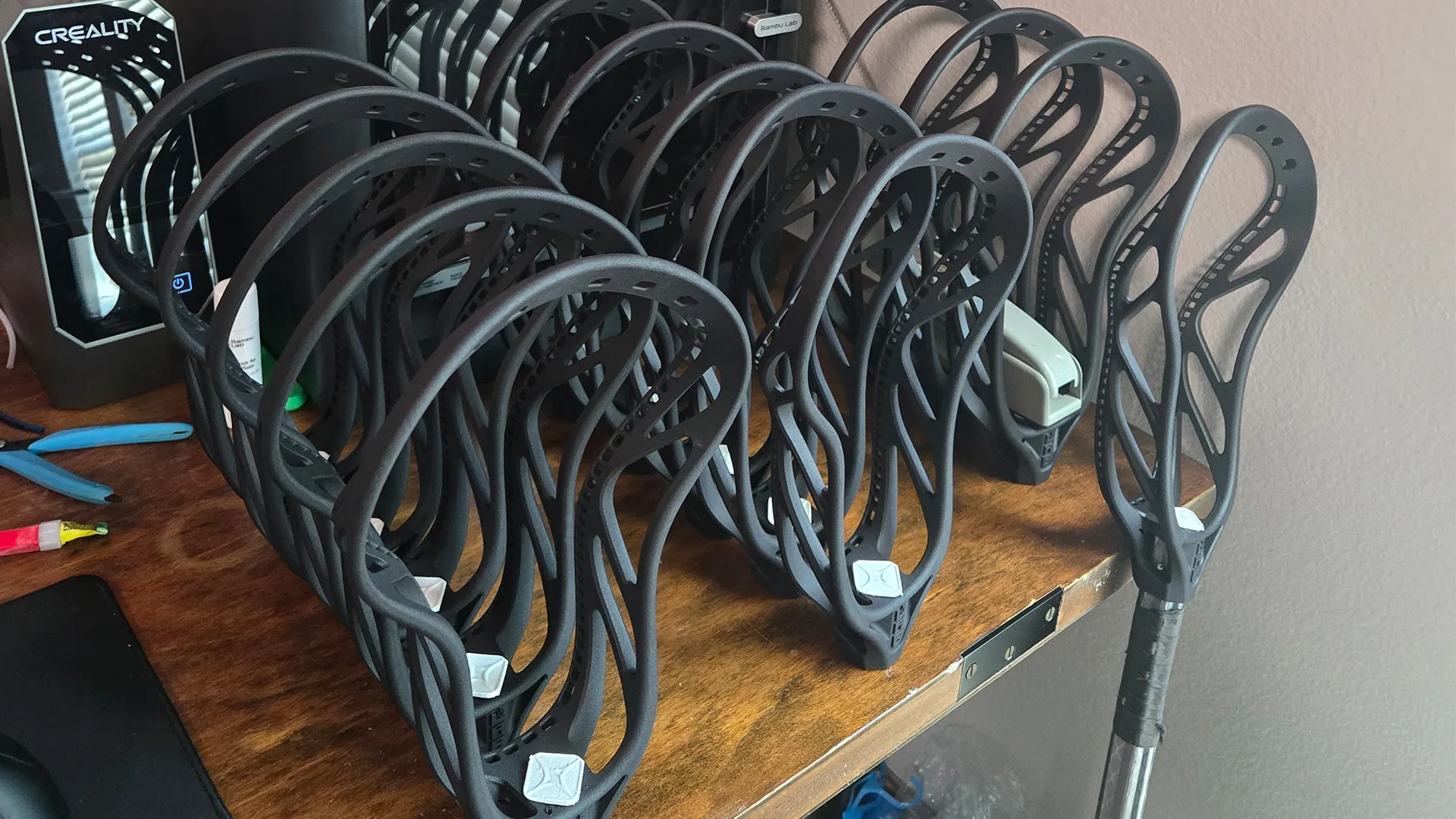
What is StickLab? Astute followers of the stringing community may have noticed the call for product testers from the StickLab Instagram account about seven months ago. But as many lacrosse fans know, the men’s lacrosse head space is quite saturated.
So, what made Baker and Sanders want to get into creating a new lacrosse head?
“I have a background in CAD, computer-aided design,” Sanders said. “I’ve been using it for about eight years now. As a lacrosse player, if you have this skill and this knowledge of this tool, you want to apply it. So, a few years ago, I tried to design my own lacrosse head — and it was really difficult. But I kept coming back to it, and a year ago I completed my first design.”
Over time, that design evolved into the iteration that was distributed to interested stringers who were chosen by Sanders and Baker. That design came with a cost. The stringers did have to purchase the head, but that money went back into the development of the stick and the company.
The testing rollout of those initial heads is about two-thirds of the way complete, and testers are entering the final phase of the process this fall. StickLab hopes to use the feedback from those testers to further improve the design for the next iteration.
“We didn't want to have people buy in to test the head,” Sanders said. “Right now, we did not have the funds to make the testing free. It’s essentially crowdfunding, and we did hate that we had to charge for it. But personally, I want to work with people who are willing to buy in. They want to be part of the program and to give real feedback.”
3D printing is not new to the lacrosse space, per se, especially in the testing sectors of large companies in the industry. Several beta versions of a head are often 3D printed before the design is finalized, not just for testing purposes, but to gauge compatibility with modern stringing materials and techniques.
Usually, 3D-printed materials are not strong enough to endure the rigors of a regular lacrosse game, which is why modern lacrosse heads are still made with an injection molding process to this day. StickLab’s 3D printing material is a proprietary blend that is more durable than what’s used in traditional machines, which is what makes the process more feasible to test.
There’s just one thing — StickLab’s most influential product isn’t going to be its 3D-printed stick.
Baker and Sanders are also developing a device and software to track player metrics called “Stat Tracker.” Originally conceived as an algorithm-based application, a physical prototype has been completed and is currently being developed for testing.
“Just calling it a stat tracker is very general,” Sanders said. “A stat tracker can be a camera or an attachment. What we have developed is a lacrosse butt end with a USB Type-C port along with a small battery and a microchip that will measure how fast you shoot. This will get rid of the need for a radar gun. Imagine sticking a Garmin watch on the bottom of your stick. It will be able to tell you where you moved, how many shots you take, how many passes you make, and how many ground balls you pick up. The pain point right now is just developing the application.”
While there are devices that track reps through the ball itself, there aren’t any products that can easily attach to any stick that offer the same data points.
Where did this idea come from? Golf, of course.
“I use apps like Arccos and 18 Birdies to track and monitor my golf progression,” Baker said. “18 Birdies keeps my golf handicap, my distances, things like that. I can choose to pay a subscription fee to get other data points. What we are thinking is that if someone buys this on day one, they’re not going to have to pay for something else.”
Baker and Sanders are looking to launch Stat Tracker early in 2027 with an eye toward multiple updates for data points rolling out as the software develops. It’s a little bit like a fitness tracker for lacrosse, but it's for your stickwork and shooting, not your effort and heart rate variability.
With so much of their development cycle dedicated to these two projects, it’s pertinent to note that both Baker and Sanders are developing this company largely by themselves. In an industry that constantly recycles its own designs, it’s refreshing to see entrepreneurs in the gear space.
“Lacrosse as a community, we’re all very tight with each other,” Baker said. “You can go out and play in a game and beat the crap out of a guy on the other team, and 15 minutes later, you’re all out at the bar hanging out. Not a lot of sports do that. That’s one of my favorite things about lacrosse. So, while we are doing our marketing, we’re trying to expand out, which is why the companies that inspire us are from places that you wouldn’t think are related to lacrosse.”
You can follow StickLab’s progression online at Sticklablacrosse.com or follow their Instagram page for updates on all its products and releases.