
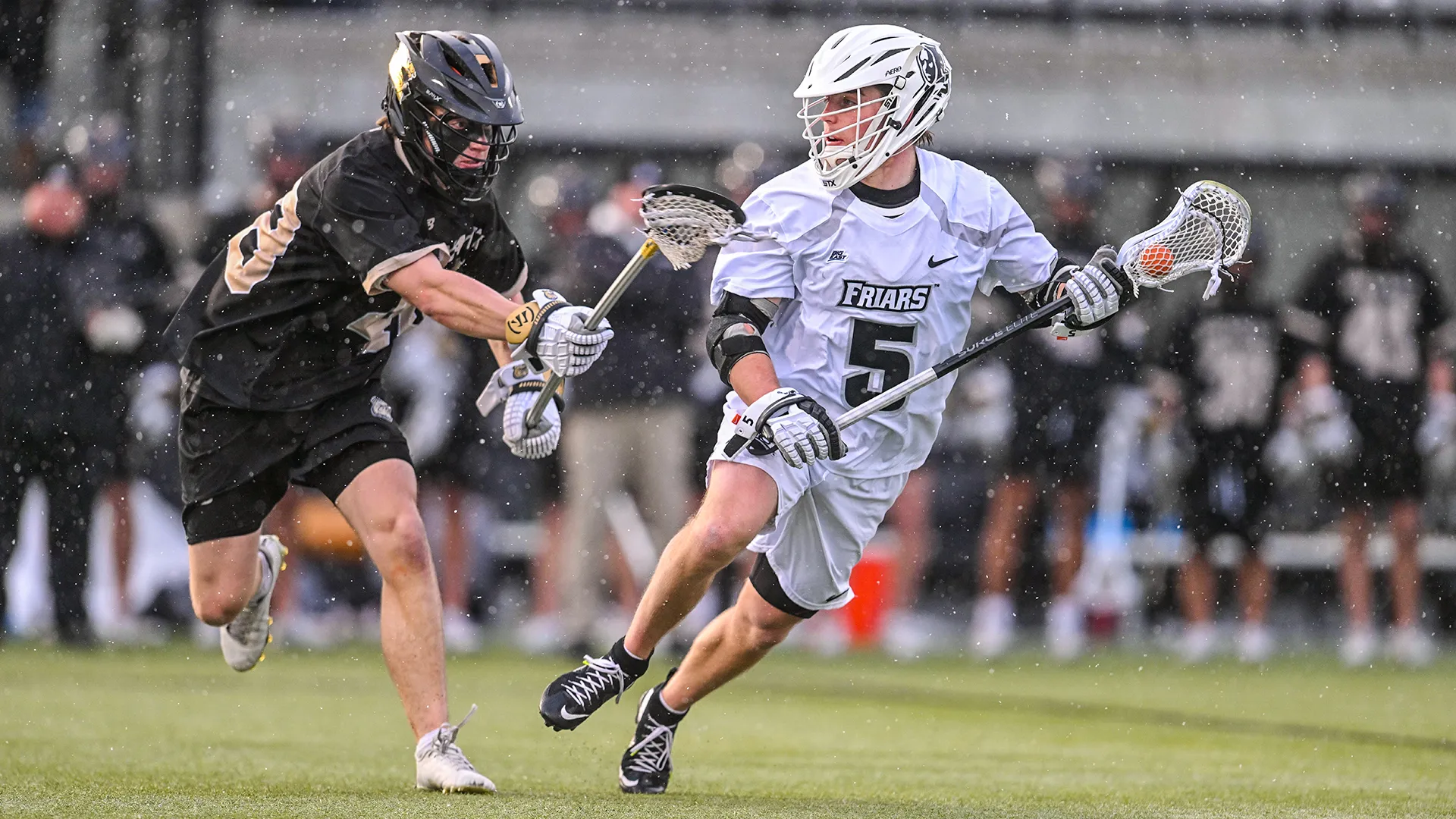
It’s time to look ahead 2027, even if next season’s first lacrosse game is more than six months away.
USA Lacrosse Magazine will spend the week running down a far too early top 25(ish), starting with today’s entry looking at teams that could find themselves contending for NCAA tournament berths next spring.
Way-Early 2027 Rankings
25-21 | 20-16 | 15-11 | 10-6 | 5-1
T-25. LEHIGH
2026 record: 8-8 (4-4 Patriot)
Last seen: Going more than 32 minutes without a goal while giving up 10 in a row in a 13-6 Patriot League semifinal loss to Army
Projected starts lost: 62 of 160 (38.8 percent)
Projected scoring departing: 71 of 315 points (22.5 percent)
Initial forecast: The Mountain Hawks went from shooting 23.6 percent in 2025 to 32.6 percent this past spring, in the process jumping from 68th to 10th in Division I. Now they’re set to bring back five of their six double-digit goal scorers, a group led by first team all-Patriot League selection Luke Breslin (34 goals, 34 assists) and the Patriot League Rookie of the Year in Finn Morgan (47 goals, 17 assists).
There are reasonable questions to offer up about Lehigh’s defense, which sees Division I career caused turnover recordholder Richard Checo graduate along with three-year starter Luke McAuliffe, and it would be premature to suggest the Mountain Hawks are a sure thing to significantly narrow the gap between them and Army.
Still, many of the Patriot League’s best teams from last year (Army, Boston University, Colgate and, to a lesser extent, Loyola) took heftier losses than Lehigh. There’s an opening for Will Scudder’s bunch to climb toward the top of the league.
T-25. STONY BROOK
2026 record: 10-6 (4-2 Coastal)
Last seen: Falling to Marist (another team that warranted strong consideration for one of the last couple spots in this exercise) in an NCAA tournament play-in game.
Projected starts lost: 34 of 160 (21.3 percent)
Projected scoring departing: 44 of 316 points (13.9 percent)
Initial forecast: Fresh off its first NCAA tournament trip since 2012, Stony Brook might not be quite as deep as a year ago, but it still has a lot of its high-end options. The Seawolves’ top six in points are set to return, a group that includes seniors Collin Williamson (40 goals, 17 assists) and Justin Bonacci (29 goals, 16 assists) and junior Kian McCoy (20 goals, 24 assists), while defenseman Ryan Dodge, short stick Will Birney and long pole Kyan East (CAA Co-Rookie of the Year) also remain in the fold.
Stony Brook needs a replacement for goalie Tommy Wilk (54.3% save percentage), who was stupendous in CAA tournament defeats of Drexel and Towson and transferred to Michigan at season’s end, and primary faceoff man Robbie Smith (53.5%) was one of the central emotional figures on the roster.
There’s work to do, certainly, yet the Seawolves have a healthy amount back from a team that won 10 of 12 after an 0-3 start and should certainly feel buoyant about the program’s direction after its breakthrough this spring.
24. UMASS
2026 record: 10-6 (3-3 Atlantic 10)
Last seen: Dropping an 11-7 decision at Richmond in the A-10 semifinals.
Projected starts lost: 52 of 160 (32.5 percent)
Projected scoring departing: 37 of 292 points (12.7 percent)
Initial forecast: The Minutemen are a 10-win team that brings back Owen Salanger (57.2% save percentage), the Atlantic 10 Goalie of the Year, as well as all six of its 20-point scorers. That seems like a promising setup, perhaps enough to make a serious run at Richmond.
But UMass needs to improve on faceoffs after winning just 31.5% of its draws last year, when it became the first Division I team since 2019 Army to reach double digits in victories despite claiming less than a third of its faceoffs. That was made possible by an impressively efficient offense that ranked 13th nationally with a 31.9% shooting percentage.
Robbie Granara (25 goals, 12 assists) probably would have opened his career with back-to-back 30-goal seasons were it not for an injury that cost him the last month, and Charles Kurtz (27 goals, nine assists), Jack Turowsky (26 goals, 17 assists) and Dylan Johnson (25 goals, eight assists) are established options. Toss in A-10 All-Rookie honorees Thomas Bagnall (20 goals, eight assists) and Colin Coyle (13 goals, 11 assists), and there’s reason to believe the Minutemen will be a dangerous, spunky bunch — but having the ball a bit more would certainly help.
23. DENVER
2026 record: 6-8 (2-3 Big East)
Last seen: Bowing out of the Big East semifinals with an 11-8 loss to Georgetown to clinch the program’s first losing season since 2009.
Projected starts lost: 29 of 140 (20.7 percent)
Projected scoring departing: 75 of 226 points (33.2 percent)
Initial forecast: Denver went 1-7 when scoring fewer than 10 goals, and it also dropped four games when it held opponents to single digits. It wasn’t merely a matter of pace; the Pioneers held opponents to 20.6% shooting.
The obvious conclusion: There was — and is — far more for Denver’s offense to fix than its defense.
The Pioneers have plenty of reason to think coordinator John Gallant’s unit will be a stout force again in 2027 with Grayson Manning (61% save percentage) returning along with the entire close defense unit. That strength was enough to stay close to the likes of Duke, Ohio State and Syracuse. But it wasn’t enough to actually win those games, and for Denver to get back into NCAA tournament contention — let alone justify any chatter about a deep postseason run — it needs to rediscover some offensive punch.
The Pioneers are set to bring back their top two scorers, redshirt senior Cody Malawsky (30 goals, eight assists) and senior Marek Tzagournis (21 goals, 21 assists), but they’ll need others to emerge to provide enough potency to complement what should be one of the nation’s best defenses.
22. PROVIDENCE
2026 record: 8-9 (3-2 Big East)
Last seen: Having a four-game winning streak snapped with a 14-6 setback to Georgetown in the conference title game.
Projected starts lost: 43 of 170 (25.3 percent)
Projected scoring departing: 67 of 307 points (21.8 percent)
Initial forecast: That’s three years in a row the Friars have finished a game under .500 overall, and three years in a row they’ve gone 3-2 in the Big East. Providence has also made the Big East tournament in all four seasons under Bobby Benson, and this spring advanced to the conference final for the first time since 2017.
It all suggests the Friars have achieved a respectable level of consistency, and now the issue is when (or if) they can do better. Even with the graduation of goals leader Richie Joseph (39 goals, 10 assists), there will be plenty of continuity on offense. Rhett Chambers (35 goals, 36 assists) will be Providence’s headliner, but eight of the team’s top nine in points are due to be back.
Same goes for both halves of a faceoff timeshare that finished a bit north of 50 percent and starting goalie Cam Sterritt (50.7% save percentage).
A noteworthy graduation loss is long pole Ian Olenik (team-high 27 caused turnovers), and his presence will be missed. But the Friars have a lot of knowns, and if they can flip their record in one-goal games (2-4 in 2026), they’re poised to have the best season yet of Benson’s tenure.
21. RUTGERS
2026 record: 8-7 (1-4 Big Ten)
Last seen: Dropping its fourth in a row to conclude the season, a 13-10 loss to Maryland in the Big Ten tournament’s opening weekend.
Projected starts lost: 45 of 150 (30 percent)
Projected scoring departing: 87 of 240 points (36.3 percent)
Initial forecast: The Scarlet Knights went 1-5 against Big Ten opponents and saw their season end in April for the third time in four years, and it’s no mystery why things unraveled this spring. In those six games, Rutgers shot 19% (44 of 231) and won 39.6% of its faceoffs (53 of 134), a combination that isn’t going to lead anyone to much success. An injury that cost faceoff specialist John Scarelli nearly all of April was an exacerbating factor, but even when the Scarlet Knights possessed the ball, they couldn’t win many matchups against the Big Ten’s brawny defenses.
There are some interesting pieces in place, notably senior Colin Kurdyla (30 goals, 27 assists) and junior Greyson Vorgang (25 goals, eight assists), and Cardin Stoller (52% save percentage) will return as a steady presence in the net.
Some transfer help is on the way, with Bellarmine’s Ezra Davis (29 goals, 43 assists) and Vermont’s Max Frattaroli (31 goals) and Jack Combs (three-time All-America East first team selection, primarily as a long pole).
During Rutgers’ stretches of being consistently dangerous under Brian Brecht, it has found a way to be different — either with tempo from 2016-18 or by loading up on grad transfers for an infusion of experience on the way to NCAA tournament appearances in 2021 and 2022. It’s a tricky thing for a program to find a way to distinguish itself without losing its identity, but threading that needle might be the Scarlet Knights’ ticket to go from landing around the bottom of the top 20 to again contending for postseason berths.
No matter what route Rutgers takes, a more efficient offense is necessary to take a step forward.