
It’s time to look ahead 2027, even if next season’s first lacrosse game is more than six months away.
USA Lacrosse Magazine will spend the week counting down a far-too-early top 25(ish), continuing today with a group of intriguing contenders — among them a rising threat in the Ivy League, everyone's favorite mid-major team and three heavyweights with question marks and upside.
Way-Early 2027 Rankings
25-21 | 20-16 | 15-11 | 10-6 | 5-1
15. PENN
2026 record: 7-6 (3-3 Ivy)
Last seen: Building an early lead against Massachusetts on a neutral field before holding on for a 13-11 victory in the regular-season finale. A day later, the Quakers were eliminated from Ivy League tournament contention.
Projected starts lost: 29 of 130 (22.3 percent)
Projected scoring departing: 50 of 208 points (24.0 percent)
Initial forecast: Penn’s record in its first season under Taylor Wray was nondescript, but its overall profile was anything but boring. Five of the Quakers’ six losses came against eventual NCAA tournament teams (the outlier was a Harvard bunch that remained in at-large contention until the final week), and they had unusual reverse splits based on game site — 1-5 at Franklin Field, 6-1 elsewhere.
But they were competitive outside of back-to-back games against Cornell and Princeton in April, and they were also fairly young. Griffin Scane (23 goals, five assists) is a notable graduation loss, and two of the top three pieces of a faceoff committee that helped Penn win 58.4% of its draws also depart. But Quinn Ball (64.0%) is back after a fine freshman year.
Five of the six Quakers to draw an All-Ivy nod also return, including second-teamers Anthony McMullan (short stick), Matthew Till (long pole) and Dante Vardaro (defenseman) and honorable mention selections Ben Beacham (midfield) and Davis Provost (team-high 32 goals at attack). A way-too-early placement in the top 10 would be premature, but it’s not hard to envision Wray’s second team in University City moving up in the Ivy League and contending for an NCAA berth.
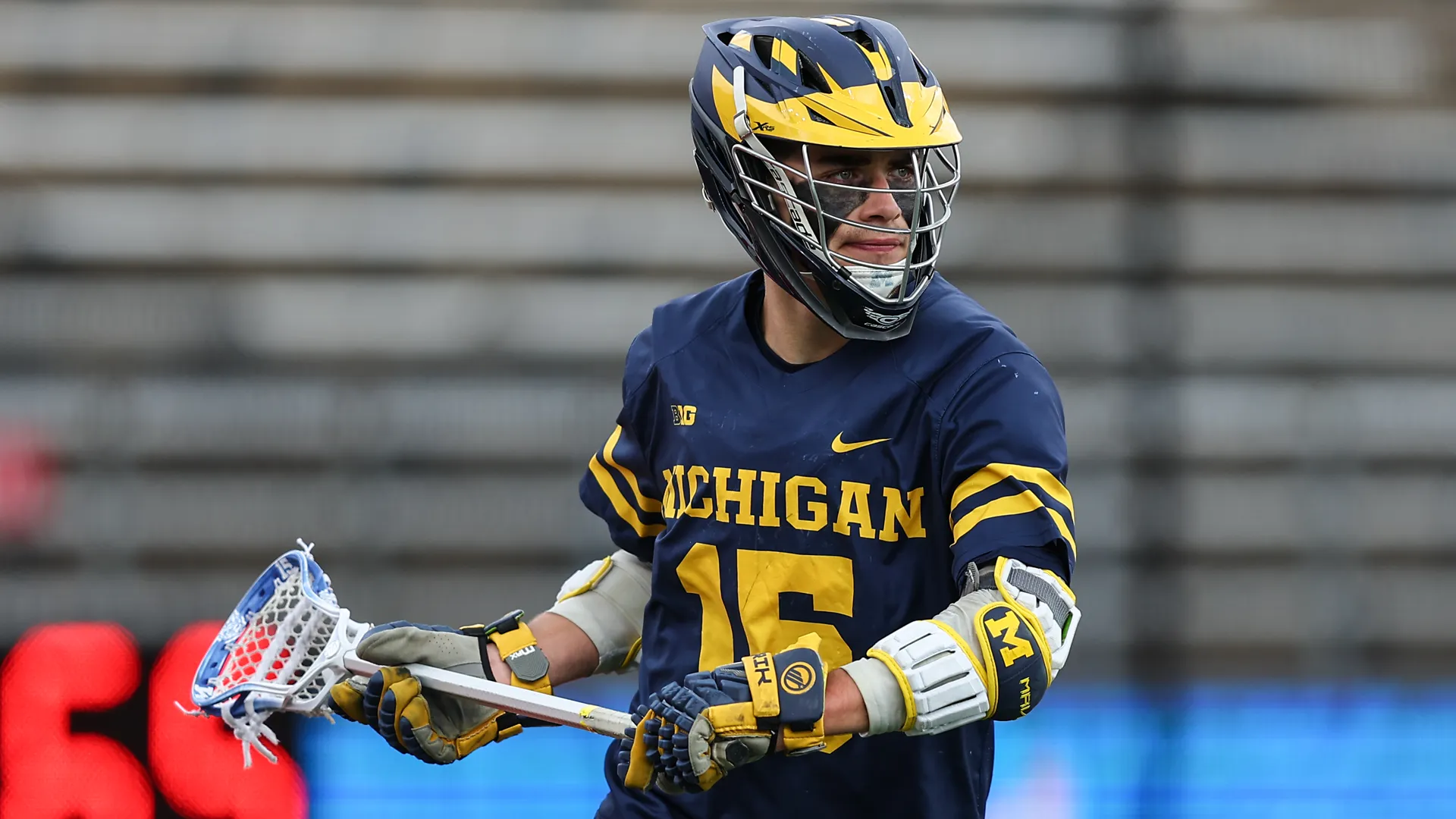
14. MICHIGAN
2026 record: 6-9 (2-3 Big Ten)
Last seen: Threatening to get back to its bid-snatching ways by erasing a five-goal deficit against Johns Hopkins in the Big Ten semifinals, only to cede the last two goals in a 14-12 loss.
Projected starts lost: 52 of 150 (34.7 percent)
Projected scoring departing: 50 of 257 points (19.5 percent)
Initial forecast: The Wolverines were a 3-7 mess when March concluded, but they wound up winning three of their last five (including a victory at Penn State) to stir memories of their 2023 and 2024 late-season surges. This Michigan bunch didn’t pull that off, but it definitely offered some promise for next spring.
All five of its double-digit scorers will be back, a group headlined by senior Nick Roode (37 goals, six assists) and that also includes Big Ten all-freshman team members Luke Shannehan (28 goals, 11 assists) and Adam Udell (14 goals, 13 assists). New to the fold will be Shannehan’s older brother Timothy (34 goals, 42 assists at Boston University), who could be one of the most significant transfer additions for anyone in 2027.
Rowan Clay, the Wolverines’ lone first team All-Big Ten pick, should again provide stability for a defense that added Stony Brook’s Tommy Wilk (the CAA tournament’s most outstanding player) with the graduation of long-time netminder Hunter Taylor (49.4% save percentage).
The massive question in Ann Arbor revolves around consistency. Can Michigan reach and then steadily play at a high level in February, March and April? That’s proven elusive even in the Wolverines’ most successful seasons. Should Michigan figure things out earlier than usual, it could exceed even this moderately bullish outlook.
13. SYRACUSE
2026 record: 13-6 (2-2 Atlantic Coast)
Last seen: Getting trounced 15-7 in the NCAA semifinals by Notre Dame, mainly because the Irish took advantage of Syracuse’s penalties (5-for-6 on extra man) and the Orange could not do the same (0-for-5 on the man up).
Projected starts lost: 111 of 190 (58.4 percent)
Projected scoring departing: 266 of 394 points (67.5 percent)
Initial forecast: Well, it’s definitely going to be different at the Dome, and not just because Syracuse career points leader and 2026 Tewaaraton finalist Joey Spallina (35 goals, 52 assists) has graduated. Also out of eligibility are Michael Leo (35 goals, 23 assists), Finn Thomson (45 goals, 13 assists) and Luke Rhoa (32 goals, 13 assists), though all four are plaintiffs in a lawsuit against the NCAA to receive a fifth year.
Still, the Orange as it stands are without their top four scorers heading into a season when a bunch of good teams have a bunch returning to campus. And don’t forget close defensemen Billy Dwan III (also part of the suit) and Jordan Beck, not to mention former defensive coordinator John Odierna (now the head coach at Fairfield).
It’s going to be a team facing a serious transition, and even coming close to a third consecutive trip to the NCAA semifinals will constitute a successful spring. But the cupboard isn’t bare. Payton Anderson (24 goals, 15 assists), Wyatt Hottle (20 goals, 12 assists) and a healthy Trey Deere (19 goals in 2025) could be the backbone of a solid offense, and two-year starting goalie Jimmy McCool (53.5% save percentage in 2026) and senior defenseman Riley Figueiras will be fifth-year seniors.
The best reason to be optimistic about Syracuse is it still has indefatigable faceoff man John Mullen (53.8%), who struggled at times as a junior but was just shy of 60 percent in three postseason games. He’s going to be pivotal in tilting possession while the Orange figures out just who they want to be in the early stages of next season.
12. RICHMOND
2026 record: 14-2 (6-0 Atlantic 10)
Last seen: Having a possession disparity finally take its toll in the final 10 minutes of an NCAA tournament first round game as Duke scored the final five goals in a 14-12 decision that brought Richmond’s splendid season to an end.
Projected starts lost: 76 of 160 (47.5 percent)
Projected scoring departing: 181 of 379 points (47.8 percent)
Initial forecast: The Spiders’ 2026 season wasn’t exactly storybook; otherwise, most of the first round-record crowd of 6,805 that showed up for Richmond’s debut as a postseason host would have gone home happy. While Richmond has already regained its mojo with good off-the-field developments — getting coach Dan Chemotti signed to an extension, defensive coordinator Paul Richards also sticking around, announcing a new lacrosse facility in June — it still has to deal with the realities of a limited eligibility clock.
The graduation departures in the River City are considerable: Aidan O’Neil (35 goals, 44 assists), Joe Sheridan (31 goals, 10 assists) and Jack Ricciardi (21 goals, 13 assists) on offense, as well as defensemen Hunter Smith and Michael Farrell and superb short stick Jack Pilling at the other end.
The Spiders will not be bereft of talent, with Lucas Littlejohn (41 goals, five assists), Gavin Creo (37 goals, 11 assists) and Daniel Picart (20 goals, 10 assists) all returning starters on a slick offense, and faceoff man Vincent Gaylord (56.0%) and goalie Connor Knight (55.6% save percentage) still in the fold.
Richmond has elevated its floor over the last couple years, but it isn’t immune to the realities of being younger and less experienced. But go ahead and book this: The team that navigates the Spiders’ typically ambitious nonconference schedule in February and March will be much greater headache once May comes around. Chemotti and his staff will see to that.
11. MARYLAND
2026 record: 7-6 (3-2 Big Ten)
Last seen: Shooting a season-low 18.8 percent in an 8-6 loss to Penn State in the Big Ten semifinals
Projected starts lost: 66 of 130 (50.8 percent)
Projected scoring departing: 155 of 222 points (69.8 percent)
Initial forecast: The Terrapins missed the NCAA tournament for the first time since 2002, and their offense was undeniably difficult to watch. At the same time, Maryland was one victory away from making the postseason anyway, and it was dramatically outplayed during its typically stiff schedule only twice (by Notre Dame at home and at Penn State in the regular season).
It’s a jarring contrast; the Terps clearly didn’t have a four-game winning streak in them in May, but they might have been a nuisance in the postseason. The top five in total points all depart, which isn’t necessarily the worst thing for a team that struggled to get to double digits.
Elijah Stobaugh (14 goals, three assists) is the only returning double-digit goal scorer and Ohio State transfer Garrett Haas (24 goals, 17 assists) will be a useful addition but not a one-man panacea. Help is going to have to burble up from ineffective or lightly used holdovers and/or freshmen for the Terps to get back to their typical perch, and it will happen with a new offensive coordinator and perhaps a dash of unpredictability.
Things are more stable on defense, where goalie Brian Ruppel returns along with long pole AJ Larkin and defensemen Peter Laake and Riley Reese. This isn’t a team that will be picked No. 1 in the preseason (like 2026) and might have its external expectations reduced to levels not seen in more than a decade in College Park.
Internally, expect an especially determined bunch that stands a better-than-decent chance to make it back to the postseason.