
It’s time to look ahead 2027, even if next season’s first lacrosse game is more than six months away.
USA Lacrosse Magazine will spend the week counting down a far-too-early top 25(ish), continuing today with a group of teams that all have some noteworthy holes to fill heading into next spring.
Way-Early 2027 Rankings
25-21 | 20-16 | 15-11 | 10-6 | 5-1
20. TOWSON
2026 record: 11-4 (6-0 Coastal)
Last seen: Having its 25-game winning streak against conference foes come to a stunning halt on its home field in a 13-11 loss to Stony Brook in the CAA final.
Projected starts lost: 42 of 150 (28 percent)
Projected scoring departing: 147 of 335 points (43.9 percent)
Initial forecast: The Tigers face life without the graduated Mikey Weisshaar (47 goals, 29 assists), the program’s career points leader who finished tied with Glenn Smith atop the school’s goals list (154). It means more than simply replacing a Towson all-timer; the Tigers could credibly believe they had the best player on the field a remarkably high percentage of the time the last few years, even against better-resourced foes, and that’s a hard thing to replace. Attackman Alex Roussel (36 goals, 15 assists) and defenseman Elijah Smith are among the other notable departures.
Yet there’s still enough in place to make Towson the CAA favorites, from attackmen Joaquin Villagomez (40 goals, 22 assists) and Ronan Fitzpatrick (13 goals in six games) to faceoff specialist Kai Lopez (60.2%) to goalie Matt Nilan (55.3% save percentage) to defenseman Joe’ll Spagnuolo (team-high 22 caused turnovers). The ceiling won’t be quite as high without Weisshaar, but the Tigers should contend for a third NCAA trip in four years.
19. HARVARD
2026 record: 9-5 (3-3 Ivy)
Last seen: Absorbing a 17-8 loss at Cornell in the Ivy League semifinals to drop its fourth in a row, a skid that ultimately caused the Crimson to miss the NCAA tournament.
Projected starts lost: 70 of 140 (50 percent)
Projected scoring departing: 170 of 268 points (63.4 percent)
Initial forecast: Did Harvard’s window for making a postseason ruckus close with the graduation of five of its seven double-digit points scorers? Or was it even open to begin with thanks to chronic faceoff issues? (It probably was, considering how close Harvard came to beating Syracuse in the first round of the 2025 tournament.)
The Crimson’s possession problems are no secret, and a mid-March injury to Owen Umansky (43.4%) left Harvard without its top option at the X. The end result was a team-wide 39.1% faceoff percentage that ranked 71st out of 77 Division I programs (up from 37.6% and 74th, respectively, in 2025). The Crimson still hasn’t reached 45 percent for a season since 2018 or 50 percent for a full year since 2013.
Remarkably, Harvard was probably just a victory away from an NCAA bid, a credit to both a loaded offense and defense anchored by Graham Stevens (53.1% save percentage). He’ll be back as a junior, and Jack Speidell (28 goals, 13 assists) and Nathan Cobery (25 goals, seven assists) are a good place to start on attack, but there are fewer established answers than at this time last year, especially in the midfield.
The Crimson have worked around their possession deficit to a remarkable degree, but there’s no escaping how much pressure it places on every other facet of the game. Simply getting within spitting distance of 50/50 at the X would be helpful, and raise Harvard’s ceiling for 2027.
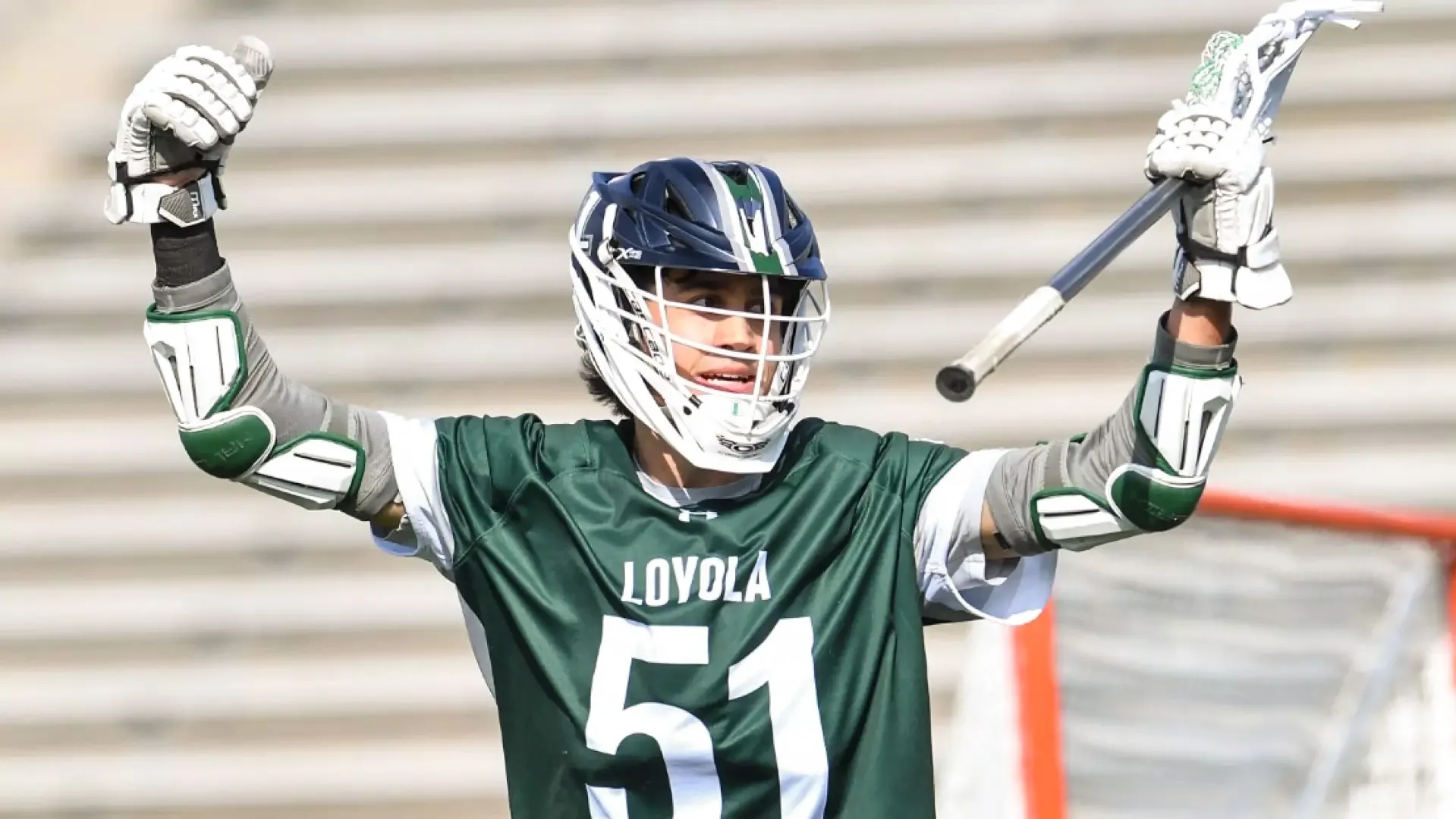
18. LOYOLA
2026 record: 10-6 (6-2 Patriot)
Last seen: Having its place as the second-best team in the Patriot League cemented with a 14-7 loss at Army in the conference title game.
Projected starts lost: 63 of 160 (39.4 percent)
Projected scoring departing: 101 of 317 points (31.9 percent)
Initial forecast: There wasn’t a team that missed out on the NCAA tournament that had reason to be happier with its season than Loyola, which saw its shooting percentage (from 27.0% to 30.7%) and scoring average (9.3 to 11.9) spike under first-year offensive coordinator Justin Ward.
The Greyhounds were extremely attack-centric on offense, and Mason Cook (59 goals, 12 assists), Kenan Everhart (33 goals, 24 assists) and Matthew Minicus (31 goals, 22 assists) all delivered strong seasons. Cook and Everhart will be the centerpieces next season as Loyola chases its first NCAA berth since 2021, and Connor Wilbur (eight goals, 18 assists) will look to build off a strong final month of the season that included nine assists in the last three games.
Luke Murphy (15 goals, seven assists), the top goal-scorer in the midfield, joins Minicus among the notable graduates, as does goalie Max Watkinson (53.3% save percentage), so there are real holes to fill on Cold Spring Lane. But Loyola finds itself in a much better spot than a year ago after re-establishing itself as one of the Patriot League’s top programs.
17. OHIO STATE
2026 record: 10-4 (3-2 Big Ten)
Last seen: Shooting 20 percent in an 11-8 loss to Michigan in the Big Ten quarterfinals.
Projected starts lost: 75 of 140 (53.6 percent)
Projected scoring departing: 126 of 221 points (57.0 percent)
Initial forecast: Well, here’s the short version: ¯\_(ツ)_/¯
That isn’t meant to be flippant. It’s just that the Buckeyes were so good on defense (allowing a Division I-low 7.36 goals per game) and so forgettable on offense (failing to reach 10 goals in any of their last eight games while finding a way to split those contests), and they now have an outflux of players (via graduation and transfers) and a coaching staff overhaul.
There’s just going to be a lot of unknown about Ohio State. It won’t be entirely a mystery, because goalie Caleb Fyock (55.6% save percentage) and defenseman Kyle Foster offer a pretty good place to start on the back end, with a healthy Bobby Van Buren (who missed last season) and Yale grad transfer Patrick Pisano enhancing what should be a typically stingy defense.
Yet that wasn’t enough in 2026, and if the Buckeyes are going to get back to the postseason, they need to drum up a more threatening offense. Points leader Garrett Haas (24 goals, 17 assists) is off to Maryland, but Ohio State will bank on Utah transfer Luke McNamara (60 goals, six assists) to help solve their scoring woes.
The bottom line for the Buckeyes: Maybe they’ll bounce back with a reinvigorated offense. But it’s probably safer to assume they’ll be part of plenty of games in which it’s a struggle for both teams to get to 10 goals.
16. ARMY
2026 record: 13-4 (6-2 Patriot League)
Last seen: Committing 14 first-half turnovers (and 19 overall) on the way to a 10-6 loss at eighth-seeded Penn State in the first round of the NCAA tournament, a game the Black Knights hung around in no so small measure because of goalie Sean Byrne’s 20 saves.
Projected starts lost: 85 of 170 (50 percent)
Projected scoring departing: 148 of 342 points (43.3 percent)
Initial forecast: On the surface, Army has plenty to replace, including the national co-goalie of the year (Byrne) and the co-midfielder of the year (Evan Plunkett). Defenseman John Sullivan and short stick Keagan Treacy also graduate, as does four-year starter Gunnar Fellows.
Yet this is a program that has shown this decade it has plenty in the pipeline, and its five consecutive 10-win seasons are tied for third nationally with Richmond (behind only Duke and Georgetown).
The offense will be junior-laden, with Brayden Fountain (43 goals, 10 assists) and Hill Plunkett (30 goals, 24 assists) already firmly established while Aiden Weisenborn (15 goals, five assists) and Tyler Clark (seven goals, 10 assists) split a starting spot in 2026.
Army’s recent goalie history is stout (from AJ Barretto to Wyatt Schupler to Knox Dent to Byrne), and the Black Knights have consistently transitioned netminders with scant college experience into more-than-effective pieces at the back of the defense. That will have to happen again next spring; senior-to-be Brady White has less than six minutes of college game time to his name, while second-year option Tade Wynn logged 10:57 (and an 83.3% save percentage) as a freshman.