
By Paul Ohanian | Photo courtesy of Princeton Athletics · April 23, 2026
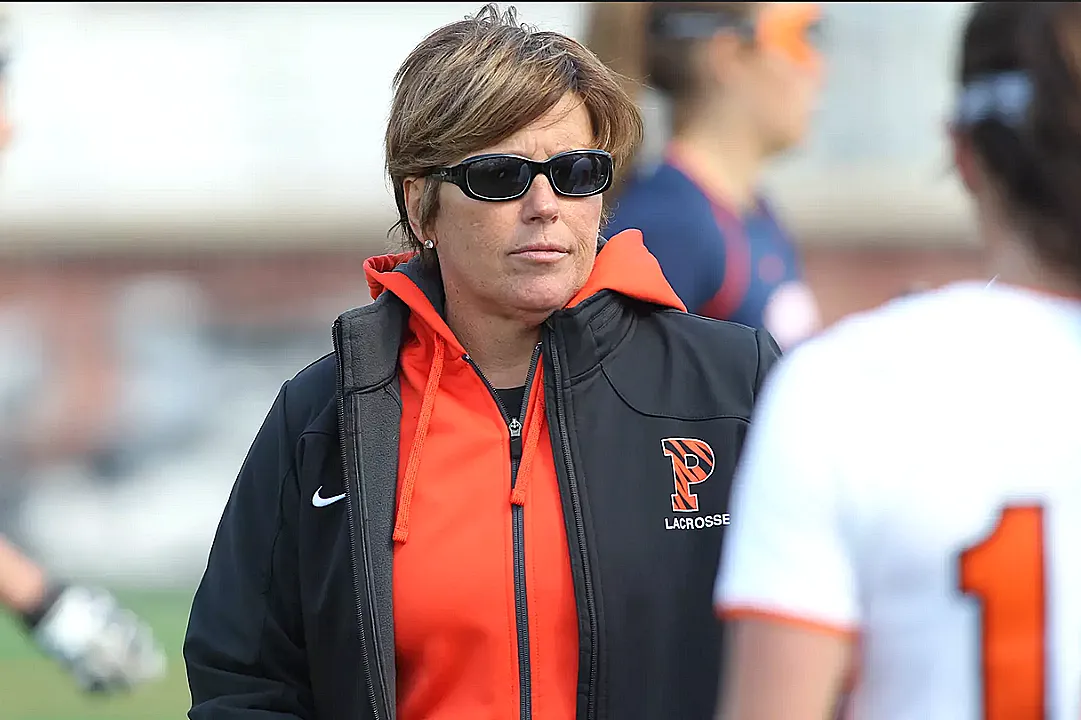
An incredible teacher, mentor, and coach, Chris Sailer spent 36 seasons as the head coach at Princeton, leading the school to 27 NCAA tournament appearances, 16 Ivy League titles, 12 final fours, and NCAA championships in 1994, 2002 and 2003. She retired following the 2022 season with 433 career victories, the fifth most of any women’s lacrosse coach at the time of her retirement.
While her record speaks for itself, there’s no doubt that Sailer’s greatest legacy is the positive and lasting influence she had on the hundreds of women she coached. Her tireless pursuit for equality for women in collegiate athletics and her selfless service to the game for over three decades created countless opportunities for women at the college level.
In recognition, Sailer was inducted into the National Lacrosse Hall of Fame in 2008, one of five Halls of Fame in which she has been recognized.
Retired, but not forgotten, she will be honored once again at the 5th annual USA Lacrosse Foundation Gala on June 4 at Gotham Hall in New York City. It’s certainly quite fitting that one of the most influential coaches of the past four decades is being recognized during the 100th anniversary of women’s lacrosse in the United States.
In advance of that event, Sailer recently sat down with USA Lacrosse for a conversation about her career, her accomplishments, and her joy of coaching.
USAL: To begin, tell us a little bit about retired life. How are you enjoying that?
CS: Retired life is good. As soon as I retired from Princeton, I immediately moved to the beach because I knew it would be impossible for me to really retire had I stayed in the Princeton area. I think that I would have always been, okay, it's 4 o’clock, I want to be over there and see what's going on. I would have just been around all the time. So, I actually think moving helped me feel like I was truly starting a new chapter.
USAL: How actively do you still follow the game?
CS: Oh yeah, I absolutely follow it. I watch every Princeton game, and I watch a number of other games. I like to see all the top teams play. I’m also still on the board of directors of Harlem Lacrosse, and I also work with the Tewaaraton Award committee as one of the co-chairs. So, I like to see as many games as I can. I also work with a club team, talking to the players and parents about the recruiting process. And throughout the year, I do some different things with the IWLCA in terms of mentoring and whatever help they need on certain things. I'm always ready to step up.
USAL: Reflecting back, how did you get into coaching? Did you always have an interest in doing that?
CS: Well, I think I always knew I wanted to be a teacher and coach. I went to Haverford High School and grew up in Delaware County, Pennsylvania, and got to see some of the best field hockey and lacrosse schools in the country play all the time. That was very unusual for women of my age. We had a lot of different sport opportunities, rec and high school, but field hockey and lacrosse were my two favorites. I had some incredible coaches growing up and some great role models.
USAL: You ended up playing both field hockey and lacrosse at Harvard. Tell us how that eventually led you to Princeton.
CS: When I was starting college, I really thought I would work at the high school level. And after I graduated, I did work my first three years at Choate Rosemary Hall School in Connecticut. I taught some health and human development and intro psychology classes. And I coached field hockey and lacrosse. After three years I decided I'd like to try my hand at the college level. So I went to UMass, where I got a Master of Science in Sport Management. And then, after a year of school, I had to do an internship, so I went down to the University of Pennsylvania. I was primarily working with the AD but would help with practice, more of a part-time basis when I was at Penn. And after a year at Penn, the Princeton job opened up, and I think my Harvard experience really helped me secure that position.
USAL: Did you feel prepared for the job when you first arrived at Princeton in 1987?
CS: I was excited, but I had a lot of apprehensions. I mean, I had coached in high school, and then I had the two part-time roles for half a year at UMass and then the year at Penn. My coach at Harvard, Carole Kleinfelder, was a huge influence on me. I really enjoyed my experience there and I tried to emulate a little bit of that in what I did. But I came in knowing I had a lot to learn. So, I was learning from assistant coaches, learning from clinics, and learning from other people in the department. I like to think that I got better as time went on.
USAL: Are there any key lessons that you learned in those early years that always stayed with you?
CS: I think the most important thing was just being open to growth. As a coach, you have to continually change. When I started, we barely had any lines on the field. No boundaries and no restraining lines. The rules were so different back then. And the recruiting process changed so much. There were no cell phones and no Internet. We used to get handwritten letters in the mail from players who were interested in being recruited. Everything has changed, including the dynamics and expectations of players and parents and the coaching profession itself over four decades. So, you have to be open and learn from every source you can. I think my coaching did evolve.
USAL: How would you define your core coaching philosophy?
CS: Setting high standards and challenging people was really big to me. I tried to create a vision of what was possible if we worked hard and really committed ourselves in pursuit of one big goal. It certainly wasn't easy in those early years, but we worked through it and little by little, we got better. Setting the bar high and trying to really create competitors and resilience in my athletes has always been a cornerstone of what I do. And trying to create teams in which players just loved each other and really wanted to play for each other.
USAL: How important is team culture and how does it get established?
CS: Honestly, it's a buy-in both ways, right? Because you can certainly have a coach who says this is how we're going to be and this is what we value. And if your players don't buy in and if you haven't done the work behind the scenes with your leaders, you're not getting them on the same page and believing in that and living according to that. It just doesn't work. So, I think when you start something new, you have to set those expectations. This is how we’re going to be as a team, and this is what we believe in and what we value. And this is what we're looking for every single day from everybody on our team. And this is what's going to get us where we need to go. The best teams are when everybody is on board and everybody believes in what you're trying to do.
USAL: How important is player leadership?
CS: I believe you need good leadership and it doesn't necessarily have to be just the seniors. In fact, you really want leaders in every class. You want people who are making sure everybody's doing what they need to do. You need locker room leaders, you need leaders on the field, you need leaders off the field. There are so many different ways that players can lead. And it's not just the best players on your team. You need sideline leaders who are going to make sure that it’s a fun and engaging environment and players are really dialed in on the sidelines too.
USAL: How difficult is it to stay connected with all the players on the team?
CS: I'm not going to tell you that I always did the best job of that, and I think I had to get better as I grew, but really players always respond better when they feel the love. Players respond better when they know that you care about them, no matter whether they're the first player or the last player. You have to constantly let them know how important they are and you have to show them how important they are. And then whenever you can, especially when kids get to be juniors and seniors, try to get them their minutes.
USAL: Did you prefer being the hunter or the hunted?
CS: Definitely the hunter. I liked being underestimated. I liked having a little bit of a chip. I liked going after something, rather than feeling like you had something that you had to hold on to. We were in that hunter role in 2000, after graduating a tremendous senior class the year before. So, we came into 2000 without many expectations, and we ended up going all the way to the national championship game.
USAL: What motivated you to stay in coaching as long as you did?
CS: I loved it. I really thought it was probably the best job that you could have. It was all about the educational process and developing people -- creating resilient, tough, smart, confident young women. I really enjoyed the players that I coached and being out on the field every day with those young women. I also hired great people as assistant coaches and they made me look good in so many ways. I just had a lot of fun. I mean, it was a job where I could wear sweatpants to work. And you get to go out on the field every day, teaching a sport that you love and being there with young women that you've recruited and really enjoy. I just loved everything about it.
The USA Lacrosse Foundation Gala
Launched in 2022, the USA Lacrosse Foundation Gala was created to honor the influential roles of players, coaches, fans and supporters in shaping the sport’s future – while also raising critical funds to advance initiatives that drive lacrosse’s continued growth. Each year, the USA Lacrosse Foundation Board of Directors selects honorees who have made outstanding contributions to the game of lacrosse. Over the first four years, the Gala has raised nearly $4 million to help support USA Lacrosse initiatives and programs.