
By Paul Ohanian | Photo courtesy of Towson Athletics · December 29, 2025
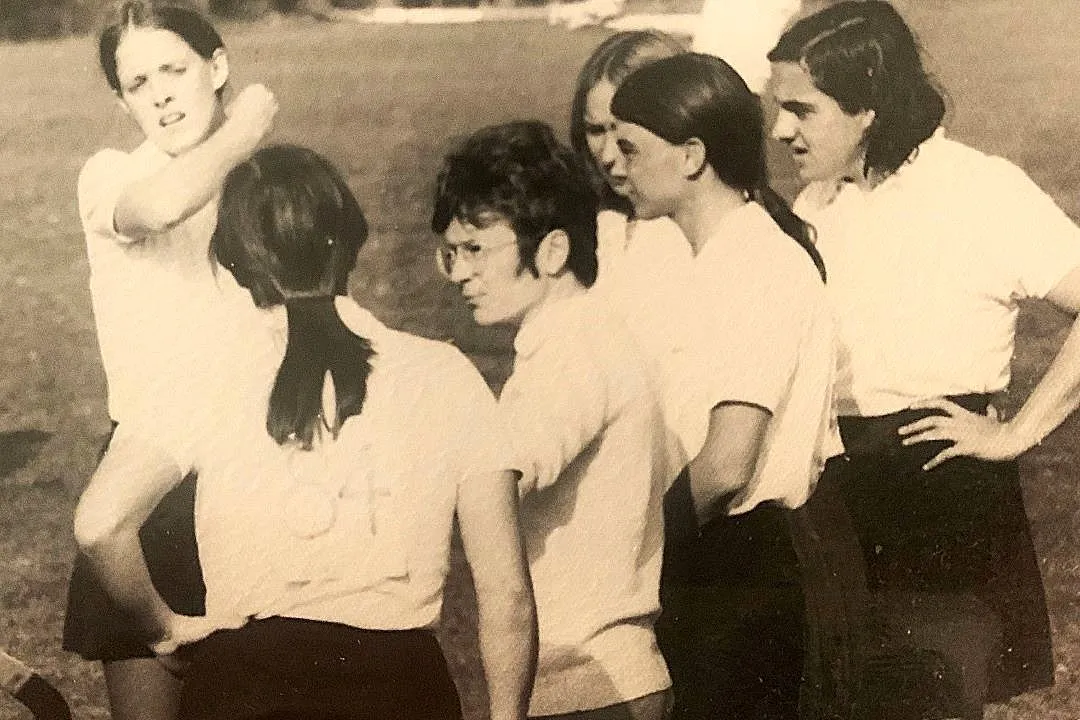
As coach of the Towson University (then Towson State) women’s lacrosse team throughout the 1970s and into the 80s, Maggie Faulkner had an ‘impossible catches’ practice drill that she liked to utilize with her players. She would throw the ball at players at nearly impossible angles, knowing that they would only be able to complete a successful catch once in every four or five attempts. A strong failure factor was built into the exercise.
Beyond developing hand-eye coordination, Faulkner’s real intent with the drill was to help her players realize that sometimes, the impossible was possible.
“I wanted them to understand what they were capable of doing, not to focus on what they couldn’t do,” she said. “It was about pushing their limits. My philosophy was that if you could achieve hard things in practice, the games would be easy.”
That philosophy helped Faulkner become Towson’s all-time winningest coach, amassing 105 career victories over a span of 15 years before retiring from coaching in 1985.
Her impact on the game, however, went well beyond the sidelines. Faulkner also served as a highly regarded game official who worked the NCAA final four in both 1989 and 1990, as well as an innovative game administrator. The totality of her contributions have now earned her a place in the National Lacrosse Hall of Fame as a member of the Class of 2025.
As chair of the NCAA Women’s Lacrosse Committee from 1981-1987 and vice-president of the Women’s Lacrosse Coaches Association for some of those same years, Faulkner was one of the catalysts in the establishment of the NCAA women’s lacrosse championship in 1982.
“Once the AIAW (Association for Intercollegiate Athletics for Women) became relevant, the NCAA dropped all of its objections to having a women’s lacrosse championship and asked me to chair the first championship committee,” Faulkner said. “It was an open division in the beginning, which had its minuses because if you couldn’t pay for your championship, then you couldn’t do things that were too expensive.”
Mary Bartel, a four-year goalie at Towson during Faulkner’s tenure, appreciates the leadership that Faulkner provided in empowering female athletes during this era.
“Most of us played during a time when women had to claw for everything we could get in the world of athletics, and Maggie did that for us and for a whole generation of female athletes,” Bartel said.
Accepting all comers who were willing to make the commitment to be part of the team was important to Faulkner. She understood the importance of opening doors for female athletes.
“We had the most diverse group of people you’d ever see on a lacrosse field,” Bartel said. “We were diverse in size, in talent, in experience. Some people had never played before and simply came out because somebody had an extra stick to give them. What Maggie was able to do with that kind of diverse group was incredible, eventually leading us to the Division II championship game. It was kind of phenomenal.”
Providing women with opportunities to play and helping young athletes to compete at their best were always among Faulkner’s highest priorities.
“I coached some phenomenal players, and honestly, they would have been great no matter who their coach was. They were naturally very gifted,” Faulkner said. “But it was the kids who really worked hard and played well for what they had to give to the game that I most enjoyed. I loved that they could experience the thrill of playing well. I'm most proud of giving as many kids an opportunity to play as humanly possible and to appreciate each of their individual skills.”
Faulkner always assembled a challenging schedule, balancing games against in-state foes like Salisbury and Frostburg State with games against top-tier national programs like Penn State, Delaware, and Maryland. She was never shy about playing more talented teams, because there was a lesson to be learned from that exercise.
“After playing out of our minds against one of those powerhouse teams but still losing the game, we get to the postgame huddle and we are devastated,” Bartel recalled. “Maggie looks at us and tells us we should be happy because there was nothing else we could have done any better to win that game. That message had such an impact on all of us because she reminded us that there was something bigger and better than just winning or losing. Our effort mattered.”
As an educator at her core – Faulkner was also a faculty member in Towson’s psychology department -- athletics simply served as an extension of the academic day.
“She led by example and she was always committed to teaching us,” Bartel said. “She lived a life of excellence and expected excellence not only from herself, but from all of us. We were held to high standards of discipline, behavior and sportsmanship, on and off the field. I think she knew that if she was constantly teaching us life lessons, everything else would fall into place. Maggie cared about us and the game, in that order.”
The National Lacrosse Hall of Fame’s induction ceremony honoring the eight members of the Class of 2025 is on January 10 in Baltimore. Tickets are available for online purchase.